Entrance to the Barn Dojo....
Showing posts with label Seipai. Show all posts

Thursday, June 07, 2018

The hemlock trees are dying

It was wet in the woods the other day. Actually, I think this was two or three weeks ago now--it's been quite busy lately and I lose track of the time. Spring had arrived and everything was alive. Even the spiders were out. I could hear the stream that runs down the hill to the reservoir. In places where the evergreens were thickest, the forest didn't look all that different in the spring as it did in the midst of winter. But the maples and the oaks and the birches and hickories were starting to leaf out and it was easier to see which trees had died over the winter, opening up patches in the canopy. On the ground beneath them, you could see seedlings ready to take over. On the part of the trail where it's widest and there seems to be the most sunlight, small hemlock saplings, no more than a foot or two high, had sprung up along each side of the path. Further up the trail, the giant hemlocks stood, many of them over a hundred feet tall by the look of them, and stately--they seemed to have no need for spreading branches to establish their places like the spruce trees or the balsam pines.

In the first technique of Seiunchin,
both arms are initially brought up
to the outside of the attacker's arm.
But the older hemlock trees are dying. I could count dozens of them along the trail and more off in the woods, the bark stripped off in places, left like red mulch around the base of the tree. They've been hit by the wooly adelgid. It's an invasive species for which the hemlock has no natural resistance. The wooly adelgid brings the borer beetle, which feeds on it, and then, after the borer beetles have burrowed beneath the bark of the tree, the woodpeckers attack, stripping the bark to get at the beetles. Fungus begins to grow around the roots of the diseased tree, and before long, the tree falls. The cold New England temperatures kept the pest at bay for years, but now they're heading north as the winters warm, and the hemlock may go the way of the American chestnut. It shows, I think, it's all tied together; a chain of events that seems to connect things in a way that's difficult to see at the start--one thing leading to another or, if not so singularly predictable, a step in one direction changing the expected outcome while opening up any number of different possibilities, like a small alteration in the environment opening an existential niche that may not have been there before. 

The initial counter from the first
sequence of Kururunfa.
For some reason, all of this made me think of how we string the various techniques of a kata together. But I wasn’t thinking about the sequences of techniques in the standard way in which it is shown in kata—beginning with the receiving (uke) technique, then progressing with the controlling or bridging technique, and finishing with a throw or an attack to the neck or head--as much as I was thinking about how an understanding of the structure and themes of a kata allows one to move between the techniques of different kata within the system. Because the Goju-ryu classical kata are composed of sequences—with entry techniques and bridging techniques and finishing techniques—it’s fairly easy to begin with a technique from one kata and then, depending on how the attacker is moving or responding to your initial receiving technique, move into a bridging technique from another kata and, again, tack on a finishing technique from yet another kata. Understanding the themes or principles of the various classical subjects also helps facilitate this sort of flexibility, especially when each kata seems to be exploring a different theme or response to a different sort of attack--that is, the receiving techniques seem to show the most variation. How one bridges the distance in order to control the opponent may also show a certain amount of variation but the idea here is basically to maintain contact after the initial receiving technique and, without putting oneself in further danger, moving to the opponent’s head or neck to finish the encounter. 
Continuing with the first technique
from Seipai (on the non-kata side).

For example, in the opening move of Seiunchin kata—and in fact in many of the other techniques of this kata—both arms are brought to the outside of the opponent’s attacking arm, whether we see this attack as a wrist grab or a punch or a grab of one’s clothing. If one were to continue the sequence, the defender’s left hand would rotate in order to grab the attacker’s left wrist as the right forearm was brought down on the attacker’s elbow. This is the position in kata that looks like two down blocks in shiko dachi (horse stance) done at a 45 degree angle.

However, if one is thinking about variations, it is easy to see how the defender might move from this initial position in Seiunchin kata to the first attack in Kururunfa kata. The defender need only maintain contact with his right arm on the attacker’s left arm, releasing the left grab, and bring the left forearm up into the neck of the attacker. This is then followed by a left knee kick. 
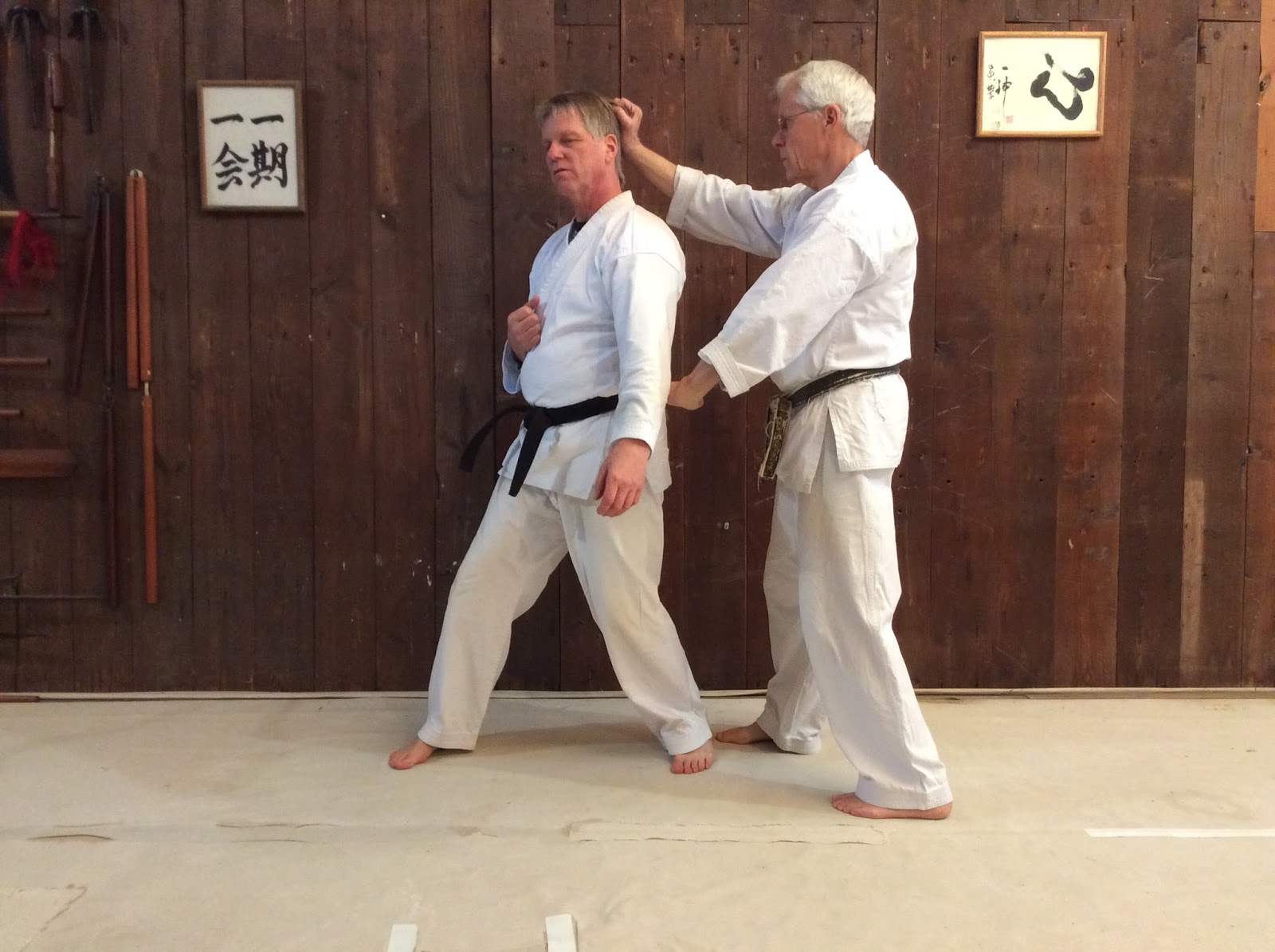
Continuing with this technique from
Seisan kata by dropping the left arm
and stepping in behind the opponent.

But if these counter attacks are somehow thwarted, the defender can then tack on the first technique in Seipai kata (though it would be from the non-kata side), with the left forearm brought up alongside the neck, since the initial straight arm technique begins from this position with the elbow or forearm attacking the opponent’s face or neck. 

Or, by dropping the left forearm down along the back of the opponent’s left arm and moving to the back, the defender could continue with the bridging and finishing techniques from the first sequence of Seisan kata. 


Continuing with the pull down
technique from Saifa kata.

[Me with Bill Diggle from photos
we did for the book, The Kata and
Bunkai of Goju-Ryu
.]


Or, once to the back of the opponent, the defender could grab both shoulders, as we see in Saifa kata, and pull the attacker down onto the knee and attack with the hammer fist strike. 

I think it is important to see the connections, but we can only really be comfortable with these kinds of connections when we understand the sequences of a kata and see the themes or principles contained within them. Once we are able to do that, the attack becomes relentless, sort of like the attack of the wooly adelgid on these stately Hemlock trees, I think. 

Hemlock tree after it has
been attacked by the
wooly adelgid, borer
beetles, and woodpeckers.


Wednesday, February 28, 2018

Patterns or structure of kata

Snow showers. I'm not even sure what that means, but they left a light, powdery coating of snow on everything. A dusting, they call it. The trail cuts a white, meandering path through the woods, and even the rocks along the path catch the snow in places, like white shadows clinging to small indentations, protected for the moment from the winter sun or gusts of wind. It almost looks as though no one has passed this way, no footprints to mark the trail and scuff up bits of leaves and gravel. I might be the only one who has passed this way, at least today, because, of course, it's a trail. Someone made it, carved it out of the forest, cut saplings and cleared brush.

I'm thinking metaphorically again, walking along the trail, mentally practicing kata, thinking about bunkai and imagining the other side, the side that's so hard to picture; the attacking side. This sort of metaphorical thinking reminds me of that book by Murakami, What I Talk About When I Talk About Running. Or that line from Il Postino where Mario asks Neruda, "You mean then that...the whole world is the metaphor for something else?" And with a abashed look, Mario says, "I'm talking crap." And Neruda says, "No, not at all."

Someone made kata, these patterns of movement that we use to remember techniques of self defense, that we use to learn the martial principles of movement. But the patterns are confusing and seemingly as haphazardly composed as a meandering trail heading off into the woods. No two trails exactly the same. No two kata alike in structure, conforming to the same rules one might use to decipher their patterns. And yet someone passed this way before, left marks, however faint, that would point the way, like trail markers, and explain how we might go about figuring out these seemingly arcane and esoteric movements.

Are they arcane and esoteric? Certainly they are, to us, a bit anachronistic, in a way, a part of a cultural milieu and time period when one might have needed to defend one's life, fighting to the death with lethal techniques, as anachronistic as many of the techniques that seem to depend on one grabbing the topknot or queue of one's attacker. But esoteric? The effectiveness of most techniques, arguably, is based largely on their simplicity, not their complexity or the difficulty one might have in learning them. The difficulty lies mainly in trying to explain movements and techniques that we can only half see. With kata, we only see the defender's response to an attack. We can only imagine the other side, and this often influences how we interpret the techniques of kata.

And whoever created these kata, certainly did not make it easy. If a single person put the techniques of these kata together--I'm thinking of the classical subjects of Goju-ryu from Saifa to Suparinpei--then I would expect the patterns to be as uniform and predictable as the set of Pinan kata or the Gekisai kata of the 20th century. But they're not. Seipai kata, for example, is largely asymmetrical--with at least the first three sequences not showing any repetition--using the left hand to "block" and the right hand for the initial attack (which is also true of the fourth sequence, though that sequence is repeated on the other side). Each of the first four sequences--there are seemingly five total sequences, though the fifth sequence shows a variation, in part, on the other side--is shown in its entirety; that is, with an initial receiving, a controlling or bridging technique, and a finishing technique. This is not the same pattern we see in Seiunchin, for example, which, aside from its set of three opening techniques in shiko dachi, repeats most of its techniques on both the right and left sides--that is, in response to a right or left attack--whereas Seipai only repeats the fourth sequence. But even in Seiunchin we have a pattern that is "interrupted," where some of the sequences, unlike most of the sequences of Seipai, only show the final techniques tacked onto the second or final repetition. This is true of the opening sequence of moves, the high-low techniques in shiko dachi, and the "elbow" techniques--that is, the first sequence, the third sequence, and the final sequence.
Core receiving technique
from Sanseiru when used
with the stepping turn.

Sanseiru kata, on the other hand, shows significant repetition in its middle section, repeating this "core" movement--chest "block," kick, "elbow," "punch," kick series--three times, and using an opening sequence that is merely a variation of similar techniques. And Seisan is entirely different again, showing three variations of what is essentially the same bunkai in the three sequences that follow the opening series of repetitive basic techniques--the three punches, three circular blocks, and three palm-up/palm-down techniques with knee kicks followed by a grab and kick.

There are so many structural variations, in fact, in just these four kata that it certainly seems to suggest different origins or sources, and it certainly adds to the difficulty one has in trying to understand the original bunkai of the different kata. And yet, different kata structures do not change
The bridging technique
of the final sequence
in Sanseiru.
the basic martial principles involved, and these principles are retained regardless of which kata one is looking at or which structure has been used to string together the techniques of the kata. In fact, one of the more interesting aspects of this structural awareness, "seeing the pattern" if you will, is perhaps a sort of radical realization that at least some aspects of the structure of any given kata are completely arbitrary.

This may seem heretical or at the very least blasphemous, but it's merely another way of seeing the sequences of a kata, another way of practicing kata bunkai. For example: If we take the first sequence of Seiunchin kata described above, we see that the first two opening shiko dachi techniques are incomplete, with the finishing technique only attached to the third repetition--this is the push forward with the "supported punch" and elbow attack. If we attach the finishing technique to the first of these steps into shiko dachi (same as the third) and/or the second of these (on the opposite side), we are not really altering the intent of the kata. We're merely illustrating it in another way, completing the sequences that are only shown in part. We could do the same thing with the core double arm receiving techniques of Sanseiru, attaching them to the open hand bridging techniques we find towards the end of the kata.

Certainly what we find is that the flow of kata that we have become accustomed to is interrupted, but the real intent of kata is to act as a repository for self-defense techniques, not to be practiced as a performance piece. In fact, the less we see kata as a performance piece for winning trophies at tournaments, the more we may begin to understand its patterns, its structure, and thereby its bunkai.

[For a more detailed discussion of these techniques see my book, The Kata and Bunkai of Goju-Ryu, here.]

Thursday, February 15, 2018

Just because it's a convention doesn't mean it's right!

[I wrote this last month, but I somewhat arbitrarily forgot to post it. But then again, what difference does a day make, or a week, or a month for that matter?]


Welcome to a new year--January 1st--and yet off in the woods the new year looks pretty much like the old one did a few days ago. The blue jays are scolding me as I trudge by on the trail and the squirrels pause to look up and jump behind a tree, waiting to see whether I'm a threat. I've read that squirrels are very territorial, so I suppose these are the same squirrels that were scurrying around last
First technique of Saifa kata.
week, digging up acorns that they had buried last fall. I wonder whether squirrels are really as busy as they seem to be or whether they might be a bit like office workers rearranging the papers on their desks into neater piles, just looking busy in case the boss comes by or the wives ask where they've been all day.

But the days are already getting longer, past the winter solstice. We've turned another page on the calendar. And yet all of this business of time and calendars is a human construct, isn't it? A mass delusion, or if not a delusion at least something that we all culturally have come to agree on; that is, there's little rhyme or reason to any of it, it's just accepted. I mean, we've had lunar calendars and solar calendars and some combination of the two. Not even the seven-day week is
First technique of Seiunchin kata.
anything but arbitrary, something we have just come to agree on. In fact, for a good deal of human history we haven't even agreed upon a 24-hour day. Daniel Boorstin's book, The Discoverers, has an interesting section on all of this. Way back in 1582, they took 10 days out to correct the old Julian calendar that was off by 11 minutes and 14 seconds each year, so really I'm not even sure of the date. And in America, we didn't even accept this restructuring until Colonial times.

Anyway, all of this got me thinking about what we accept as a society, what we take for granted as we carry on with our daily lives. Actually I was thinking about all of this because I had been reading Kazuo Ishiguro's book, The Buried Giant. He describes a medieval England where strangers are  feared and the forests are filled with ogres, and mists shroud the land and bring an eerie forgetfulness. And it's all accepted as perfectly natural.
Initial technique of the first
sequence of Sanseiru kata.

It made me wonder about all of the things we accept in karate without question, all supported and bolstered by the bulwark of convention or lineage or rank. Of course,  we practice all sorts of harmless conventions in the martial arts, from the karate gi to the formalities of seiza and bowing to the shrine and pictures of those teachers who have preceded us to the use of Japanese terminology and the practice of kata. But we also practice what I can only call conventional interpretations of kata technique. And these conventional interpretations (bunkai) get passed on with very little questioning of their practicality, as if we are hesitant to question anything that most everyone else seems to be doing.

First technique of Seipai kata.
And these problematic inter-pretations are everywhere in Goju-ryu. For example: The opening technique of Saifa does
not use both of the defender's hands to pull away from an attacker's wrist grab. Why disconnect from the attacker? The opening technique of Seiunchin kata does not use both hands to release the opponent's choke hold. Why would you step towards someone who was choking you? The opening technique of Sanseiru (after the three slow punches, that is) is not used in order to block an opponent's kick and then grab the kicking foot and muscle the attacker to the ground. Why would you lean forward with your head undefended as an attacker was coming at you and then even attempt to grab a kick? The opening technique of Seipai is not a nukite to the opponent's chest--it's not a nukite at all--nor an elaborate wrist release. Why would you even think of attacking a hard target with the finger tips? And why would you take the time to weave your hands in and out of the arms of an opponent grabbing you with both hands using the techniques that follow it, as the conventional interpretation shows? There is no response to a full-nelson in Kururunfa. Try it sometime against an uncooperative opponent who's bigger and stronger.
Convention suggests that this
technique from Kururunfa is
a release from a full-nelson.

And yet these are all conventional interpretations of kata techniques. The problem is they don't make a whole lot of sense for a variety of reasons: they are too slow or they leave the defender open to attack or they don't really follow kata or they are easily thwarted by the opponent, etc. Their only reason for being is that they are the conventional interpretations, and conventions are rarely questioned.
This is not to suggest that all conventions are useless or without merit. Clocks and calendars are very useful even if they are a somewhat arbitrary means of marking time. But conventional wisdom once suggested that the earth was flat, that there was witchcraft at work in Salem, that you'd catch your death if you walked around with wet feet.

Most of the conventional interpretations of kata, I think, are, at the very least, useful in pointing out some of the pitfalls one may encounter with interpretations of kata, as ironic as that may be. And by example, they can steer us off into better directions, bushwhacking through the woods in search of a better trail.

[For a more detailed discussion of these techniques see my book, The Kata and Bunkai of Goju-Ryu, here.]


Tuesday, December 12, 2017

It's a system, like the trees in the forest

The forest was wet today. Droplets of water collected in the leaves here and there, and the moss looked a bit brighter green after the rain we had overnight. But the temperature is dropping gradually, the days are getting shorter, and most of the trees are bare. It's hard to tell which trees are dead this time of year. The only thing that seems to be thriving is the lichen and small colonies of mushrooms clinging to the old tree trunks that lay rotting by the side of the trail. 


Saifa kata
Seipai kata
When I'm out in the woods these days, I don't usually think of the forest as an eco-system, though I know it is. I know that when the larger trees fall, after a strong rain or a heavy storm with high winds, they leave a hole in the canopy overhead and the wild grasses, the ground cover, and the acorns lying buried beneath the leaves, some waiting patiently for years, will start to grow in the spring, reaching for the sunlight that's finally been able to make its way through the leaves of the taller trees. 


Suparinpei kata
Seiunchin kata
No, when I'm out walking in the woods these days, I'm just looking for the seemingly random beauty you can find when you go out "forest bathing." Nothing seems so systematic. Everything seems chaotic and haphazard. But, of course, it is a system, just like any martial art, despite what some may imply when they suggest that a style like Goju ryu, for example, is a random collection of kata that come from different sources andwere created by different people at different periods in the past.


Kururunfa kata
Seipai kata
While this may be true (and probably is given that the structure of the Goju classical subjects varies considerably), it does not change the fact that it's a system. The different kata show variations as if they were jazz compositions, as if different composers were given the same melody and told to improvise. One need only compare techniques from different kata to see the variations, to appreciate how different techniques explore similar themes. Certainly there are differences--any given self-defense scenario may vary depending on one's position in relationship to the attacker or, for that matter, what the initial attack is--but the apparent similarity of some techniques and the fact that they are used in a very similar manner (the application or bunkai) underscores the notion that they are all part of the same system, regardless of whether or not the different classical subjects may have had different origins.

Sanseiru kata
Shisochin kata
The key here, of course, is to understand (or "see") the applications. You can't rely solely on the appearance of the techniques. This is admittedly a challenge. We have to first let go of our expectations, which may include not only what the technique appears to be, but also
what we may have been told--in other words, the conventional interpretation of the techniques in question. The problem may be compounded by texts and pictures that seem to record "end" positions; that is, it's difficult to convey in pictures or words what happens in-between the pictures one generally sees in karate manuals or texts which discuss kata, and it's often in the space between one move and the next that we see how a given technique is applied.

Saifa kata
Seipai kata
And you need the whole system. You need all eight classical kata in order to address different scenarios on the one hand and, on the other, to be able to see how to move from one technique in one kata to a similar technique in another kata if the dynamics of the situation change--and they are likely to change. That is, you need to see the similarities and variations in order to alter your counterattack. You may begin with the opening or receiving technique from Saifa (as pictured above), but you have to be able to change to the controlling or bridging technique from Seipai, for example (the bridging technique from Seipai being the technique which follows the Seipai opening technique pictured above). In other words, once you "see" the similarities and variations, you should be able to move back and forth between the techniques of each sequence of moves. This is the way a system works. Of course, you have to also be aware of the sequences. And if you can see the sequences, then you realize that the techniques within a sequence function in specific ways--that is, they can't just mean whatever you want them to mean.

Some have suggested that any single kata is a complete system of self-defense in itself. This is a rather silly notion, as is the idea that any given technique has multiple interpretations or applications. Either one of these notions gets in the way of "seeing" the whole system and being able to comfortably work within the system. Both of these views are short-sighted. Metaphorically, they're like being lost in the woods, failing to see the forest for the trees.


Friday, September 22, 2017

When a tree falls in the forest...and other thoughts on bunkai.

A single leaf at the end of
a new shoot.
If a tree falls in the forest and there’s no one there to hear it….does it really matter? It will lead to all sorts of unexpected outcomes. The tree will fall. There will be an opening in the canopy overhead. Sunlight will reach the forest floor where it hadn’t, where it had been shady for years. A small seedling will begin to sprout or an acorn lying dormant under a blanket of leaves will feel the sun. The next thing you know, there will be little twig-sized slips of oak or maple or aspen, two over-sized leaves on a slender stick the size of a toothpick. Of course, the grass takes over first, it seems, followed by the weeds and the ground creepers, but the trees are there--a balsam fir or a white pine or a spruce. They each send up these little, central shoots with a more or less symmetrical arrangement of branches. It begins with a cluster of buds at the tip of the shoot. The central bud becomes the trunk of the new tree and the buds that surround it grow laterally into branches. And each year's growth follows the same pattern, unless the deer come and nibble off the buds or the central bud gets damaged somehow. If it does, the tree is programmed in such a way that one of the lateral buds that had been destined to become a branch takes over the role of the central bud and becomes the trunk. 


First entry or receiving technique
from Kururunfa kata.
I've been reading a lot of Bernd Heinrich lately. He writes about birds and trees and running, among other things. I hope I'm not over-simplifying what he says about trees too much, but it's this changing aspect of the new tree that got me thinking about its relationship to the martial arts as I was out in the woods the other day. We approach the study of kata as if it's something sacrosanct, a ritualized performance piece. And yet we look at bunkai as if the movements are so fluid and dynamic that they supposedly have countless ways of interpreting or applying them. This point of view is, in fact, so widespread that it almost seems as though it has fostered the growth of a whole new industry based on seminars and the discovery of new and ever-more-outlandish applications. 
Initial technique from Seipai kata.

So I would suggest that it may be time to simplify things a bit. We could start with a simple statement about the structure of a kata. Kata are composed of different kinds of techniques--entry or receiving techniques, bridging or controlling techniques, and finishing techniques. Each entry technique is part of a sequence, but because of the exigencies of any given situation—how the attacker responds to the initial block or receiving technique, one's balance, the strength of the opponent—you may need to change things up at some point, sort of like the new shoot when a deer comes along and nibbles off the central bud.

Sliding down the back of the arm
and grabbing the head.
For example, if you respond to an attack with the opening receiving technique from Kururunfa, something unforeseen could happen that causes you to change the sequence and instead continue with the initial technique from Seipai kata. That is, from the forearm attack to the neck in the initial technique of Kururunfa, you might straighten out the right arm, pushing the attacker's head down. Then, you might continue with the first sequence of Seipai by stepping through with the left palm-attack to the chin, going on to twist the head. Or, alternatively, from the initial Kururunfa technique, you might drop the right arm down along the back of the opponent's right arm to move behind him, as we do in Seisan.  Once you’re to the back of the opponent, you could continue with this sequence from Seisan, grabbing the back of the head with the left hand and stepping in to grab the chin with the right hand. Or, you could simply grab the opponent’s trapezius muscles from the back and pull him down onto the front knee, as we do in Saifa kata.
Pulling down by grabbing the
trapezius muscles in Saifa.

Kata itself is a repository of technique, and each technique functions differently. But once we understand this, we can take them apart and put them together in different ways, all depending on what happens in any given situation. In that sense, the system of self defense we know as Goju-Ryu becomes both smaller and larger at the same time. It is smaller because it becomes more manageable--there are, for instance, a finite number of receiving techniques and the same might be said of the bridging and finishing techniques as well. In other words, one doesn't need to become a master of what at one time must have seemed like an encyclopedic number of techniques. But it is also larger because if we truly understand the system and its kata then we can see an almost infinite number of ways that the individual techniques can be taken apart and put back together. That is, the entry technique from one kata might be combined with the bridging technique of another kata and the finishing technique of yet another kata. 

So what if a tree falls in the forest. Stuff happens. Another tree will come along and take its place.


Wednesday, May 25, 2016

Kamae!

More typical fighting
posture readiness.
   The thought occurred to me the other day--I suppose I've been wrestling with this a long time--but I found myself thinking about training in the old days, when I used to wear a gi and everything was rather formal. We'd line up according to seniority and then kneel and sit in seiza. "Mokuso!" Of course, it was all very precise, sort of like the Japanese tea ceremony without the tea cups.
   "Mokuso yamae!"
   "Sensei ni, rei!" the senior student would bark out. And, after all the formal bows, the teacher would take over.
   "Kiyotsuke. Rei. Yoi," the teacher would say, pausing between commands as the students responded. And then...
   Then we began practicing kata. But here's where it gets interesting.
   "Kata Saifa. Yoi. Hajime (begin)." Next was Seiunchin. "Yoi. Hajime." And then Shisochin. "Yoi. Kamae. Hajime." You see, there's that extra word--kamae. We used kamae not in the general sense of "posture" or even as a command--"kamae-te"--but in the connotative sense of "ready to fight." We generally understood it as a ready position, but no one every asked why the other kata (Saifa, Seiunchin, Seipai, and Kururunfa) didn't begin with a kamae or ready position. Why don't they?
Kamae posture found
in a number of kata.
   In Goju-ryu, putting aside Sanchin and Tensho for obvious reasons, there are four kata that begin with this double-arm kamae posture and four kata that don't. Each of these four double-arm kamae postures begins with three basic techniques that are repeated. Each of the other four kata begins immediately with a bunkai sequence (sometimes in threes and sometimes not). Why the difference? If all of the kata are part of the same system (supposing for the moment that they are from the same system), wouldn't we expect that they would conform to the same structure or pattern? Well...unless there is a message in the pattern or structure.
   Saifa begins with a  self-defense scenario (bunkai) against a same-side wrist grab (opponent's left to defender's right). Seiunchin begins with a self-defense scenario (bunkai) against a cross-hand wrist grab (opponent's right to defender's left). Seipai begins with the opponent grabbing one's shoulder or lapel. Each of these kata shows defensive scenarios (bunkai sequences) against grabs or pushes, while Kururunfa, it seems to me, shows responses to an opponent's punch. The other four kata, however, show defenses and responses to an altogether different situation--one that begins from a wrestling clinch or, if you will, the posture one sees at the beginning of a Judo match. Just compare the postures.
One of Judo's beginning
postures. 
   It's almost as if there is a flag or label tacked onto the beginning of the kata, stating "the techniques of this kata begin from a grappling position," and we are meant to apply the entry techniques at least with this in mind.
   So, does this change the way one sees the bunkai of these kata? Does it open up new possibilities? Do we need to re-think the opening "punches" (if that's even what they are!?) in Seisan and Sanseiru or question the "nukite" or "shotei-tsuki" techniques at the beginning of Shisochin? At the very least, we should question why so much of the bunkai people find in the Goju-ryu classical kata looks the same--most of it beginning with two people squared off, facing each other, until the attacker lunges in with a punch--when clearly, just from the way they begin, there is an implied difference.
   It also makes me wonder about the three kata--sometimes said to be older or perhaps more related to each other (Sanseiru, Seisan, and Suparinpei)--having the same beginning "kamae" posture, as if they were based on a more grappling-oriented martial art, something like Okinawan sumo, for instance, though that's just a wild conjecture.
   So anyway, before you start shouting, "No, Goju is about blocking and punching and kicking...after all, it's karate, not judo"....just wrestle with the idea for a bit. I think this is where it starts to get interesting.


Monday, July 06, 2015

Very like a cloud...

Clouds rolling in over the tarn
on the fell. (Helvellyn)
So I was thinking about Hamlet the other day. It was in Act III, scene ii, or thereabouts. The conversation between Polonius and Hamlet. The Melancholy Dane says, quite apropos of nothing: "Do you see yonder cloud that's almost in shape like a camel?" The old man responds, "By the mass, and 'tis like a camel, indeed." To which Hamlet says, "Methinks it is like a weasel." Agreeably, Polonius responds, "It is backed like a weasel." Hamlet then playfully suggests, "Or like a whale," and Polonius knowingly, and famously, says, "Very like a whale." Of course, Hamlet realizes that the cloud in question cannot have all of these qualities--that Polonius is merely agreeing with the poor boy they all think is mad. They humor him for their own ends.
Beginning of Seipai
"jump" sequence.

I thought, isn't that the wonderful thing about clouds, these amorphous, evanescent conglomerations of water droplets; they can be all of these things, because in reality they are none of these things. And we know that. It's a game. We're not hallucinating. We are letting our imaginations play with the world around us. And it's perfectly okay--they're clouds.

But sometimes I think it's a lot like kata and bunkai; people begin to see whatever they want to see in it. Their imaginations run wild with interpretation. And I wonder, when did this begin? Different schools and teachers do things a bit differently in kata. Sometimes these differences are very slight and perhaps insignificant. At other times, however, the differences are pronounced and lead people to vastly different interpretations of application.

The "jump" in Seipai.
One I recently encountered was a discussion of the "jump" in Seipai kata. Some schools teach this as an actual jump--the farther, the better. But it's not a jump. The defender is merely stepping to the outside of the attacker, grabbing (that's the control technique), and unwinding or twisting in a counter-clockwise direction to throw the attacker to the east (assuming the front is north). Why is it not a jump? Because it's connected to the previous technique. Though they look similar--the previous cat stance double punch (and I say that only as a description of what it looks like, not what it actually is) and the cross-footed double punch--the kata is not showing opposite sides of the same technique. Why is it connected to the previous technique? Because the first technique is not lethal by itself, and the second technique (the "jump") doesn't show an entry technique. Combinations and sequences, that's just the way Goju kata were designed. It's a principle of understanding Goju bunkai, if you will.

Foreaarm attack to the
neck in Seiunchin, after
bringing the head down.
And there aren't any uraken (backfist) attacks either, at least not the way they are usually practiced in most dojos--not with the back of the fist or even the knuckles. Whether it's in Saifa kata or Seiunchin kata or Seipai kata or any other of the classical Goju kata, what looks like a uraken attack is really a strike with the forearm. That's why the Okinawan practice of kote-kitai (arm pounding) is so significant, because there are so many places in the Goju classical subjects where the forearm is used to attack.

Knee or thigh kick from
Seisan kata.
And while I'm on the subject of what isn't there: there aren't any back kicks in the Goju classical katas. That doesn't mean it isn't a good technique or even that one shouldn't practice it, only that it isn't a technique we find in Goju kata. Some schools and teachers will show a back kick in Seiunchin because their interpretation of these movements suggests an attack both from the rear (presumably with a bear hug) and the front. The problem is that none of these possibe attacks to the rear are lethal, not to mention the fact that they're not very realistic. Try it. Other schools show a back kick in the beginning of Seisan kata. But again, this is not correct. It is instead a knee or thigh kick to the groin done three times, as both hands are brought up (palm up) and then down as one advances. This is a close-quarters technique.

So there you have it: no jump in Seipai, no urakens in Saifa and Seiunchin, and no back kicks in Seiunchin or Seisan. But, you say, why do different schools see these things differently? I can only think that when we look up on a wonderfully balmy summer's day we see clouds, and from there it's anybody's guess.


Friday, April 24, 2015

In an alternate universe...cont.

Entry technique and initial attack
from Seipai kata.
"Wait," I said. "Let's start all over again."
   "Okay," he said. "But let me point out one possible flaw in your beginning premise. You suggested that bunkai came before the creation of kata. But doesn't it really depend on how you look at the relationship between kata and bunkai? Under your scenario it really demands that you see kata as a collection of combinations--not just individual techniques--that shows how one deals with specific attacks by an opponent, from the beginning receiving technique (uke) to the finishing technique."
   "Yes," I said. "I would agree with that. Kata shows--really thematically--how to deal with single aggressive movements by an opponent; how you avoid and receive them, move to control the opponent so he cannot attack again, and how to end the confrontation."
Controlling technique from Seipai.
   "That makes sense, but why would they--whoever they were--put certain techniques together to create a particular kata?"
   "Well, it seems to me," I responded, "that they're part of a system organized around individual themes. I think based on an analysis of bunkai you could make a pretty convincing argument for this. But you could probably just as easily suggest that the katas were created by different people, at different times, though still part of the same system."
   "But just for the sake of argument," my friend suggested, "couldn't you look at kata not as a collection of sequences or combinations, but as individual techniques? Perhaps each technique is itself a receiving technique, in which case there are no combinations or complete bunkais shown."
   "But there are clearly some techniques that are attacks. How," I asked, "would you reconcile those? How could you look at the double 'punch' down attack in shiko-dachi in Seipai as a receiving technique or more pointedly without connecting it to the techniques that precede it?"
   "I guess you're right," my friend said, "but couldn't that technique be attached to a number of other techniques?"
Finishing technique from Seipai
along with the technique which
follows it.
   "Certainly," I said. "One of the end products of studying the combinations in kata, for me, is to see where they can connect to other combinations, sometimes within the same kata and oftentimes with techniques in other katas. That's why we can call it a system. For example, you could take the entry (uke) technique from one kata and pair it with the controlling technique of another kata and the finishing technique from yet another kata."
   "Okay," he said, "so there are an almost infinite number of ways to pair up techniques, but each individual technique should only be understood as having one interpretation, more or less. Is that right?"
   "Yes," I smiled.
   "Why don't more people see that then?" he asked, musing a bit to himself. "I suppose it's more fun to make up a whole bunch of cool applications. And then again, every teacher can be an authority or at least their own expert. And, I suppose, the prevailing opinion has something to do with it--that any technique from kata can mean anything as long as it works."
   "Well, as long as it works in the dojo," I laughed, "where logic doesn't always prevail and few are willing to suggest to the teacher that a technique or interpretation doesn't make sense."
   "So how we interpret kata and bunkai may really have a lot to do with our expectations," my friend suggested.
   "Yeah, maybe," I agreed. "In 1949 there was an experiment set up by two psychologists at Harvard to test people's perceptions when faced with a reality that contradicted their expectations. Students were shown playing cards and asked to identify them as they were flipped over. Most of the cards conformed to exactly what one would expect, but the experimenters had also slipped in cards that one wouldn't expect, like a red six of spades and a black four of hearts. When the cards were turned over quickly, the subjects simply ignored the incongruities, calling the red six of spades a six of hearts, for instance. When the cards were turned over more slowly, the subjects were just plain confused and 'completely flummoxed'" (cited in The Sixth Extinction by Elizabeth Kolbert, p. 92).
   "So the real problem when we look at kata," he said, "may be that we tend to find what we expect to find. So what's the solution?"
   "Make sure it's logical. Make sure it's real. Make sure it conforms to sound martial principles."


Saturday, April 11, 2015

I can't believe he said that.

   "So, let's start with an acceptable premise for both of us, since we come from very different
Pointing the way, from Seipai kata.
But the attack is coming from your
left, not the front, and the left hand
is the primary "blocking" hand.
traditions," I suggested.
   "Okay, what would you suggest?" he asked.
   "Well, how about the idea that the techniques we see in bunkai came before the creation of kata--that the ancients, whoever they might have been, found techniques that worked in either combat or self-defense and then only later put them into kata in order to have some way to remember them or some sort of solo practice method."
   "Yes, but the katas have all been changed, or at least we should probably assume that the katas have all changed since that's human nature, and anyway different schools do katas differently, so that alone suggests katas have been changed, and it would be a fruitless endeavor to attempt to discover the original intent of the katas," my friend countered.
   "That may be true," I replied. "But the reason I'm suggesting this is that, if true, it would imply that each technique originally had only one interpretation or suggested application. If there are differences in how katas are performed it suggests two things to me: one, that some people altered kata to conform to their own erroneous ideas about bunkai; or two, some of the changes are actually insignificant and merely show slight variations of how one might apply the same bunkai--that is, as long as they conform to the same martial principles, perhaps both ways of doing the kata are correct. In any event, the way to unlock the keys to the bunkai is to find the principles that they all conform to."
   "That's exactly what I'm saying," my friend immediately countered. "If multiple bunkai could be correct, then a better principle might be to say anything that works is a correct bunkai." Wait, is that what I said?
   "Anything?" I asked, incredulously. He nodded and smiled. "But it has to follow the kata, doesn't it?" I asked.
   "Why?" he replied. "Just because the kata shows a forward step, does that mean you can't step back? I once asked my teacher, the venerable Poobah, the same question. Do you know what he said to me? He said, 'do you have a problem with stepping back?' I said, 'no, Sensei.' "
   "But it's not just that," I said. "Your bunkai for that particular move in kata"...we had been sharing our interpretations of various kata techniques..."well, in kata your right hand is on top, and when you do your bunkai your left hand is on top."
   "So. You should be able to do it either way."
   "That may be, but the way you're showing it isn't the way it's shown in kata, and besides, you're stance is wrong as well."
   "Well, my teacher explained to me that for bunkai the body can be divided into quarters: above the waist, below the waist, the right side, and the left side. You can use the techniques independently or together, and they don't have to necessarily conform to exact kata movement."
   "But bunkai means to analyze kata, so it would seem to me that if you're not sticking to kata movement--and that would include not just the hands and feet but also the stepping that's shown in kata--then you're not really doing bunkai," I said, as gently as I could.
   "Well," my friend suggested. "In all my travels and research, I've come across two schools of thought on that. One is that you stick to kata movement as closely as possible, and the other is that it's okay to deviate from kata because what you're really doing is studying the principles of movement. Two schools, two different opinions."
   "Yes," I said. "But one of them is wrong." I couldn't stop myself. "At least that's what I would say. But I'm not sure I really understand what you mean. Isn't the kata teaching principles of movement? If you deviate from kata movement, then you're not really getting the message, not really learning the principles the kata is trying to teach." At this point I didn't really expect much of an answer.
   To this he responded by demonstrating a technique from kata against one of the other students. It conformed to the way he did kata, but it didn't conform to sound martial principles. "Why didn't he hit you with his other hand when you did that?" I asked. "One of the principles of bunkai that I always look for is whether or not the opponent is in a position to initiate another attack after your initial "uke." In this case, the technique is applied against the opponent's left arm, but the opponent is still in a position to reach you with his right." So I asked, "Why doesn't he hit you with his right?"
   My friend was quick to reply, "Well, hopefully, he doesn't know the bunkai."
   Did he really just say that?

Disclaimer: My apologies to anyone if this sounds familiar. Any similarity to conversations with anyone, living or dead, is purely coincidental. In any case, this imagined conversation is only meant to illustrate the difficulties one often encounters in trying to find the original intent behind the kata of Goju-ryu...the bunkai.

Monday, October 13, 2014

Barry White? What's that got to do with the martial arts?

I was listening to some Al Green songs the other night. Smooth stuff. You sit down with a glass of wine and put your feet up. You know, some Lou Rawls, a little Marvin Gaye, maybe some Bill Withers mixed in, and I was trying to think, I'm missing somebody. Who's that guy with the incredibly smooth, deep voice? Oh yeah, Barry White. You know you can find that guy on Google if you type in "deep smooth sexy male singer motown?" The problem is that so much of it is dated. It's all this incredibly over-orchestrated 70s stuff. You can really appreciate the voice, but forty years later the songs don't travel that well. It's sort of like that movie I got once--The Sword and the Dragon, a Russian-made film from the 1950s that I watched over and over again as a kid. They used to show it late at night, and I would always stay up to watch it. Then I asked for a VHS copy of it one Christmas 'cause I couldn't think of anything else that I needed. Of course, I didn't need that either, which I soon found out. When I got it, I couldn't believe how lame it was. I mean, it was cute and all, but all of the cool special effects I remember as a child--the wind monster and the three-headed dragon--were about as convincing as the original King Kong or Godzilla movies. Things get dated. Nothing exists in a vacuum. Everything is influenced by the time.

Most people do these techniques
from Seipai as an arm-bar instead
 of  an attack to the head or neck.

In the martial arts, of course, this notion that one is practicing an anachronistic art may come up every time one picks up a "rokkushaku bo" or "tonfa." But we also find techniques in kata that suggest one is grabbing hair or a top-knot, and using it to pull the head down, a technique that one might not be able to use all that effectively nowadays. And why practice barefoot, especially in New England? It might have made sense in Okinawa where you could quickly slip off your geta or zori, but how is it realistic in today's world? There's a lot of stuff that's "time sensitive," not just the junk mail they send out with the words "Open Immediately" stamped on it.

Most people use this technique at the
end of Seipai to grab a kick or to grab
the oppoent's wrists instead of
his head.
Just as interesting to me, however, is what effect our world view may have on practicing an art that is so clearly from a different time and place, really a different world. And what occurred to me is this: Perhaps our more modern world view, superimposed over an ancient martial art, has colored the way we view and practice martial arts today. We are looking through a twenty-first century lens at a system of self-defense created for a far different time and place. Is it possible that a martial art that was once developed to protect one in life-threatening confrontations has unconsciously, and perhaps necessarily, adapted and changed to fit into a less violent time, an art that is practiced in gymnasiums and community centers by men, women, and children? Now, I'm not talking here about the development of Gekisai kata and other training subjects during the early years of the 20th century in order to bring karate into the Okinawan school system. I'm talking about traditional or classical kata and how most people practice it--that is, Saifa, Seiunchin, Shisochin, Seipai, Sanseiru, Seisan, Kururunfa, and Suparinpei.

You can find some very prominent
teachers on the Internet who will
show this technique from Seiunchin
as a nukite or shuto attack to
the opponent's ribs.
And the funny thing is you don't have to consciously do much of anything. All that needs to happen is to interpret or analyze kata (bunkai) in a less violent manner. You look for interpretations that match the situation and conditions of your training. In this case, you make all of your bunkai, blocks and punches. It's easy, and much less dangerous, to block the arms of your attacker/partner and punch, generally to the chest, maintaining a safe distance while you're at it. You don't have to "see" the combinations that contain grabs and throws and neck breaks. In fact, all of that stuff is difficult to train with a partner anyway, especially in a commercial dojo, one with potential liability. People don't want to get hurt nowadays. We have other priorities, like making it home for dinner, and getting up to go to school or work the next day. So we preserve the kata and call it traditional or authentic karate. But kata is a series of codified movements meant to preserve the principles of the art and its applications (the bunkai), and if you don't interpret it correctly, what are you left with?

I'm not really sure, but I'll tell you one thing: If you just want to forget about the whole thing and continue to throw some punches and do some chest blocks and throw in an arm-bar here and there and call it traditional Okinawan Goju-ryu, kick back for a bit, put your feet up, and listen to some Barry White...that is, without the 40-piece orchestra, 'cause it's a bit dated. Better yet, try some Al Green or Lou Rawls. That'll take your mind off it.