Entrance to the Barn Dojo....

Tuesday, October 13, 2015

It is what it is...

Opening attack from Seiunchin kata.

I was having an imaginary conversation with my daughter the other day. She isn't actually a little kid anymore, but it was the kind of conversation we used to have fifteen or twenty years ago. You know, the kind of conversations you're never really ready for because you never really imagined yourself as a parent. And who can prepare for that anyway? Or maybe you have the same questions 'cause you never got any better answers than "because it just IS!!"

Or maybe they were just dumb questions, like how come people have eyebrows? Or, why don't animals talk? Or, why does it rain? I was actually wondering about all this because I had just watched a video of Hokama Tetsuhiro sensei demonstrating bunkai from Seiunchin kata. It was on a Facebook page titled: Goju Ryu Karate. It's a short video, about 4 minutes long.
Stepping forward and executing an
arm-bar to bring the attacker's
 head down.

Now I have a lot of respect for Hokama sensei. Back in 1987, I think it was, we were visiting and training in Matayoshi sensei's dojo--going to Okinawa for the first time with my teacher, Kimo Wall sensei, for two months--when Matayoshi sensei invited Hokama sensei, who had studied kobudo with him, to come by the dojo and talk to us. He brought copies of his first book, signed them, and gave them to all of us visiting Americans. Of course, this first edition was in Japanese, but the pictures were wonderful. But, back to the present. In this bunkai video I watched, Hokama sensei was showing what looked like very Aikido-esque techniques. I've seen many teachers concentrate on this sort of bunkai--Kuba Yoshio sensei is another one (here's a video showing other Aikido-like bunkai for Seiunchin: http://youtu.be/KyBXOiucFpk). Kuba sensei does this a lot, but it seems to me a bit of a stretch.

Right hand grabs the head (or top-knot)
and the left comes in to attack and
grab the chin.

And so I wondered why people seemed to be attracted to all of these joint manipulations just to throw the opponent. Is that really Okinawan karate? Doesn't the opponent just get back up and attack again? Is it to find less brutish-looking techniques, less violent alternatives? Is it seen as somehow more exotic and esoteric? Perhaps it appears to be more magical--a slight touch here, a little twist and the opponent is down. If you watch the videos carefully (and a bit critically), you see that the demonstrataed two-person techniques (bunkai?) only partially resemble the moves in kata. Why is that? Why not just come out and say, "Here are some cool moves I found while I was watching stuff from another type of martial art. Hey, if you squint your eyes up, they sort of look like Goju."

Conclusion of the opening sequence
of Seiunchin kata--an elbow attack
to the back of the head, neck, or
spine.
The problem for me is that it's not Goju. Why not? Because these teachers have taken individual techniques out of the kata and theorized about their application without seeing them in the larger context of the sequence of moves that forms a single bunkai combination. They have also not stuck to a strict analysis and repetition of the kata technique--in other words, they are not doing the bunkai for this particular kata. So why call it Seiunchin bunkai? I know some people will call this oyo bunkai or something along those lines; that is, when you start with a technique from kata and then you get "creative" or "personal" with it, as one discussion forum put it. Or how about this? And I quote: "Bunkai is the analysis of kata, and oyo is the application." I'm sorry, but when you analyze moves in kata isn't that the same as figuring out how you apply them? Let's face it, oyo is when you haven't got a clue and you're just making it up. Or it's when you find something really cool but it's not really part of your own system, and yet you'd hate to drop it from your repertoire.

Goju is a close-in fighting system with a lot of grabs and such, but Goju quickly bridges the distance and attacks the head or neck. Neck breaks and head twisting are standard fare in Goju. Why? I don't know why; I didn't make this stuff up. But why? Because it just IS!!!!


Friday, August 28, 2015

Give a man a fish...

The other day I was reading one of the few blogs that I find interesting on the Internet--very opinionated, but honest, obviously heartfelt, and written by a karate practitioner who trains seriously, with little interest in self-aggrandizement. I may not do it justice by trying to summarize the intent of the blog post--I'm sure I can't--but to me it bemoaned one of the seeming shortfalls in a society where everything seems to be at our finger tips, particularly information, that in turn has led to a culture of expectation and entitlement, and how this has all spilled over into the dojo, affecting how we learn karate and more importantly how we expect to be taught karate. In a word, according to this blog post, students of karate today expect their teachers to regularly "feed" them.

I think there's a lot to this. And yet it reminds me of something one of my senior students once said, jokingly, in response to a question she was asked by a junior student: "If you have to ask, you're not ready to learn." I say jokingly, because one might argue that this is precisely the moment when someone is ready to learn--when they are asking the right questions. When I'm teaching kata, I will frequently ask students if they have any questions. More often than not, they will say, "No, just have to do it more." To me, that's probably a very honest response; they don't know enough to know what questions to ask. Once the questioning starts, however, it seems to me that it's my job to "point the way." It's my job to at least explain the principles, to explain why one is being asked to move in a particular way, why one way is better than another way.

Mike Clarke sensei goes on to relate a wonderful little story that Miyazato sensei told him about two fighting birds he once owned. You can read the story for yourself--It's titled "Post 500..."--here: shinseidokandojo.blogspot.com/  You might also find it instructive to poke around in the archives of this blog a bit while you're there. Anyway, Miyazato sensei then makes the analogy to karate training, saying to the author, "If I give answer, you go home and forget; better you learn for yourself through training." Tough love.

But I wondered, as I read that: Are students likely to find the answers? Is that why the Internet is filled with so many outlandishly ridiculous and unrealistic examples of "bunkai"? Are all these people teaching themselves? What is the role of the teacher? Is Miyazato sensei implying that anyone can find the answers with enough training or that each individual's answers, though different, are all correct? Why do we have teachers if the extent of their instruction is to suggest that we find our own answers? Isn't the teacher there, in some sense, to shorten the journey, to share what they have discovered so that the student will surpass the teacher at some point? What would happen if I turned on my GPS and asked Siri for directions and she told me, "I'm sorry, but if I told you how to get there, you'd soon forget, you'd never learn how to read a map. Better to figure it out for yourself"?

Perhaps I'm overstating the case, finding fault where there is none just to make my own point. I'm sure the analogy is not meant to suggest that Miyazato sensei didn't teach or try to "point the way." But so often, I think, there is an implicit paradigm associated with learning in the karate dojo that suggests that one is not training hard enough if one has to ask questions. Do the kata 10,000 times and then you will understand, Grasshopper. Or, don't ask any questions until you have done the kata 10,000 times. But what's to prevent the charlatan from using this clever sort of cover for his own ignorance? A teacher is there to teach--to at least point the way--to explain the principles. If they don't know something, perhaps it's better to just say, "I don't know." If I give a man a fish, I may just whet his appetite for more. He may ask me how I got that fish, and I'll have to show him how you go about catching fish. He may end up being a better fisherman than me, but when asked, he'll say that I once gave him a fish and taught him how to fish.


Monday, July 06, 2015

Very like a cloud...

Clouds rolling in over the tarn
on the fell. (Helvellyn)
So I was thinking about Hamlet the other day. It was in Act III, scene ii, or thereabouts. The conversation between Polonius and Hamlet. The Melancholy Dane says, quite apropos of nothing: "Do you see yonder cloud that's almost in shape like a camel?" The old man responds, "By the mass, and 'tis like a camel, indeed." To which Hamlet says, "Methinks it is like a weasel." Agreeably, Polonius responds, "It is backed like a weasel." Hamlet then playfully suggests, "Or like a whale," and Polonius knowingly, and famously, says, "Very like a whale." Of course, Hamlet realizes that the cloud in question cannot have all of these qualities--that Polonius is merely agreeing with the poor boy they all think is mad. They humor him for their own ends.
Beginning of Seipai
"jump" sequence.

I thought, isn't that the wonderful thing about clouds, these amorphous, evanescent conglomerations of water droplets; they can be all of these things, because in reality they are none of these things. And we know that. It's a game. We're not hallucinating. We are letting our imaginations play with the world around us. And it's perfectly okay--they're clouds.

But sometimes I think it's a lot like kata and bunkai; people begin to see whatever they want to see in it. Their imaginations run wild with interpretation. And I wonder, when did this begin? Different schools and teachers do things a bit differently in kata. Sometimes these differences are very slight and perhaps insignificant. At other times, however, the differences are pronounced and lead people to vastly different interpretations of application.

The "jump" in Seipai.
One I recently encountered was a discussion of the "jump" in Seipai kata. Some schools teach this as an actual jump--the farther, the better. But it's not a jump. The defender is merely stepping to the outside of the attacker, grabbing (that's the control technique), and unwinding or twisting in a counter-clockwise direction to throw the attacker to the east (assuming the front is north). Why is it not a jump? Because it's connected to the previous technique. Though they look similar--the previous cat stance double punch (and I say that only as a description of what it looks like, not what it actually is) and the cross-footed double punch--the kata is not showing opposite sides of the same technique. Why is it connected to the previous technique? Because the first technique is not lethal by itself, and the second technique (the "jump") doesn't show an entry technique. Combinations and sequences, that's just the way Goju kata were designed. It's a principle of understanding Goju bunkai, if you will.

Foreaarm attack to the
neck in Seiunchin, after
bringing the head down.
And there aren't any uraken (backfist) attacks either, at least not the way they are usually practiced in most dojos--not with the back of the fist or even the knuckles. Whether it's in Saifa kata or Seiunchin kata or Seipai kata or any other of the classical Goju kata, what looks like a uraken attack is really a strike with the forearm. That's why the Okinawan practice of kote-kitai (arm pounding) is so significant, because there are so many places in the Goju classical subjects where the forearm is used to attack.

Knee or thigh kick from
Seisan kata.
And while I'm on the subject of what isn't there: there aren't any back kicks in the Goju classical katas. That doesn't mean it isn't a good technique or even that one shouldn't practice it, only that it isn't a technique we find in Goju kata. Some schools and teachers will show a back kick in Seiunchin because their interpretation of these movements suggests an attack both from the rear (presumably with a bear hug) and the front. The problem is that none of these possibe attacks to the rear are lethal, not to mention the fact that they're not very realistic. Try it. Other schools show a back kick in the beginning of Seisan kata. But again, this is not correct. It is instead a knee or thigh kick to the groin done three times, as both hands are brought up (palm up) and then down as one advances. This is a close-quarters technique.

So there you have it: no jump in Seipai, no urakens in Saifa and Seiunchin, and no back kicks in Seiunchin or Seisan. But, you say, why do different schools see these things differently? I can only think that when we look up on a wonderfully balmy summer's day we see clouds, and from there it's anybody's guess.


Monday, June 15, 2015

Resurrecting the past

Hanging out with Kimo sensei.
Finally back at it...well, almost. Busy month. Five weeks out from total hip replacement surgery. Lying around. A lot of reading and rest. Of course they get you up to walk a little the next day--miracle of miracles--but still. I mean, they cut your thigh bone off and pound a titanium spike down it. No more running marathons, I guess. Slow and rather lengthy recovery...what do they say, at least three months, though more like six to feel "normal" again? Try to get in a mile or so walk a day and some exercises, but nothing all that strenuous. Still limping a bit, but at some point I should be almost like new. Can't really complain. What the hell, at least I can walk again.

I'm always amazed to discover how integrated karate movement is whenever I get injured. Now, of course, it's the realization of how the waist/hip area (koshi, if you will) is involved in everything you do in the martial arts. We all know this intellectually, but when you get injured you experience it in a very different way--different from when you work on it and use it every day you train if you're healthy. But anyway, the job now--the training for me--is to make a full and healthy recovery. Not an easy task, given how quickly strength and flexibility seems to leave you over the course of a six-month lay off.

Elbow technique from Shisochin kata.
But is it an attacking elbow or is it a
hooking elbow? Is there any similarity
between this elbow technique and the
elbow we see in Sanseiru kata?
The weird thing is that I had this odd sensation that as I slept, so did the rest of the martial world. I look back at the Goju blogs and forums and find the same old stuff, as if nothing ever changes. As if "reuse, recycle, and reduce" were a sound martial arts slogan. How many times can you watch a couple of random guys trying to come up with good bunkai for Gekisai kata? For that matter, how many times can you watch black belts practice Fukiyu or Gekisai kata? How many times can you read a forum post asking for people's opinions about which "gi" is best or which kata is their favorite? Why doesn't anyone question the necessity of the karate gi--and while they're at it, the belts and patches and titles? What does it mean to say that one has a favorite kata? Despite what some influential people have suggested, each kata is not a system of self-defense in and of itself. So we should be asking: what does it mean to practice a system composed of various kata? What relationship do those various kata have to the system as a whole? Are they thematic? Are they related to each other in any way? Could you have an incomplete system where some themes or scenarios or self-defense situations have been left out or lost?

Is this a technique from
Shisochin kata or
Suparinpei kata?
I came across one recent post trying to resurrect an old argument that a number of people seemed to have bought into seven or eight years ago; that there are two groups of Goju kata: one group that Miyagi sensei learned from Higashionna sensei (Sanchin, Sanseiru, Seisan, and Suparinpei), and another group that Miyagi sensei himself made (Saifa, Seiunchin, Shisochin, Seipai, and Kururunfa). If I remember it correctly, the original argument was based on a "cluster analysis" of the different techniques and the seeming difference between the "asymmetry" of the first group of katas and the "symmetry" of the second group. I hope this isn't an over-simplification of their argument. However, the real over-simplification is in suggesting that such a small sample can yield significant results when studied using cluster analysis, not to mention the obvious, that some similarity of technique occurs between both groups. Secondly, there are elements of asymmetry and symmetry in both groups of kata as well. My initial criticism of this study when it first came out was that any comparison of kata without a thorough understanding of bunkai was superficial at best. Many movements may appear similar but function quite differently within the structure of the kata and the application of its techniques. Conversely, many techniques may look quite different but may have essentially the same function in bunkai.

But as I say, this whole argument resurfaced. The suggestion now is that even though Miyagi sensei said he learned everything from his teacher, he actually didn't mean it. In other words, the writer argues, what Miyagi sensei said in public (tatemae) was not what he actually felt in private (honne). He goes on to suggest that there is a cultural component to this.

Forgive me, but to base a scholarly argument on the supposition that what a source said is, for all intents and purposes, the opposite of what they meant seems not just weak but the most circuitous route to a rationalization of an unfounded and unsubstantiated position that I can imagine. When you stop to think about it, it's really quite brilliant! I'm sorry, I didn't mean that.


Thursday, May 07, 2015

What's wrong with Sanseiru?

The kick-elbow-down punch combination
occurs only on one side in Sanseiru. But
you can always take techniques out of
kata to practice the other side.
   Recently I decided it was time to make some changes. I realize I'm a bit late. After all, it's already the beginning of May and most people have long since made and abandoned their New Year's resolutions. Most people have moved on to newer and better things by now. Smart phones, smart televisions, smart watches. I'm going to wait a bit 'til they come out with a smart hat--one that can think for me and keep my head warm in the winter and dry in the rain.
   So anyway, I was thinking about what sorts of improvements I could make around the house and I noticed the old crab apple tree was looking a little unbalanced. I mean it would probably do better to cut the thing down as it's home to more ants than birds, but I'm attached to it. The problem is that when you look at it straight on, the left side doesn't match the right side--it's asymmetrical--so I'm thinking of taking the chain saw to it. 
   Of course there might be more pressing problems. I was cleaning up the yard the other day, putting things away, and I noticed my son's football lying around. Now I don't know too much about football, but what's with the whole oval shape? A ball's supposed to be round. It's supposed to roll. So I started to think that might be a good project--make a round football. I mean people are improving things all the time--that's just what we do. My son showed me a cool invention the other day: an umbrella that used jets of air instead of a cloth canopy to keep the rain off. It looked like a big microphone or flashlight, but the battery that operated it--and I have no idea whether it was strong enough to work in a real downpour--the battery charge only lasted thirty minutes. And what happens to those poor souls walking next to you that get sprayed with the water getting blown sideways by these jets of air from your clothless umbrella? On second thought, maybe that proves the old adage: just because you can do something, it doesn't mean you should.
This technique illustrates one of the
differences between the Shodokan
(Higa) version of the kata and the
Meibukan/Jundokan versions.
   Anyway, I paused in my ruminations and resolutions to sit down and get caught up on some blog posts and forum discussions. I came across one where the teacher had decided that the Goju kata Sanseiru was puzzling because it was so
unbalanced or asymmetrical. Of course, all of the Goju-ryu classical subjects are unbalanced and asymmetrical to some extent, so I wondered why Sanseiru particularly bothered him. But at any rate, he decided to "correct" the problem by putting in extra movements--doubling up single techniques--to make the kata more balanced and then post the performance on-line. To give him his due, this was just for training purposes. I'm sure he was not suggesting that the kata be permanently modified just to satisfy some human craving for balance and harmony.
   But of course the most obvious question one might ask is: why does a kata need to be balanced? A kata is not a performance piece. I think too often in modern karate practice we treat our karate--and particularly the execution of kata--as if it were a performance. But kata is, above all else, a repository of technique. It contains the principles and self-defense techniques of the system. To superimpose an artificial construct of balance on kata is...putting the cart before the horse...it's pounding a square peg into a round hole...it's analyzing kata through the distorted prism of our own petty biases...I don't know, but it ain't right.
The final technique of Sanseiru only
occurs once in the kata. The structure
implies that its mirror image could be
attached to the same preceding
techniques on the opposite side.
Is there a need to repeat it then to
satisfy our need for visual balance?
The real lesson: Know Thy Structure.
   Rather than trying to make Sanseiru a more balanced pattern, we should be asking what the three "punches" at the beginning of the kata have to do with the rest of the kata. Or why there is a repetition of three block-kick-elbow techniques in the middle of the kata. Or what relationship the open-hand techniques have to the rest of the kata, so much of it closed hand. Or how many entry techniques there are. Or how many finishing techniques. What if some of the apparently distinct sequences do not actually show an entry technique but instead begin with the controlling technique because of a unique structure to the kata? Heck, it would be better (and more instructive) to ask what significance there is to the differences in the Jundokan/Meibukan version versus the Shodokan (Higa) version of Sanseiru. These are difficult questions to answer. They take years of trial and error (bunkai) and much open-minded thought and experimentation. Perhaps that's why people look for balance, because not having the answers to these questions makes one feel a little unbalanced, a little uncomfortable. Geez, the very fact that a kata is not balanced suggests that there are combinations of techniques that go together in less than obvious ways, doesn't it?! Like, you show the controlling technique on both sides of the kata and then only tack the finishing technique on to the end of the second series. It's not about balance, it's about understanding the structure.
   Being a little uncomfortable can sometimes be a good thing, though, which is why I think I might just leave that long, scraggly, awkward and unbalanced limb on the crab apple tree...at least until the insects get the best of it or a storm comes and takes the whole thing down. On second thought, maybe I'll just cut it down 'cause all that stuff about balance in kata and trees doesn't have anything to do with karate anyway.

Friday, April 24, 2015

In an alternate universe...cont.

Entry technique and initial attack
from Seipai kata.
"Wait," I said. "Let's start all over again."
   "Okay," he said. "But let me point out one possible flaw in your beginning premise. You suggested that bunkai came before the creation of kata. But doesn't it really depend on how you look at the relationship between kata and bunkai? Under your scenario it really demands that you see kata as a collection of combinations--not just individual techniques--that shows how one deals with specific attacks by an opponent, from the beginning receiving technique (uke) to the finishing technique."
   "Yes," I said. "I would agree with that. Kata shows--really thematically--how to deal with single aggressive movements by an opponent; how you avoid and receive them, move to control the opponent so he cannot attack again, and how to end the confrontation."
Controlling technique from Seipai.
   "That makes sense, but why would they--whoever they were--put certain techniques together to create a particular kata?"
   "Well, it seems to me," I responded, "that they're part of a system organized around individual themes. I think based on an analysis of bunkai you could make a pretty convincing argument for this. But you could probably just as easily suggest that the katas were created by different people, at different times, though still part of the same system."
   "But just for the sake of argument," my friend suggested, "couldn't you look at kata not as a collection of sequences or combinations, but as individual techniques? Perhaps each technique is itself a receiving technique, in which case there are no combinations or complete bunkais shown."
   "But there are clearly some techniques that are attacks. How," I asked, "would you reconcile those? How could you look at the double 'punch' down attack in shiko-dachi in Seipai as a receiving technique or more pointedly without connecting it to the techniques that precede it?"
   "I guess you're right," my friend said, "but couldn't that technique be attached to a number of other techniques?"
Finishing technique from Seipai
along with the technique which
follows it.
   "Certainly," I said. "One of the end products of studying the combinations in kata, for me, is to see where they can connect to other combinations, sometimes within the same kata and oftentimes with techniques in other katas. That's why we can call it a system. For example, you could take the entry (uke) technique from one kata and pair it with the controlling technique of another kata and the finishing technique from yet another kata."
   "Okay," he said, "so there are an almost infinite number of ways to pair up techniques, but each individual technique should only be understood as having one interpretation, more or less. Is that right?"
   "Yes," I smiled.
   "Why don't more people see that then?" he asked, musing a bit to himself. "I suppose it's more fun to make up a whole bunch of cool applications. And then again, every teacher can be an authority or at least their own expert. And, I suppose, the prevailing opinion has something to do with it--that any technique from kata can mean anything as long as it works."
   "Well, as long as it works in the dojo," I laughed, "where logic doesn't always prevail and few are willing to suggest to the teacher that a technique or interpretation doesn't make sense."
   "So how we interpret kata and bunkai may really have a lot to do with our expectations," my friend suggested.
   "Yeah, maybe," I agreed. "In 1949 there was an experiment set up by two psychologists at Harvard to test people's perceptions when faced with a reality that contradicted their expectations. Students were shown playing cards and asked to identify them as they were flipped over. Most of the cards conformed to exactly what one would expect, but the experimenters had also slipped in cards that one wouldn't expect, like a red six of spades and a black four of hearts. When the cards were turned over quickly, the subjects simply ignored the incongruities, calling the red six of spades a six of hearts, for instance. When the cards were turned over more slowly, the subjects were just plain confused and 'completely flummoxed'" (cited in The Sixth Extinction by Elizabeth Kolbert, p. 92).
   "So the real problem when we look at kata," he said, "may be that we tend to find what we expect to find. So what's the solution?"
   "Make sure it's logical. Make sure it's real. Make sure it conforms to sound martial principles."


Saturday, April 11, 2015

I can't believe he said that.

   "So, let's start with an acceptable premise for both of us, since we come from very different
Pointing the way, from Seipai kata.
But the attack is coming from your
left, not the front, and the left hand
is the primary "blocking" hand.
traditions," I suggested.
   "Okay, what would you suggest?" he asked.
   "Well, how about the idea that the techniques we see in bunkai came before the creation of kata--that the ancients, whoever they might have been, found techniques that worked in either combat or self-defense and then only later put them into kata in order to have some way to remember them or some sort of solo practice method."
   "Yes, but the katas have all been changed, or at least we should probably assume that the katas have all changed since that's human nature, and anyway different schools do katas differently, so that alone suggests katas have been changed, and it would be a fruitless endeavor to attempt to discover the original intent of the katas," my friend countered.
   "That may be true," I replied. "But the reason I'm suggesting this is that, if true, it would imply that each technique originally had only one interpretation or suggested application. If there are differences in how katas are performed it suggests two things to me: one, that some people altered kata to conform to their own erroneous ideas about bunkai; or two, some of the changes are actually insignificant and merely show slight variations of how one might apply the same bunkai--that is, as long as they conform to the same martial principles, perhaps both ways of doing the kata are correct. In any event, the way to unlock the keys to the bunkai is to find the principles that they all conform to."
   "That's exactly what I'm saying," my friend immediately countered. "If multiple bunkai could be correct, then a better principle might be to say anything that works is a correct bunkai." Wait, is that what I said?
   "Anything?" I asked, incredulously. He nodded and smiled. "But it has to follow the kata, doesn't it?" I asked.
   "Why?" he replied. "Just because the kata shows a forward step, does that mean you can't step back? I once asked my teacher, the venerable Poobah, the same question. Do you know what he said to me? He said, 'do you have a problem with stepping back?' I said, 'no, Sensei.' "
   "But it's not just that," I said. "Your bunkai for that particular move in kata"...we had been sharing our interpretations of various kata techniques..."well, in kata your right hand is on top, and when you do your bunkai your left hand is on top."
   "So. You should be able to do it either way."
   "That may be, but the way you're showing it isn't the way it's shown in kata, and besides, you're stance is wrong as well."
   "Well, my teacher explained to me that for bunkai the body can be divided into quarters: above the waist, below the waist, the right side, and the left side. You can use the techniques independently or together, and they don't have to necessarily conform to exact kata movement."
   "But bunkai means to analyze kata, so it would seem to me that if you're not sticking to kata movement--and that would include not just the hands and feet but also the stepping that's shown in kata--then you're not really doing bunkai," I said, as gently as I could.
   "Well," my friend suggested. "In all my travels and research, I've come across two schools of thought on that. One is that you stick to kata movement as closely as possible, and the other is that it's okay to deviate from kata because what you're really doing is studying the principles of movement. Two schools, two different opinions."
   "Yes," I said. "But one of them is wrong." I couldn't stop myself. "At least that's what I would say. But I'm not sure I really understand what you mean. Isn't the kata teaching principles of movement? If you deviate from kata movement, then you're not really getting the message, not really learning the principles the kata is trying to teach." At this point I didn't really expect much of an answer.
   To this he responded by demonstrating a technique from kata against one of the other students. It conformed to the way he did kata, but it didn't conform to sound martial principles. "Why didn't he hit you with his other hand when you did that?" I asked. "One of the principles of bunkai that I always look for is whether or not the opponent is in a position to initiate another attack after your initial "uke." In this case, the technique is applied against the opponent's left arm, but the opponent is still in a position to reach you with his right." So I asked, "Why doesn't he hit you with his right?"
   My friend was quick to reply, "Well, hopefully, he doesn't know the bunkai."
   Did he really just say that?

Disclaimer: My apologies to anyone if this sounds familiar. Any similarity to conversations with anyone, living or dead, is purely coincidental. In any case, this imagined conversation is only meant to illustrate the difficulties one often encounters in trying to find the original intent behind the kata of Goju-ryu...the bunkai.

Saturday, April 04, 2015

Mirakian Sensei...a sad farewell.

At a Feeding Crane seminar with
Sifu Liu hosted by Mirakian Sensei
at his Watertown dojo.
I was greatly saddened to hear this week that Anthony Mirakian Sensei passed away. Sensei Mirakian was one of the early pioneers of karate in American, bringing authentic Meibukan Goju Ryu to America and his home state of Massachusetts in the early 1960s. He was truly a kind, extremely generous, often brutally honest, and incredibly knowledgeable man, and, what many who knew him may remember most, a wonderfully entertaining story teller. He seemed to have crossed paths with everyone in the martial arts, and he remembered it all. I enjoyed his stories and always looked forward to talking with him whenever I made it out to Boston. He will always be an example for all of us in the martial arts, and I'm sure he will be greatly missed by so many people whose lives he has touched. My condolences go out to all his friends, his students, and his family.


Tuesday, March 03, 2015

Are there rules for deciphering kata?


I got a letter the other day from someone who seems to be a sincere and dedicated practitioner of traditional Goju-ryu. I'm quoting this not at all to attack this individual or point of view, but only to respond to the question in a bit more detail.

Here's what he said:

"...if there are universal rules to deciphering Okinawan kata (an assumption that you may not agree with), might exploring bunkai in kata sequences you are not familiar with have the potential to provide insight into deciphering applications from the forms that are in your system?"

I take this to be a rhetorical question, because the person who asked it has spent time doing just that, attempting to decipher kata through the lens of another system. Does it help? Certainly any number of things might jar us out of our comfort zone, a sort of state where the "blinders" of tradition or lineage keep us from "looking outside the box" or "coloring outside the lines." There are many karate practitioners who believe wholeheartedly in the value of cross-training. And I can't deny the potential benefits. I learned a lot about Goju-ryu by training with Sifu Liu, the Feeding Crane master. Heck, I learned a lot about Goju-ryu from training Yang style T'ai Chi. But I didn't learn anything applicable to Goju kata and/or bunkai by studying Tae Kwon Do or Shotokan karate, or watching Wado-ryu karate or Hapkido. And what I did learn from Feeding Crane and T'ai Chi Chuan was a way of moving, weight shifting, relaxation, and power generation that only peripherally helped in deciphering Goju-ryu kata and bunkai.

Stepping back to attack in
Seiunchin kata.
Actually the person who wrote to me pointed out exactly the problem; i.e., the assumption that there are universal rules to deciphering Okinawan kata, that they are the same for all styles. And he was right about how I look at this; I'm not at all sure that the assumption is true. I'm not sure Shorin or Uechi kata conform to the same rules one would use to decipher Goju kata. I'm skeptical because, for example, Toguchi sensei himself (the founder of Shorei-kan Goju-ryu) gets one of these "rules" wrong when it's applied to Goju-ryu, the system that he himself taught. In his second book, Toguchi sensei states three rules for deciphering kata bunkai. One of these "rules" (and I'm paraphrasing) is that stepping forward in kata implies an attack or offensive technique, while stepping back implies a block or defensive technique. But many of the techniques in the Goju classical kata contradict this. It would, on the face of it, seem so simple and obvious and, perhaps, logical--so much so that it would seem to be one of those "universal rules" that would cross style lines. But "rules" (though guidelines might be a better term) come from within the katas themselves; they are not superimposed from outside. That is, it all depends on the structure of the kata, to some extent. There are many ways to structure a kata--repeating techniques on both sides or doing single techniques, only tacking the ending techniques of a sequence onto the last technique, etc. I've mentioned many of these structures in earlier posts. But all katas, even within the Goju-ryu "system," are not structured the same. It's quite doubtful that a single individual put the katas together--they're too dissimilar in structure. For example, some begin with three disconnected techniques, like Shisochin and Seisan, and some don't, like Seipai or Kururunfa. So if the keys or guidelines to deciphering kata really depend on understanding the structures of the different katas, and the structures differ even within a single system like Goju-ryu, then how can a random sampling of techniques from another system altogether help one in "deciphering applications from the forms that are in your [own] system"? The answer for me is that in most cases they can't, unless on the off chance they suggest a different way of looking, a different perspective if you will. And similarly, someone from outside a particular system would have an equally difficult time adequately explaining the techniques of a system that they were unfamiliar with, regardless of whether the techniques looked familiar since the structures would certainly be different.

But supposing, for the sake of argument, that there were "universal rules to deciphering Okinawan kata." Are they written down somewhere for all karate-ka to read? Maybe only senior practitioners or teachers all know them. Except if that's the case, going back to an earlier point, how could Toguchi sensei get one of them wrong or at least proffer a rule that is not universally born out in the Goju classical kata? What kind of "rule" is that? At least you can't call it a universal rule. And if there are universal rules, then why doesn't everyone's bunkai look the same? And if Toguchi sensei meant that these rules apply most of the time and we are only nit-picking a few isolated instances, then why would he have created the two-person sets for the Gekisai kata that contradict so many of the principles of movement and rules for deciphering kata shown in the classical subjects of Goju-ryu (There's a distinction here, of course, between "rules" or principles of movement--like keeping the elbow down and using koshi--and "rules" or principles of deciphering kata in order to discover bunkai.)

Shakespeare's garden.
Rules, rules, rules. There are rules, but they have to be discovered, because they grow organically from within; they can't really be imposed from the outside, and that's what so many people seem to do when they analyze kata. Did anyone ever know the rules? (There's the 64,000 dollar question!) Is there a cultural aspect to the practice of karate that somehow gets in the way? (I often wonder.) Think of the difference between an English garden and a Japanese garden. Walk through an English garden, one from the Elizabethan era perhaps, and you'll see a wonderfully disordered array of flowers and herbs and bushes in no recognizable pattern, lacking symmetry, and seeming to have all of the cacophonous ebullience that one would find in nature itself. Take a stroll through a Japanese garden, on the other hand, and everything is so beautiful and orderly. If you look closely enough, only then do you notice the wires wrapped carefully around a branch to make it bend in a way that will be pleasing to the human eye. Branches are clipped, weeds are plucked, and buds are snipped off. Then there's ikebana. And chado, the tea ceremony. The beauty of form itself. The question is, when considering kata and bunkai: Has the content been somehow sacrificed in order to serve the form? What influence does culture have on how we look at things?

Whether this is an apt analogy or not, one should bear in mind that any true analysis of kata techniques should begin with an understanding of the structure of the kata--how the techniques go together in this particular kata--not a piece-meal explanation of what each technique appears to be doing. You can't do this if you don't know the kata or the system. This slicing and dicing of techniques--what so many people do when they attempt to practice bunkai--is like eating up the individual ingredients off the chopping block before the chef gets a chance to mix them all together into a wonderfully savory feast! You're eating all the same things, and yet it's not the same.

Poached eggs anyone?


Tuesday, February 17, 2015

Ya can't get they-ahh from hee-yahhh


Goju-ryu posture very similar to the
opening posture in one of the first two
Pinan kata. In the Shotokan Heian
version, the stance is much longer
and much less mobile.

I came across an interesting post the other day on an Internet forum. It was by a guy who was a bit disillusioned but still searching for meaning in his kata--kata that he had been practicing for more than twenty years, I think. He was asking all the right questions, it seems to me: what message was contained in the repetition of techniques in kata? Are there patterns or sequences of techniques, and if so what do they signify? Are there themes that certain kata focus on? The problem was that he practiced Shotokan karate--a style, it seems to me, that is so far removed from its Okinawan origins as to make it nearly impossible to determine the original intent (or original bunkai) of any of the movements that make up the kata.
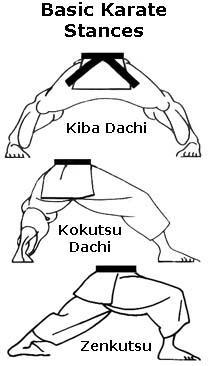
The stances of Shotokan
are generally wider and longer
than their Shorin antecedents.
After doing a little foraging on the Internet, I found that this searching into the meaning of Shotokan kata is not really new at all. Apparently certain Shotokan practitioners have been bucking the system for years--I'm only hinting at the chilling effects powerful international organizations may have on individual initiative and any questioning of the official line--practitioners like Bryce Fleming, Elmar Schmeisser, Bill Burgar, and John Vengel. Fleming even cites some of my own thoughts on kata analysis in a nicely written article titled "Bunkai: Returning Kata to the core of Karate," though I'm not sure he understood what I was trying to say in every case, which may very well be my own fault, as I'm not sure any of my ideas are applicable to any other art than Goju-ryu. But it is interesting to me that there is an attempt to place kata and the study of kata applications back in the forefront of popular karate study, and Shotokan may very well be the most popular karate style in the world. The problem is, how do you reconstruct the original intent (bunkai) of a kata after the kata has been changed? It's like trying to figure out what Shakespeare was saying in Macbeth after only watching the episode of The Simpsons that referenced it, or as someone once put it, reconstructing the original hits when all you have are the Weird Al Yankovic versions. Well, maybe not quite that bad, but still.

Of course, not all of the movements have been altered, but if one movement in a sequence is altered enough, it will alter how one may interpret the rest of the sequence. Correct me if I'm wrong, since I'm certainly no authority on Shorin-ryu, but if you change a neko-ashi-dachi (cat stance) to a kokutsu dachi (back stance), as Shotokan does with its Heian versions of the Pinan series, it seems to me that you will be hard pressed to "see" the kick (whether a kick with the knee or the foot) in the sequence. And once you change the cat stance to a back stance, the upper body and arms are also re-oriented in relation to the possible attacker, so they may further alter how one interprets the techniques. One could certainly argue, as many do, that there's no guarantee that even any school of Okinawan karate--Goju, Uechi, or Shorin--has preserved the original way that any particular kata was performed; they've all undergone change (though that's just an assumption in itself and with no more certitude really than to argue that nothing has changed). But that still doesn't mean that all changes are equal--that the bunkai you find in Shotokan is as valid as the bunkai you find in Shorin kata.
All of this, of course, begs the question: Are all versions of kata equally valid? Is the Shotokan version of a kata (and by implication the bunkai) as valid as the Shorin version of the same kata? Is the Isshinryu version of a kata as valid as the Goju version of the same kata? What about more minor differences we find in Meibukan or Shodokan or Jundokan or Shoreikan versions of the same kata? Is it all equally valid because you can, with varying degrees of effort and imaginative interpretation, manage to make a bunkai that fits the kata movements? It won't be the same bunkai necessarily, but so what?! You got a problem with that?

Well, yes. I actually think these are troubling questions, though I know they don't seem to bother the vast majority of karate practitioners out there. Explaining kata movement, or at least the debate over it, is as popular among Shotokan practitioners as it is among the practitioners of the various Okinawan styles apparently, at least after you tire of the tournaments and such. And it would seem that the majority of people who practice karate are pretty satisfied with what they're getting. Otherwise, I can only hope, there would be more people out there pointing fingers and declaring that "the emperor has no clothes," because it's fairly obvious that a lot of the bunkai out there is crap.  The problem is that even though you may have a bunkai to explain a technique that has been altered--as the example of the change in neko-ashi-dachi above--in altering the kata, you have not only altered the bunkai, but you more than likely have altered the themes the kata is exploring and probably the principles of the system as well.

And it can get even more problematic than that. Fleming, citing Harry Cook, writes that "Gusukuma, an original student of Ankoh Itosu," (one of the early Shorin masters) said that "Itosu didn't know all the applications and felt that some of the movements [of kata] were just for show" (Fleming). If Itosu didn't know the applications for all of the moves in the classical kata of Shorin-ryu, how did he go about creating the Pinan series of kata? If you don't know what all of the applications are then how do you know which techniques to use in the Pinan series and which to leave out? Are you taking isolated techniques out, techniques that are actually part of sequences? What themes and principles are you going to use as the basis of these new kata if you're not sure of the applications in the first place? If the embusen (pattern) of the original kata don't carry any message that might demonstrate tai sabaki (off-line movement) because the applications are not fully understood, for instance, what message, if
any, will students be able to extract from the "H" or "I" pattern of the Pinan kata? And when you don't understand something, the very human tendency to change it to something you do understand--or create something you do understand--often steps in and takes over. Not to throw all of Shorin-ryu out with the bath water, but the Pinan series forms a large part of the curriculum in Shorin as well as Shotokan schools, so if you are learning to decipher kata through an analysis of the Pinan kata, you see the problem.

I read stuff over and over again from Shotokan practitioners who say that kata has no purpose other than as a performance art, that it's pointless to even look for meaning in kata. And no wonder, given its history. Certainly it's worth trying to find meaning in kata, but if you're practicing an art that is so far removed from its origins, it's going to be a hard slog at best. If you ask me, which of course you didn't, and me being from New England, I'd have to say, "Ya can't get they-ahh from hee-yahhh."


Monday, January 19, 2015

Enlightenment and the martial arts

I have a close friend whom I don't see all that often, but we go way back. I mean we've known each other for thirty years or so, and we train together whenever we do manage to get together. We've been to Japan together and Okinawa, and we've gone on weekends to the Zen Mountain Monastery. Our interest in Zen Buddhism did not naturally come about because of a shared interest in the martial arts, I don't think, but rather from a similar spiritual interest. We would often have long discussions about books on Zen or how one might reach enlightenment through the practice of the martial arts. These discussions have not been as frequent in recent years, but then, what with family obligations and all, our visits have not been all that frequent either.

Yet every time I see him he always asks me the same question: "So, are you enlightened yet?" We always joke and laugh and leave it at that. Perhaps it's just a conversation starter, much like asking about the weather. Perhaps it's nothing more than a harmless attempt at re-establishing that erstwhile spiritual connection, sort of a reminder that we haven't seen each other for a long time. But the next time he asks me that question--"Are you enlightened yet?"--I'm going to say, "Yes. How about you?"

I'm not exactly sure what this will lead to, what sort of reply one can have to that. Some questions certainly are never meant to be answered. I suppose one needs to laugh heartily and say, "Oh, come on," as if to imply, "Hey, who are you kidding." Or, "Get out of town." But this all comes down to a real philosophical problem for me, and one that I see quite often in the martial arts. Simply put: If you ask me whether I have reached enlightenment or not, and I say that I have, who are you to say that I haven't? That is, don't you have to know what enlightenment is yourself to know whether or not someone else has or hasn't reached it? Well, I suppose, unless enlightenment is something like pornography. Then, I guess, to paraphrase Justice Potter Stewart, I'd have to say, "I may not know how to define it, but I know it when I see it."

This all comes up for me when people tell me that bunkai can't just be one thing or have one right answer. My response is usually, "Why not? Why can't it?" They suggest that each movement in kata has multiple interpretations or applications. I agree--since I always try to be accommodating--but, if I might be so bold, only one of them is correct. What I'm really waiting for is for them to start their response with "You can't be right because...." And what follows "because" would be an argument based on the supposition that I have violated logic or clear martial principles, not "because" my teacher said so or "because" it's not the bunkai we use at our school or "because" it's not what I saw on the Internet or "because" how could you know, you don't even speak Japanese. When I say that the bunkai of the Okinawan classical kata is all about going for the head, I just want someone to prove I'm wrong. It shouldn't be terribly difficult to point out where a particular bunkai errs. I see it all the time. One of the most egregious errors is when techniques purport to be bunkai and then don't follow kata movement. Another is when the attacker seems to be frozen in time, holding his punch out there in mid-air, allowing the instructor to apply some fancy technique, while out of deference not hitting him in the face with the other hand (the hand that he dutifully holds in chamber). Yet another I often see is when the supposed bunkai does not finish the opponent; it looks more as though it would annoy the attacker, rather than make sure that you weren't attacked again by the same person. (I would give specific examples, but it generates too much hate mail, and that's not my point.) Watch bunkai on YouTube sometime and see if it satisfies these simple tests. And then tell me how logical it is for the creators of kata, whoever they might have been, to have created kata where the techniques could have multiple interpretations and bunkai can be whatever a fertile imagination can come up with.

In the meantime, if you ask me if I know the real bunkai to the Goju-Ryu classical kata, I'll tell you, "Yes, I'm fairly certain about most of the classical kata," but I'm still training and learning. If you ask me how I know, I'll tell you that it conforms to good martial principles, follows the kata exactly, and is realistic. It's also self-referential as any good system might be. If you ask me whether I've reached enlightenment yet, I'll tell you, "No, not today. Tomorrow, maybe."


Thursday, January 01, 2015

Hey, hold on, Buster!

Against a grab in Seiunchin.
When I was young, I used to wonder why we trained against grabs. I mean, who gets grabbed by the wrist? And how likely is that anyway? I'm thinking, how oblivious to the situation do I have to be to be standing there and let some guy reach over and grab hold of my wrist?! Imagine the scenario: We would train against a cross-hand wrist grab (right to right), the same side wrist grab (left to right or right to left), the lapel grab, the shoulder grab (either hand), the double wrist grab, the double lapel grab, the choke hold, etc., etc. I used to think, what do I care if someone grabs me. I'll just punch him in the face or use both hands and whack his ears. After all, I thought, they're at a disadvantage; they've committed themselves to an attack, and they're already using one hand, or better yet maybe they're already using both hands. I was really into punching and kicking. But that's all I was familiar with, that's all we really used in doing ippon kumite and the Shorei-kan kind of two-person bunkai to Gekisai kata, Gekiha kata, and Kakuha kata. We trained to be stronger and punch faster. And maybe there's nothing wrong with that. Of course, the techniques we used against all of these different grabs had nothing to do with the classical Goju katas. The techniques we practiced were a kind of generic jiu-jitsu.


At the time, I didn't think that the classical kata of Goju-ryu actually had a lot of defenses against pushes and grabs. We didn't really practice bunkai to classical kata very much. Like most dojos, I suppose, we did a lot of basic drills, and much of it was centered on the Gekisai kata because beginners and seniors trained together. One of the problems in many dojos: everyone trains to the lowest common denominator. Then they tell you it's not what you train that separates a junior from a senior, it's how you train. Yeah, okay.

Against a grab in Saifa.
In Okinawa I met students that had been training in traditional dojos for ten or fifteen years, who said they didn't know any bunkai to classical subjects. Of course, that wasn't strictly true; we used clearly recognizable classical techniques (a few anyway) in one, two, or three-step drills. But looking back, I'm not sure I would have called them bunkai either; rather than a focus on an analysis of the movement in the kata, they were more of an adaptation of kata movements to different scenarios. And sometimes the techniques bore no resemblance to any kata moves.

Of course, at some point most people begin looking at classical kata, trying to find bunkai. The problem is that you generally find what you're looking for. We had been trained in block, punch, kick karate, and so what we found in exploring the applications for the classical subjects were block, kick, and punch applications. When this sort of training begins to seem elementary, as it certainly did, we latched onto that oft repeated dojo rejoinder: A punch is not always a punch, a block is not always a block. This road led us to that enticing morass of martial arts mumbo jumbo where anything could mean anything. I started finding grab releases everywhere. At this point, almost anything could be used as a grab release--especially if you're working with a compliant compatriot. Only much later did I realize that Goju-ryu classcial katas actually hit more with the forearms than they do with the fist, kick more with the knee than they do with the foot, and there are a lot of responses to grabs. I mean, designed specifically for grabs. Why?

Against a grab in Seipai.
I don't think people initiate attacks with a wrist grab, but they do block and then grab, and this is the way we train the grab responses in the Goju-ryu katas. That is, when we train against grabs--like the first technique in Seiunchin, for instance--the attacker punches, the other person blocks and grabs, and then the attacker executes the appropriate kata technique against the grab. This is the reason, I believe, there are so many applications against grabs in the Goju katas; Goju is a close-in fighting system, and as soon as you "cross hands" with an opponent, you need to respond to the opponent's "touch," whether that's an actual grab or the opponent is merely "obstructing" your arm. You have to respond to the block or grab before you can move into controlling the opponent and then counter-attacking. In this sense, the "touch" of the opponent on my arm or my shoulder or my chest is the same as a grab. Someone may not initiate an attack with a grab--because, after all, what was I doing while they took the opportunity to grab me?!--but pushing and grabbing are certainly as likely to happen in any confrontation as blocking and punching.

Thursday, December 04, 2014

Hey, watch out, your hubris is showing!

I'm getting so tired of looking at bunkai on YouTube and not being able to recognize what kata the techniques come from. I mean, how's that bunkai?! Isn't bunkai supposed to be the application of the moves of the kata? I was watching one the other day where this very senior Okinawan teacher was blocking the student's punch--very fast and powerful with good body mechanics and all--but it wasn't any recognizable technique from any of the Goju classical subjects. So I'm not really sure what's going on here.

Opening move of Saifa kata
Then I found another bunkai of the opening moves of Saifa kata. The bunkai wasn't particularly bad; in fact, in many respects it was a perfectly adequate bunkai. The funny thing about it was this disclaimer at the beginning of the video:

"Saifa is not a kata my group practises, but today (22nd of November 2014) I took the sequence to the dojo and we spent 10 minutes at the end of the class collectively exploring the possible uses for the motion."

In fact, it is difficult to find any information about what style it is that this group practices, though I suspect it's Shorin-ryu. And the analysis (bunkai) came not from years of practice in the system of Goju-ryu, but from spending "10 minutes at the end of the class collectively" figuring it out. Oh, that and posting a request for video footage from blog readers who might have their own takes on the bunkai of Saifa. And submissions came from people who practiced Goju, Aikido, Tae Kwon Do, Krav Maga, Shotokan, etc. In fact, someone had even re-posted my own video of Saifa bunkai, and without my permission!!!

End of the opening sequence of Saifa
Is there something wrong with this picture or am I just too Old School and ornery? I mean, why study kata or bunkai that is not a part of the martial system that you practice? Matayoshi sensei used to call these people "stealy boys." What good is it to take a kata or a bunkai without the rest of the system--without seeing how it fits in, without the themes and principles that go along with it? It's like playing at karate.

You practice a variety of kata and the bunkai of a system so that you can understand, both with the mind and the body, the principles of movement that the system is trying to teach. It is the principles of movement that you use and draw from in the instant that you may need your martial art for self defense. It's unrealistic to suppose that in that instant you will be able to call up one particular bunkai from a vast collection of unrelated techniques that you have amassed from watching YouTube videos or attending seminars. And yet year after year, people attend seminars with teachers that bring them new and creative bunkai from kata that their group doesn't practice. Or they practice "systems" that aren't really systems at all, just amalgams of whatever works that some self-professed expert put together.

In all fairness, these bunkai are not necessarily any worse than half the stuff that purports to be from authentic sources, but I can't help thinking that something's missing. And some might argue that this is a fantastic resource, putting up videos of various people's interpretation of the opening moves of Saifa kata. But is this really what martial arts training has come to? Can you really learn a martial art this way? Or is it just another way for some people to create a following and make a dollar? It just strikes me as the height of arrogance: I don't know this kata, but I'll tell you what it means. And on top of that, I'll take a video of myself doing it and post it on YouTube. The ancient Greeks would have called it hubris. You would have been set adrift on the open sea for 10 years, unable to get home. Or maybe you'd have to poke your eyes out or something.


Thursday, November 20, 2014

In the shadow of the teacher

The shrine in the Barn Dojo.
I was watching an interesting video the other day, though perhaps interesting isn't the right word for it. In it, a very senior karate-ka sat in seiza at the feet of the teacher, An'ichi Miyagi, who sat above him in a folding chair. The student was interviewing him ostensibly about training in the old days under Miyagi Chojun sensei and who knew what katas and who taught whom what kata, but what really came through the interview was a sort of unabashed self promotion and a less disguised bashing of Morio Higaonna. It reminded me of a game we used to play as kids. It was a variation of the traditional game of tag, I suppose, because you "tagged" the other person by stepping on his or her shadow. It's actually kind of interesting in that it adds another dimension to the game. You have to not only make sure you avoid all of the other players, but in turning and dodging and weaving in and out of obstacles, you have to be aware of your shadow as well. And your shadow moves as you move; that is, sometimes it's behind you, sometimes it's alongside of you, and sometimes it runs off in front of you.

I'm not exactly sure why I thought of all this, except that I know it had to do with shadows in a metaphorical way. So often, it seems to me, students want to sit in some teacher's shadow, and in doing so, they want to make sure that their teacher's shadow is bigger than someone else's shadow. I suppose this is the whole lineage question. But why do students think that they can bask in anyone else's glory, by association, simply standing in someone's shadow? The extent of one's knowledge or understanding of karate can only be measured on the dojo floor. It's something personal. I'm reminded of Plato's Cave. What if the shadow you're standing in (and it might even be the shadow of "the world's greatest karate master") isn't the real thing?

With Choboku Takamine and
Seikichi Higa senseis.
This video was sort of funny and sort of sad at times, and I found myself wondering what point there was in putting it on the Internet. "Who taught Miyazato" or "Who taught Morio Higaonna"  this kata or that kata, the interviewer asked over and over again. "I teach," An'ichi Miyagi would answer. So-and-so didn't know that kata, he would add, or so-and-so had no "understanding" of that kata. I think the point that the viewer was supposed to take away was that the student, kneeling at the foot of the master, had found the source. He was legitimizing himself by proximity to the real source. Everyone else was not the real thing.

We have guilt by association, so I suppose we also have its opposite, something like legitimacy by association. But then again, neither one is really true, is it? And I am making no judgment here on what An'ichi Miyagi knows or what Eiichi Miyazato knows or what Morio Higaonna knows. Personally, and this is probably obvious to anyone who has read any of my ramblings, I'm not a fan of any of their ideas on bunkai or understanding of Goju-ryu. In my experience of training in Okinawan dojos, they teach hojo undo, junbi undo, kihon, kata, and various forms of kiso kumite and yakusoku kumite. Very little bunkai of classical kata is taught--though this seems to be changing in recent years--and if you don't teach the bunkai to the classical kata, it is very difficult to practice the principles upon which Goju-ryu is based. My teacher once said to me, "Don't follow me. Follow Goju." The teacher points the way. But it is each individual's journey. The only things that lurk in the shadows are paper dragons.

Sunday, November 02, 2014

Idle ramblings and word associations

Practicing Gwa in
Matayoshi's dojo.
It's easy to teach kata, I suppose, and you can pick up lots of bunkai fairly easily off YouTube. Of course, it doesn't mean the bunkai is any good or that the kata is done correctly. So how do you know what you're getting?

Matayoshi sensei was very proud that the tradition of kobudo in his family went back generations. He showed me a family tree once, tracing his family back four hundred years. I'm not sure they all practiced kobudo, but the martial tradition in his family did go quite far back in time. And the point was, as he said, that once upon a time there were many many different martial traditions, but over time they got pared down. The bad ones died off, because in the old days you had to use your martial arts to survive. If
you didn't survive the battle or the confrontation, neither did your martial art. Those who survived passed their systems on to others. The problem is that that same natural weeding out of what's good and what's bad doesn't really exist today; we don't generally use our martial arts in battles or confrontations of the sort that might have been more commonplace in ancient times. Nowadays anybody can put a shingle out and teach martial arts without having to put it to the test, without having anyone question the techniques.

How one steps and turns
is very important in
executing this bunkai
 from Shisochin correctly.
I once learned a bo kata from a friend who trained in a traditional Uechi dojo. As a rule, they didn't do very much kobudo--after all, kobudo is really a separate tradition--but their teacher had taught them this one bo kata. I spent about 30 minutes following my friend through the moves of the kata before I realized that it was Sakugawa-no-kon, a kata I already knew. What confused me was the fact that they had been taught the mirror-image of the kata; everything was backwards. Not that there's anything wrong with doing a kata backwards, but I suspect that the teacher had taught himself from watching a video.

You can certainly learn a lot from videos. We live in a very technological age. I've often heard people say that you can find anything on the Internet. And many people are quite adept at navigating through all of that information. The problem is that some things can't be taught through videos. There are some things I have trouble teaching students in the dojo. You have to see it and realize what you're seeing in order to practice it. You can teach the moves, but not the movement. I'm reminded of some of the principles talked about in the Chinese classics and that can be found in Douglas Wile's T'ai-chi Touchstones: Yang Family Secret Transmissions. Here are a few:

"All the joints of the body should be connected without permitting the slightest break." "Power issues from the back." "At all times bear in mind and consciously remember that as soon as one part of the body moves the whole body moves." "Do not allow gaps." 

This movement from Saifa is really
the start of the third sequence, but
it occurs in-between the techniques
that we usually recognize. We don't
turn and face the opponent to then
execute the hand techniques. The
turns in kata show how to step
off the line of attack.
It's all so poetic and cryptic because it's difficult to teach...and just as difficult to talk about. It's almost as if the phrases are only reminders, only useful if you already understand what they mean.
And the really interesting thing is that the katas--and more importantly the bunkai of the various kata--reinforce this kind of movement. In fact, to do the bunkai to the Goju-ryu classical subjects, you have to move this way. In a way, a correct analysis of the kata (bunkai) demands that you understand the lessons contained within the movements of the kata.The most obvious movements are how you get from one technique to the next technique. But the turns and changes of direction are also important in most cases. As someone once pointed out, an awful lot occurs between the movements of kata. So often I see bunkai that ignores the stepping that occurs in the execution of the same technique in kata, as if the body and the hands are disconnected from the feet. It seems to me that people often content themselves with practicing the hand techniques of karate only. If they use the feet, it's only to kick. The stepping and turning in karate, however, are integral to a proper understanding of bunkai, as well as a lesson in how to move. Without a proper understanding of movement, kara-te really is just "empty hands."