Entrance to the Barn Dojo....

Wednesday, February 01, 2012

More thoughts on the Chinese classics

"Never forget for a moment that as soon as one part of the body moves the whole body moves. Do not move just one part independently." T'ai-chi Touchstones: Yang Family Secret Transmissions. Compiled and trans. by Douglas Wile, p. 113.
Everything is connected. This is the only way to move effortlessly in a relaxed fashion. It is also the only way to move with real power and speed. So often you see people demonstrate kata without the waist or the legs when they are attacking or blocking with the arms or the hands. It's most notable when people turn in kata to face another direction. They appear to ground themselves firmly in some rigid stance before they attack or block with the hands or arms. This sometimes happens in the first turn-around in Seisan kata. The students demonstrating kata turn and sink firmly into basic stance before the arms move. Or students stepping forward in the second move of Seipai move in such a way that you can see the hands moving independently of the lower part of the body, instead of being connected and really "powered" by the movement of the waist and lower half of the body. Or students stepping up from zenkutsu-dachi to a feet parallel stance with an overhead hammer fist attack in the middle of Saifa will stand up and then attack with the hammer fist. But even this swinging or arcing hammer fist should be connected to the waist and powered by the rest of the body. Or when blocking in the last sequence in Saifa (turning before the final mawashi and cat-stance), the forearm block should be executed by engaging the waist--in other words, when the arm moves to block, the whole body moves. This is rather hard to convey in words, but it is easy to see.
"The circle of retreat is easy; the circle of advance is difficult." T'ai-chi Touchstones: Yang Family Secret Transmissions. Compiled and trans. by Douglas Wile, p. 89.
When I read this, I think of the angles of counter-attack shown in the Goju-ryu classical katas. We see retreat directly back in Seiunchin. We see "blocking" or receiving movement stepping back along a diagonal in Kururunfa. We see stepping off-line to the sides--at a 90 degree angle to the opponent's attack--in Seisan and Sanseiru. We even see defense from a position with no movement in Seipai, as if one is caught with one's back to the wall, unable to move off-line in any direction. But with a very real attack it has always seemed to me that the most difficult movement is to move along the forward diagonal, along the tangent of the circle of advance. We see this in the diagonal steps before the kick in Saifa or before the first kick in Seipai or the corner techniques in Seipai. This movement is more difficult, but it is certainly made easier if one keeps in mind the admonition of the first quote above: "...as soon as one part of the body moves the whole body moves."
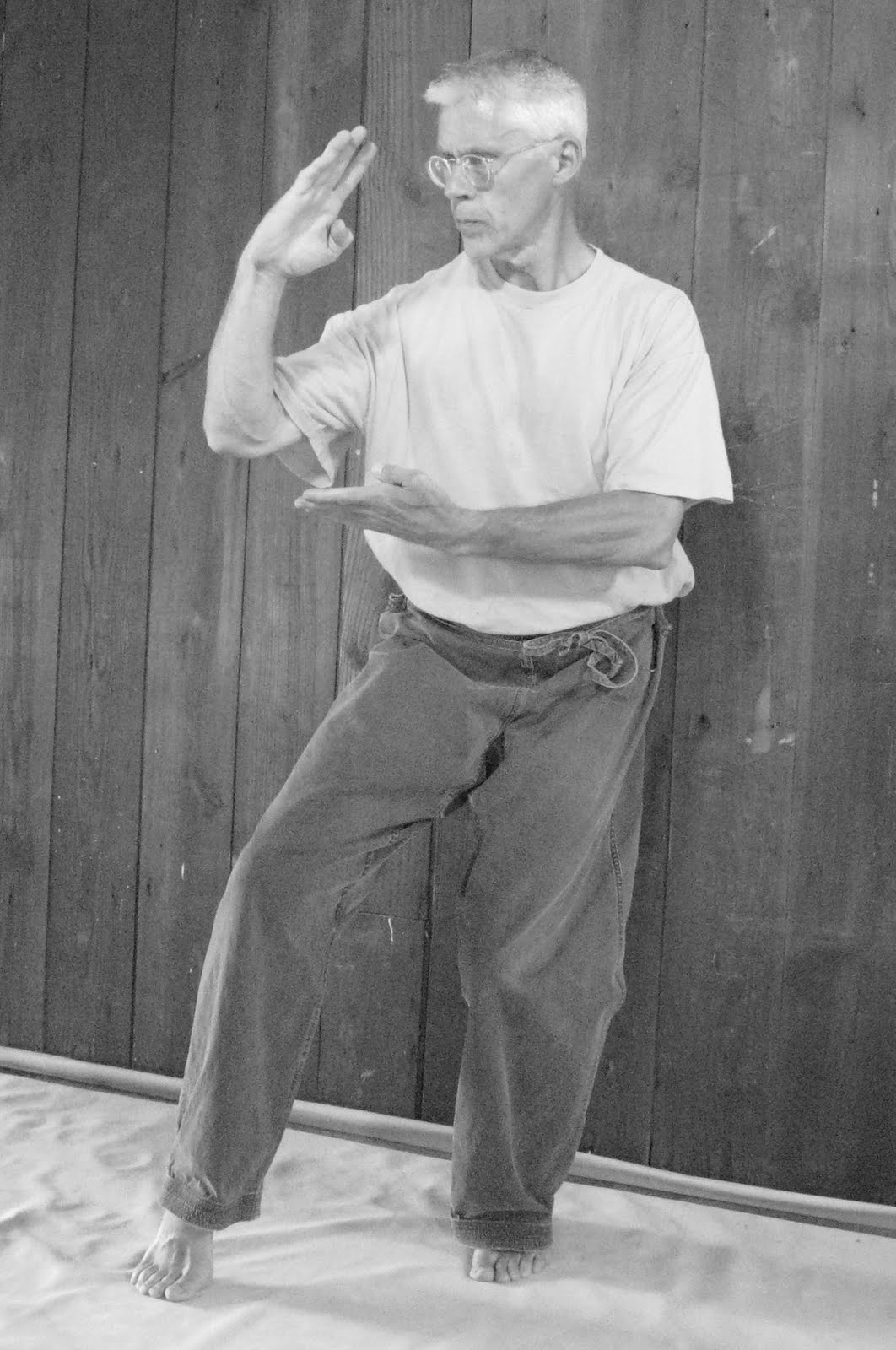
Pictures: Seipai, Saifa, Saifa, Seipai.

Thursday, January 26, 2012

Themes in kata?

Are there themes in kata? I don't mean whether a kata is a monkey kata or shows clear evidence of dragon-style kung fu. I've actually read these debates. They sound so erudite...so filled with posturing and punditry. And where do they get you in the long run? I once asked Matayoshi sensei this sort of question--whether the different Goju katas showed the influence of different animals--having been, of course, raised on the stories of the fighting of animals influencing early martial arts teachers or martial arts masters basing their techniques on the movements of various animals. But Matayoshi sensei said that the different techniques were spread throughout the katas instead of each kata being thematically influenced by a single animal. So that in any given kata, he suggested, you might find snake or leopard or dragon techniques all mixed in together. So much for theme.

But I'm not really thinking of kata themes in that manner anyway. The problem, however, when you think of different katas exploring different themes, it seems to me, is that it raises so many other questions, regardless of whether or not you get the themes right. For example, if you suggest that Seiunchin is a kata that was created to explore responses to pushes and grabs--since that is certainly not enough to base one's self-defense on--then other katas would be needed to explore other self-defense scenarios. That in itself presupposes that some or all of the katas go together in one system, whether they were created that way or whether they were merely collected and put together in that way. Which raises the question: Is it a complete system? Of course, this thematic analysis of kata is based on bunkai or application of moves, which itself is a matter of some disagreement or at the very least multiple interpretations.


In any case, I find it an interesting exercise because it is a way to "see the system" or at least a way to organize a seemingly random and large collection of techniques. For example, Kururunfa seems to be a thematic exploration of one kind of an outside block--the defender's right hand blocks the attacker's right punch or the defender's left hand blocks the attacker's left punch. We see this over and over again in the kata. In fact, all of the initial or receiving "blocks" seem to show this, in various forms. There is some variation; that is, sometimes it is shown with the hand vertical, sometimes with the palm up, and sometimes with a palm-up hooking block. Seipai, on the other hand, seems to be a thematic exploration of another kind of an outside block--the defender's left hand blocks the attacker's right punch or the defender's right hand blocks the attacker's left punch.


The problem is that Seipai is also about "twisting the head off." This comes up a lot in the combinations of the kata. And Seisan seems to be a thematic exploration of the "sun and moon block." But one of the problems here is that the Higa dojo (Shodokan) seems to be the only school of Okinawan Goju-ryu that even does the sun and moon block in Seisan kata. And how are we to look at Shisochin? Is it an exploration of four direction fighting, as its name implies--responses to attacks from the front, sides, and back--or is it an exploration of how to use the forearms in blocks and attacks? Is Saifa a basic beginning kata that deals with responses to grabs, pushes, and punches--why it's taught first? Or is it taught first because it shows how to use the waist or koshi?


In any case, I don't think this is a fruitless journey or pointless question just because there is no definitive answer. The understanding you gain is certainly beneficial to your ability to see variations within the different kata and beneficial to your ability to use each of these techniques.

Sunday, January 15, 2012

Simplify, Simplify, Simplify

“Our life is frittered away by detail. Simplify, simplify, simplify!” Henry David Thoreau


I have often wondered about the supposed complexity of the way many people see karate. People seem to pride themselves, and build reputations, on how many applications of kata technique they can come up with. These are the same people, of course, who propagate the notion that kata can mean anything you want it to mean.


I once read a forum post by someone who was arguing that “every inch” of movement in kata was meaningful (which I don’t have a problem with) and should be analyzed for bunkai (which I do have a problem with)—and not just full of meaning but containing multiple application possibilities. His example was the simple punch or tsuki. This technique, he pointed out to his obviously less schooled audience, in addition to being a punch, could be a block on the way out, a block on the way back, a grab, an elbow attack to the rear, etc., not to mention the multiplicity of techniques that could be gleaned if one were to couple it with the other arm. I think he randomly threw out the number twelve as the number of possible techniques one could apply from the simple punch. But this is not simple to me.


It seems to me that if you want an effective method of self-defense, you must simplify it. This is really what happens when you are able to see your martial art as a system. It’s what happens when you look for and base your practice on principles instead of techniques and the acquisition of techniques. Certainly you need to learn, practice, and study technique, but in Goju-ryu, when the techniques are based on principles (for lack of a better or more specific word), the techniques in kata can be seen as variations. And when you study kata this way, it tends to simplify your understanding.


For example, using the Goju-ryu classical kata, one might argue that there are only four ways to block an opponent’s right punch; blocking on the outside with your left arm or hand, blocking on the outside with your right arm or hand, blocking on the inside with your left arm or hand, and blocking on the inside with your right arm or hand. Whether you block with your hand, forearm, or closed fist is itself only a variation. So the “entry” or receiving (uke) technique of any of the Goju bunkai shown in the classical kata must begin with one of these in some manner—not, for the moment, considering responses to an opponent’s two-handed push or a grab.


One can imagine then that any bunkai sequence that begins with a left outside block to the opponent’s right punch might “tack on,” so to speak, any other closing or bridging technique and finishing technique from any other kata. That is, the last technique in Saifa, for example, is a variation of the last technique in Seipai—or the corner techniques in Seipai or the second sequence with the right front kick, for that matter. They all begin with a left outside block to the opponent’s right punch attack. So one could begin with Saifa and end with Seipai.


The same would be true for any left hand outside block to the opponent’s left punch. We see this in the “blocking” technique in the left or west side move in Kururunfa, or the closed fist double block-punch before the “jump” in Seipai, or the double handed changing-gate technique in Sanseiru. They all begin with a left outside block (palm up) to the opponent’s left punch. So one could begin with any one of them and end with any other one.


The reason this is important is because as a matter of self-defense, as opposed to agreed upon dojo practice, one can’t predict how the opponent will move, so one must be flexible or sensitive enough to vary one’s technique. It’s easiest to vary one’s technique if one simplifies one’s technique, and one way to simplify is to see the relationships between various techniques. The system then becomes both smaller in the sense that it is easier to grasp, and larger in one’s ability to draw on any number of responses depending on the situation.

*Pictures: 1) Saifa 2) Seipai 3)Kururunfa 4) Seipai 5)Sanseiru


Saturday, December 24, 2011

How real is this?

I was looking around the Internet the other day and stumbled upon a number of people recommending books by Kenwa Mabuni (at least one or two translated by Mario Mckenna and generally available). Now I'm familiar with the stories of the close friendship Miyagi Chojun sensei supposedly had with Mabuni sensei. Someone even referred to them as "best friends." I've heard how they were both part of a study group that had as one of its members Go Ken Ki. It says in Patrick McCarthy's book, Ancient Okinawan Martial Arts: Koryu Uchinadi, that Mabuni "trained directly under Higashionna Kanryo," though only for a year (McCarthy, p. 4)--and yet McCarthy says the following: "In an advertisement that he ran in his book on seipai, Mabuni describes himself as a shihan of Goju-ryu kempo...." (p. 30)


I find that surprising, though I'm not sure what to make of it. Further on in his book, McCarthy quotes Mabuni as saying, "There are no styles of karate-do, just varying interpretations of its principles." (p. 33)


I don't really understand this either, though perhaps there is something lost in translation. It seems to me that different schools or martial arts may emphasize different things, but that principles are principles. How can an interpretation of a principle vary?

In fact, I never really understood why you would collect both Shorin and Goju into one system. Isn't there redundancy of some kind at the very least? From the list in McCarthy's book there are 52 kata in Mabuni's Shitoryu system. How can one practice, let alone fully understand, so many kata? I've had occasion to talk to Shitoryu black belt instructors, and they have confessed that their knowledge of many of these kata is at best "rusty."


When I look at the cover of Mabuni's book on Seipai (illustration above), I immediately wonder how realistic this application from the last technique in the kata is. It seems to me that if the attacker is throwing a double punch, your chances of grabbing the attacker's arms in this fashion and executing a throw are rather poor, and not much better if the attacker is grabbing the defender...unless, of course, you have a very willing and compliant partner--that is, a dream technique that may work only in the dojo. Masaji Taira sensei of Jundokan shows this application, I believe, as well as a number of other prominent teachers.


The other thing that bothers me when I see this kind of discussion or illustration of application is that the right hand is "out of position" or not really following kata movement. You can't grab an incoming attack quickly and securely this way unless the "attacker" is not resisting. (It has always seemed to me--and something I was always taught--that the kata is there to teach correct movement and bunkai means the analysis of kata. If your application doesn't follow kata movement then the kata is not teaching you how to move nor are you really analyzing kata.) And further, the stance does not show how the lower half of the body is moving in kata; Mabuni seems to be in shiko dachi.


The kata, it seems to me, actually shows that one is side-stepping a right punch/attack from an attacker stepping in from the west (supposing that the kata begins facing north). The left hand or forearm "receives" (uke) the attack while the right arm comes across to the right side of the attacker's neck. This places the defender in a 90 degree relationship to the incoming attack--that is, getting out of the way. In this position, with the defender's arms describing a small circle, the attacker's right arm is brought up and the attacker's head is brought down, while the defender steps back into a left foot forward neko-ashi-dachi (cat stance). This is followed by a hammer fist to the attacker's temple.


In another text translated and published by McKenna, Kobou Jizai Goshin-jutsu Karate Kenpo, Mabuni shows applications of a number of techniques from Seiunchin, but here again the interpretations only partially seem to follow the actual movements of the kata. I wonder whether that's what Mabuni meant by "varying interpretations of principles"--randomly ignoring logical movement. In this illustration depicting the opening of Seiunchin, Mabuni's defender is not stepping out along the 45 degree line or outside the attack. Neither is there an explanation of why both of the defender's arms are brought down over the thighs. Because of the stepping shown in figure 1 (or lack of stepping to the outside of the opponent's attack), the defender has left himself open to a second attack. Furthermore, the counter-attack shown in figure 3 is certainly less than lethal. And it also raises the question of why one would drop into shiko dachi to block an opponent's punch in the first place.


Again, it has always seemed to me that one should follow kata technique when doing bunkai since the kata--if kata is worth anything--is teaching one how to move. In this application, illustrated above, the stepping is important and both hands are used. In addition, the defender's counter-attack is to a more vulnerable target, the opponent's throat.


Mabuni's second sequence is equally questionable it seems to me. He doesn't show the cat-stance fist-in-palm technique that immediately follows the last technique in the first sequence and precedes the first technique in this second sequence. Then he seems to show the two-handed technique as a push against the opponent, who then seems to advance once more and is attacked with an elbow to the mid-section. Not to say that these technique would be completely ineffective but there are a number things that seem unrealistic about them. Why would one push the opponent away just to allow him to attack again? Again, in the kata, the left open palm is cupped over the right elbow. Is this one of Mabuni's "varied interpretations"? I much prefer to see this sequence as a continuation of the previous sequence of moves.


So how does one explain the differences? Are these just variations in interpretation or are they more significant than that? Was Mabuni hiding techniques by showing only fairly simplistic bunkai? Could he have thought that to show more lethal bunkai was at odds with one of his apparent themes in this publication, to stress the health and fitness benefits of practicing karate? Or did Mabuni, "the shihan of Goju-ryu kempo," not study long enough to really learn much about Goju-ryu? That sounds so blasphemous though.


Monday, December 05, 2011

Off with their heads


"Off with their heads!" the Queen of Hearts in Alice's Adventures in Wonderland, by L. Carroll.


Sometimes it strikes me as odd how much time people spend practicing punching in Goju-ryu. I suppose it happens because we need to train things that all levels can train together. This is not to suggest that learning how to punch correctly is not important. Of course it is. But when you look at the totality of techniques in the Goju-ryu classical subjects punches seem to make up a rather small percentage. Then why is there such an emphasis on punching, not just in doing group basics together but also in doing ippon kumite and in a good deal of the bunkai that one sees being done in most schools? Perhaps it satisfies some urge we have to punch things. Or perhaps it simply fits our expectations of a karate school--indeed, martial arts in general. Or perhaps punching seemed less violent--as ironic as that may sound--when early pioneers tried to popularize karate with the general public. I must admit that I've often thought that many of the "real" techniques in the Goju-ryu classical kata have seemed to me at times too violent or dangerous to actually practice with a partner. For example, the first technique above from the opening sequence of Seipai (though it is demonstrated in mirror image) is difficult to actually practice as a neck break, so it is taught, and in fact the way most people understand it, is as an attack to the opponent's ribs with the elbow. Or the second technique from the middle of Kururunfa--another twist-your-head-off technique. Or the last technique in Sanseiru--now there's a bunkai you won't find in most schools. Or the "arm break" which isn't really an arm break in Seipai.

You can find these techniques in most of the Goju-ryu kata. And if not techniques which are intended to twist the head off, at least techniques to attack the head or neck. So what's with all the chest punches and all the work devoted to hitting the makiwara? Perhaps we should be working the nigiri-game (gripping jars) far more or twisting bundles of bamboo to develop the grip strength to twist someone's head off. And, of course, we should be doing all sorts of exercises to build up strength in our own neck muscles so we might be able to actually train some of these. Or is that all just too violent to consider?


Saturday, November 26, 2011

Thoughts on the Chinese classics--Part IV

"Continuity Without Interruption. The power of external stylists is extrinsic and clumsy. Therefore we see it begin and end, continue and break. The old power is exhausted before the new is born....From beginning to end there is no interruption. Everything is complete and continuous, circular and unending." The Ten Important Points, oral instructions of Yang Ch'eng-fu, recorded by Ch'en Wei-ming, compiled and trans. by Douglas Wile, p. 13.


One should look for this rhythm in kata and bunkai. So often students demonstrate kata with a kind of dead, static movement--as if they were demonstrating each position for judges at a tournament or as if they were demonstrating still postures from a book. However, from the beginning of a sequence till the end of that sequence there should be "continuity without interruption"; the movements should be continuous and without gaps. For example, from the opening technique in Seipai through the grab and neck twist there should be no gaps.


Find the beginnings, where the "uke" or receiving technique begins, and then look for the endings, where the opponent is left incapacitated or down. Everything from beginning to ending should be done in a continuous, uninterrupted fashion with no gaps.

Wednesday, November 23, 2011

Thoughts on the Chinese classics--part III


"We avoid the frontal and advance from the side, seizing changing conditions." Yang Family Manuscripts Collected by Li Ying-ang, quoted in T'ai-chi Touchstones: Yang Family Secret Transmissions, compiled and trans. by Douglas Wile, p. 37.


"We must quickly evade by withdrawing our center and attacking from the side." Transmissions of Yang Pan-hou published by We Meng-hsia, quoted in T'ai-chi Touchstones, compiled and trans. by Douglas Wile, p. 67.


This is the meaning of the patterns of Goju-ryu kata. We should study all of the turns and direction changes in order to learn how to "avoid the frontal and advance from the side." This is the structure and lesson of the directions in Goju kata. So often, students (and teachers) looking to apply the techniques of kata look only at the hands. It's as if we're lions caught in a cage at the circus and the only thing we can focus on is the chair held in our face. The initial movement in kata--the "uke" or receiving technique in a series--is usually accompanied b the movement, generally off line, of the feet and body. We move in along a northwest or northeast line (supposing that the kata starts facing north) as in the kicking techniques of Saifa or the first three shiko dachi stances of Seiunchin. We step to the side (the attack coming from the west) at the end of Saifa. We step back along a southwest or southeast diagonal at the beginning of Kururunfa. But so often, people either ignore the stepping or directions of kata or they will argue such nonsense as "the kata shows stepping forward but in actuality one would step back" (as I've heard quite reputable people say about the opening moves of Seiunchin). The kata is a teaching device. If you study this one lesson carefully, you will see all sorts of useful things that may not have been apparent before.


Of course you first have to see where the sequence begins, where the initial "uke" or receiving technique occurs. But once you have found these, you have to keep in mind that the kata itself, at least with Goju-ryu, is showing how to "avoid the frontal and advance from the side." The end of Seisan turns back to the front with a right block and left open-hand palm strike. This is a clear example of the kata pattern showing us how to apply this technique by moving to the side, avoiding the attack, removing our center, and attacking the opponent from the side, placing ourselves in a position that is at once safer and from which we are better able to control the attacker. So often those who merely look at the hands and ignore the lessons contained within the kata's pattern simply turn to face a new opponent, one attacking from the kata's original front, in this technique from Seisan. If you imagine that the attacker is really advancing from the east (the right) then a very different understanding of these techniques may emerge.


Thursday, November 17, 2011

Thoughts on the Chinese classics--Part II

"The Millstone Turns But the Mind Does Not Turn. The turning of the millstone is a metaphor for the turning of the waist."--Cheng Man-ch'ing. Quoted in T'ai-chi Touchstones: Yang Family Secret Transmissions, compiled and trans. by Douglas Wile, p. 19.

So often I see karate students using their arms as if their arms were disconnected from the rest of the body. The arms are moved by the waist. The waist moves, the arms and legs move. When this is done properly, there is very little effort involved in "blocking" (or receiving) the opponent's attack. But this is difficult to learn from a book or a magazine. Some things are better learned from a teacher.

"The root is in the feet, energy issues up through the legs, is controlled by the waist and is expressed in the hands and fingers."--Yang Lu-ch'an's Commentary to the T'ai-chi ch'uan Classic (Wile, p. 102).

How can you really see what's going on in this technique from Seipai unless you understand the movement of the millstone? It is difficult to learn how to step in towards the attacker, as the kata shows. "The circle of retreat is easy; the circle of advance is difficult," it says in the "Yang Family Manuscripts Copied by Shen Chia-chen" (Wile, p. 89). And it is especially difficult without first learning how the waist enters into all movement.

"The hands and feet work together and likewise knees, elbows and waist." From "Yang Family Manuscripts Collected by Li Ying-ang" (Wile, p. 36).

You can learn kata and bunkai--from watching or looking at videos or even from books and magazines--but you can't really learn how to move until you train with a partner. And even then, if it is not under the watchful eye of someone who knows these things, you won't get it. But once you do see this, then you will see the "hard and soft" in Goju. This is just good martial arts. It cuts across style lines.


Thoughts on the Chinese classics -- Part One

"All the joints of the arms should be completely relaxed, with shoulders sunk and elbows folded down." --Yang Ch'eng-fu, quoted in T'ai-chi Touchstones: Yang Family Secret Transmissions, p. 6. Compiled and translated by Douglas Wile.


So often, people collect kata or bunkai without really learning how to move. This is especially a problem for people who try to learn by reading or watching videos, studying photographs in a magazine or talking to others over the Internet. It is difficult learning movement without working with a teacher, without working it out on the dojo floor. It is easy to collect kata or even bunkai, but you won't really learn how to move without doing kata and bunkai in front of a teacher.


Most people who practice karate are far too rigid. It is difficult to learn how to relax. But without relaxation, you won't be fast enough or have real power. If you have never experienced it, then it is also hard to imagine. The joints must be open and relaxed in order to use the whole of the body in each technique. Folding the elbows down--the position of the arms in Sanchin--is one of the lessons we learn from Sanchin kata and one of the lessons we carry over into other katas and many other techniques, in fact almost anytime we "touch arms" with an opponent. It is the structural integrity of this position that is so important. For example, if this position is correct, then one is in a position to effectively withstand the force of the attacker with very little effort. There have been some recent discussions in books and articles, as well as on line, about some of the important lessons we learn from Sanchin, and yet this position is given little or no discussion or emphasis.

Sunday, November 13, 2011

Ah, he's just old or what does he know anyway?

I can't remember how long ago it was...maybe twenty or twenty-five years ago...when I came across an article in a popular martial arts magazine. The author--sorry that I can't now remember his name--was comparing the cat stance (neko ashi dachi) of Shorin-ryu with the back stance of Shotokan. His theory was that the mainland Japanese had misinterpreted Funakoshi sensei's stance since he was by then fairly old and teaching young university students. (Of course, there was another theory that the Japanese had lengthened the stances of Shorin-ryu because they were getting pushed around by Japanese judo players.) I have always liked this theory, even if there is little to actually support it.


A number of years ago, I was watching a tape of Yagi Meitoku sensei doing Seiunchin kata. He must have been in his 80s by the time they filmed this. He looked feeble and sometimes even a bit unsteady on his feet. But he began the kata, stepping out with his right foot into shiko-dachi with his hands simultaneously moving up and out, back-to-back with the palms up, and then closing and pulling down, ending over each thigh. The difference I had noticed was that Yagi sensei did not step out to a right shiko-dachi with both open hands pointed down. Nor did he step out to shiko-dachi and then bring the hands up, palms down, fingers pointing towards each other, then separating them, making a circle until the backs of the hands meet again out in front of the chest...as at least one noted teacher does who heads a large "international" association.


I have seen various interpretations (or bunkai) for each of these movements. In the first, people have suggested that the defender is responding to a bear hug from the rear. In the second, the defender is supposed to be responding to a double lapel grab or a two-handed choke. The problem with the first idea is that there is no follow-up shown--that is, the techniques that follow the first move don't have anything to do with someone attacking from the rear. The problem with the second idea is that it ignores the feet, stance, and direction of movement--not to mention some of the principles of Okinawan karate. Why would you step into an attack of this nature?


But I just think--and I mean no disrespect by this, in fact, quite the opposite--I just think maybe the old guys may have known something that didn't quite get passed on to everyone. When Yagi sensei steps to the right into shiko-dachi, he is stepping to the outside of the attacker, who has grabbed the defender's left wrist with his left hand, or he is punching with a left punch. Yagi sensei is stepping in, but off line, to the outside of the attack. His arms move up at the same time as he steps in. As the arms are brought down and the hands close, the left hand turns over to grab the attacker's wrist, and the right arm comes down on the attacker's elbow. This brings the attacker's head down. The defender's right hand then grabs the attacker's head, while the defender's left hand comes in to attack the opponent's chin or throat. This is serious self-defense. It shows off-line movement. It doesn't allow the attacker multiple attacks. And it's far more deadly. Just like Funakoshi sensei and the cat stance, I think Yagi sensei knew exactly what he was doing.

Friday, September 23, 2011

The "funny angle" of the spear hand in Seiunchin

I was just watching a video discussion, showing bunkai, of the open hand spear- hand-looking technique at the beginning of Seiunchin.


As I'm typing, I find it funny how difficult it is to discuss karate techniques. You must give them a name and yet as soon as you do, the name itself overshadows the discussion. If I call it a spear hand technique, one immediately imagines using the technique as a spear hand, just as in the video the technique is referred to as "nukite" and is used to attack the opponent's abdomen or there abouts (similarly Morio Higaonna sensei uses this same technique in Seiunchin to attack the outside ribs of an opponent). What we need, however, are descriptive words that only call to mind the look or the shape of the technique--like some of the postures in T'ai Chi. "Parting the horse's mane," for example, or "needle at sea bottom" don't describe the function of the move but only its look or outward shape. In that way, we are not "coloring" the moves with some preconceived notion of how they are to be applied. In other words, what if the "nukite" at the beginning of Seiunchin is not meant to be applied in this way at all. Afterall, if you watch this instructional video there is a lot missing--specifically, what came before the move and what comes after it, not to mention it leaves one wide open against the opponent's other hand. And does the bunkai even explain why one goes down into shiko dachi? Then again, does the bunkai that is shown satisfy one of the cardinal principles of Okinawan karate--that is, does it illustrate "ikken hissatsu" or what some have come to understand as "one punch, one kill." This itself seems to be a very contentious phrase that might better be understood to mean that in Okinawan karate one should move and "block" (uke) in such a way as to allow the opponent only one punch or attack. It is not meant to refer to one's own superhuman punch. Afterall, if a martial art is any good, it will protect you or at least provide you self defense when you may most need it--when you may be older and more vulnerable. In order for this to happen you need to fully understand and rely on principles rather than brute strength or speed. Anyway, back to the "nukite"..... Suppose this is not a nukite at all, at least as it is shown. Suppose with the opening technique you have blocked or intercepted the opponent's punch, or, better yet, you have rotated your left hand up because the opponent has grabbed it with his left hand. Now you have stepped in on a tangential line to the northeast, palms up. Left grabs the opponent's wrist as the right hand comes down on the opponent's elbow. The "arm bar" brings the opponent's head down. The right hand then comes up, keeping the elbow down, turns over and grabs the opponent's head. The left "nukite" or open hand then comes in to attack the opponent's throat--not the abdomen or the ribs. Once you have the head in this fashion it explains the angle of the hand across the body, and, of course, the moves that follow it--the cat stance with the fist on the palm, the hand rotation, and the elbow that attacks the back of the opponent's head. Anyway, that's my reasoning for wanting technique names that only describe the look or shape of a move. A rather long-winded rant for a simple concept perhaps...but then what are blogs for?

Monday, September 05, 2011

Original bunkai??

I was just reading Victor Smith's new blog on bunkai here: http://isshin-concentration.blogspot.com/2011/09/bunkai-i-look-at-original-explanation.html

He quotes Funakoshi:

"Once you have learned technique thoroughly which are required for each Dan, you should analyze them. For instance; this movement belongs to this, that one belongs to that etc."

That sounds good--learn kata and only later focus on applications. My problem is the way Smith goes on to assume that this means that there are many different interpretations or applications for each move in kata. Smith draws the following conclusion from the Funakoshi quote:

"This does not seem to indicate," Smith says, " there was a defined use of kata but a more open ended study."

Why?! What in the Funakoshi quote implies that there isn't a "defined use of kata?" Is this not rather an instance where we find what we wish to find in a suitably ambiguous or vague quote? Mr. Smith has more than once advocated this open-ended interpretation of kata and bunkai. I'm, of course, a strong advocate of at least trying to understand (however difficult and frustrating this may be) the original intent of kata and bunkai. I'm not against using kata techniques in a variety of ways, but I think one should first attempt to learn the principles and the original intent of techniques.

Smith goes on to cite Mabuni's analysis of Seiunchin, with appropriate illustrations from the Mckenna translated book. The ones that are illustrated are rather bogus. Whoa, that's a bit of blasphemy, isn't it?! I used the same illustrations to discuss Seiunchin kata and bunkai in an article in Journal of Asian Martial Arts called "The Teaching of Goju-Ryu Kata: A Brief Look at Methodology and Practice (vol. 14, no. 2, 2005). I'm not looking to upset the apple cart--afterall, Mr. Smith practices Isshinryu and I practice Goju-ryu, so maybe we're both wrong about what Funakoshi may have meant--but why isn't there more open and critical discussion of such things on the Internet?


Sunday, September 04, 2011

How many different versions are there?

Why are there different versions of kata? I have often wondered about this. When I first went to Okinawa--maybe twenty-five years ago now--I knew what I assumed was the Toguchi or Shoreikan version of the classical Goju-ryu canon of kata. Not entirely sure we did the Shoreikan version in all cases, since my teacher had trained in both the Shoreikan dojo and the Shodokan dojo of Higa Seiko sensei. But when I first went to Okinawa we trained in Shodokan dojos--with Gibo Seiki sensei and Higa Seikichi sensei. There were differences in kata. Not much in Saifa and only very small and somewhat insignificant differences in Seiunchin. (The back to back wrist technique that looks like an elbow attack was one difference.)


In Shisochin, there was a difference in how the forearm attacks were done that are most often (in most schools?) used as arm-bar techniques. There were also some stance differences, and the turning direction in the final technique was to the right instead of the left--a seemingly insignificant but actually quite important difference, seems to me.

In Seipai there seemed to be few differences of any consequence in the performance of the kata--though interestingly one was an extra turning over of the clasped hands at the beginning--but in Sanseiru there were many. In fact, this kata, with its controversial past, seemed to be the most varied. When I asked Gibo sensei about this, he laughed and said he knew seven different versions. In the Shoreikan version, for example, we had always stepped back at the beginning of the kata and were told it was to block a kick, grab the kick, and then both hands were raised up in front of the chest in a kind of "x" formation and rotated as one stepped forward to kick, etc.


How could different teachers who all had claims to having trained under the same person--Miyagi sensei in this case--practice different versions of the same kata? Some differences have profound influences on bunkai. Did some teachers favor certain bunkai and this, however subtly, affected the way they did kata? Did some teachers not learn bunkai, possibly affecting their understanding and performance of kata? Does bunkai inform kata or does kata inform bunkai? I don't know about historically what would be the case, but I have often seen people alter kata movement when performing applications against a partner and still call it bunkai. Would this, over time, affect how one did kata? Or did some teachers have physical idiosyncracies that their students mistakenly copied?


For example, after the opening three "punches" in Sanseiru, most schools perform a right open-hand block followed by a move where the left hand sweeps down along the right arm, stepping back into a long front stance. If you are told that this is a block of an opponent's kick, does this influence how you do kata? Could it also, over time, however subtly, influence various hand positions?


Why raise the question? Let me rather ask, is it logical for an attacker to initiate an attack with a low kick, especially from a distance that would allow one to block it this way? Is this even the best way to block a kick? If this is a lethal attack, why isn't one responding with a more lethal counterattack?

The Changing Gate Block

I was watching a video of a teacher doing Seipai kata recently. It was nicely done--strong, crisp movement, precise. But when I watch kata there are a few I suppose somewhat subtle things I try to see, and for this kata one of these things is the "changing gate block," for lack of a better name. I find this a fascinating "block" or receiving technique. It can be found in Seipai and Sanseiru. Goju-ryu generally blocks and attacks almost simultareously. This is also true of the "changing gate" block, but the uniqueness is that one blocks and attacks from the outside and then moves inside almost immediately. Almost all the bunkai shown in Goju classical kata have three parts to them--the receiving technique, often containing both a block and attack, the bridging or controlling technique, which moves in much closer to the opponent, and the finishing technique. I would say that this is nowhere more apparent than with the "changing gate" techniques, except that there are many teachers--some quite "big" and with a large YouTube following--that interpret these moves in kata quite differently. But the "changing gate" is quite a fascinating technique and wonderfully versatile when it comes to employing kata variations--that is, connecting to other controlling and finishing techniques from other kata. Of course, the illustrated techniques here are just the beginning of the "changing gate," the entry technique showing the block and attack from the "outside"--the first from Seipai and the second from Sanseiru. The technique that follows each is the inside technique. The "change" occurs inbetween them, as is so often the case in Goju-ryu. One should always pay attention to the spaces in between.
Of course, there is another significant "problem" this brings up and one I have been wondering about for some time. The "changing gate" block shown above--Sanseiru kata in the Shodokan (Higa) school using open hands--is not done apparently in Meibukan, Jundokan, or Shoreikan schools, at least from what I have seen on YouTube. Why of these major Goju-ryu schools is the Shodokan version so different? Higa Seiko sensei was the senior student under Miyagi Chojun sensei, but the teachers who started these other kans studied with Miyagi sensei also. Why the difference? It's not done in the To'on Ryu version either. The "changing gate" block seems so fundamental to an understanding of the end part of this kata. It's like the "sun and moon block" in Seisan that seems to be unique to Shodokan. Why such significant differences in kata?

Thursday, August 25, 2011

There are still questions...

Why do some katas begin with three elementary techniques, as if you were practicing basics--Shisochin, Seisan, Sanseiru, Suparinpei--while others begin with what seem to be three techniques showing bunkai/application--Saifa, Seiunchin--and some begin with neither--Seipai, Kururunfa?

Why are some techniques done slowly in kata? Is it because these moves are demonstrating a different kind of sustained application of strength, the kind that would be evident in grappling or throwing? And yet not all slow moves seem to be used in that fashion.


How were teachers able to preserve kata movement without teaching bunkai? Or is that itself an assumption--that is, is it a faulty assumption to presume that some schools accurately preserved kata? And if so, which ones? Or, how do we know they didn't teach and pass on bunkai? There is certainly some evidence to suggest that they didn't. I had a friend in Okinawa, who had been studying for 10 to 15 years, who said he had never been taught bunkai to classical kata. A senior student in Jundokan once told me that Taira sensei spent years trying to "work out" his bunkai for the classical katas, implying that he was not taught them in the dojo by his teachers. Does kata movement get corrupted when there is no reference to bunkai? Or does our natural inclination to "find" bunkai, when none is taught, corrupt the way we practice kata? Conspiracy theorists might indulge in the notion that Okinawans are just not teaching bunkai to Americans. Or others might question this altogether, saying that they have been taught bunkai and their school is very clear about bunkai. But then why does bunkai vary so much? Does kata mean anything you want it to mean provided it "works" in a fashion? If the bunkai deviates from the kata--that is, if how one applies a technique from kata doesn't look anything like it does when one does kata--can it still be called bunkai? Some would suggest that these deviations demonstrate different levels of bunkai. Is it logical that kata--meant to preserve technique--has different levels? Can something be used to show and hide at the same time?


Why do I keep thinking of a Ralph Waldo Emerson quote? "A foolish consistency is the hobgoblin of little minds." Was Emerson right or was this just an easy way out of a sticky situation?