Entrance to the Barn Dojo....
Showing posts with label Saifa.. Show all posts

Thursday, June 07, 2018

The hemlock trees are dying

It was wet in the woods the other day. Actually, I think this was two or three weeks ago now--it's been quite busy lately and I lose track of the time. Spring had arrived and everything was alive. Even the spiders were out. I could hear the stream that runs down the hill to the reservoir. In places where the evergreens were thickest, the forest didn't look all that different in the spring as it did in the midst of winter. But the maples and the oaks and the birches and hickories were starting to leaf out and it was easier to see which trees had died over the winter, opening up patches in the canopy. On the ground beneath them, you could see seedlings ready to take over. On the part of the trail where it's widest and there seems to be the most sunlight, small hemlock saplings, no more than a foot or two high, had sprung up along each side of the path. Further up the trail, the giant hemlocks stood, many of them over a hundred feet tall by the look of them, and stately--they seemed to have no need for spreading branches to establish their places like the spruce trees or the balsam pines.

In the first technique of Seiunchin,
both arms are initially brought up
to the outside of the attacker's arm.
But the older hemlock trees are dying. I could count dozens of them along the trail and more off in the woods, the bark stripped off in places, left like red mulch around the base of the tree. They've been hit by the wooly adelgid. It's an invasive species for which the hemlock has no natural resistance. The wooly adelgid brings the borer beetle, which feeds on it, and then, after the borer beetles have burrowed beneath the bark of the tree, the woodpeckers attack, stripping the bark to get at the beetles. Fungus begins to grow around the roots of the diseased tree, and before long, the tree falls. The cold New England temperatures kept the pest at bay for years, but now they're heading north as the winters warm, and the hemlock may go the way of the American chestnut. It shows, I think, it's all tied together; a chain of events that seems to connect things in a way that's difficult to see at the start--one thing leading to another or, if not so singularly predictable, a step in one direction changing the expected outcome while opening up any number of different possibilities, like a small alteration in the environment opening an existential niche that may not have been there before. 

The initial counter from the first
sequence of Kururunfa.
For some reason, all of this made me think of how we string the various techniques of a kata together. But I wasn’t thinking about the sequences of techniques in the standard way in which it is shown in kata—beginning with the receiving (uke) technique, then progressing with the controlling or bridging technique, and finishing with a throw or an attack to the neck or head--as much as I was thinking about how an understanding of the structure and themes of a kata allows one to move between the techniques of different kata within the system. Because the Goju-ryu classical kata are composed of sequences—with entry techniques and bridging techniques and finishing techniques—it’s fairly easy to begin with a technique from one kata and then, depending on how the attacker is moving or responding to your initial receiving technique, move into a bridging technique from another kata and, again, tack on a finishing technique from yet another kata. Understanding the themes or principles of the various classical subjects also helps facilitate this sort of flexibility, especially when each kata seems to be exploring a different theme or response to a different sort of attack--that is, the receiving techniques seem to show the most variation. How one bridges the distance in order to control the opponent may also show a certain amount of variation but the idea here is basically to maintain contact after the initial receiving technique and, without putting oneself in further danger, moving to the opponent’s head or neck to finish the encounter. 
Continuing with the first technique
from Seipai (on the non-kata side).

For example, in the opening move of Seiunchin kata—and in fact in many of the other techniques of this kata—both arms are brought to the outside of the opponent’s attacking arm, whether we see this attack as a wrist grab or a punch or a grab of one’s clothing. If one were to continue the sequence, the defender’s left hand would rotate in order to grab the attacker’s left wrist as the right forearm was brought down on the attacker’s elbow. This is the position in kata that looks like two down blocks in shiko dachi (horse stance) done at a 45 degree angle.

However, if one is thinking about variations, it is easy to see how the defender might move from this initial position in Seiunchin kata to the first attack in Kururunfa kata. The defender need only maintain contact with his right arm on the attacker’s left arm, releasing the left grab, and bring the left forearm up into the neck of the attacker. This is then followed by a left knee kick. 
Continuing with this technique from
Seisan kata by dropping the left arm
and stepping in behind the opponent.

But if these counter attacks are somehow thwarted, the defender can then tack on the first technique in Seipai kata (though it would be from the non-kata side), with the left forearm brought up alongside the neck, since the initial straight arm technique begins from this position with the elbow or forearm attacking the opponent’s face or neck. 

Or, by dropping the left forearm down along the back of the opponent’s left arm and moving to the back, the defender could continue with the bridging and finishing techniques from the first sequence of Seisan kata. 


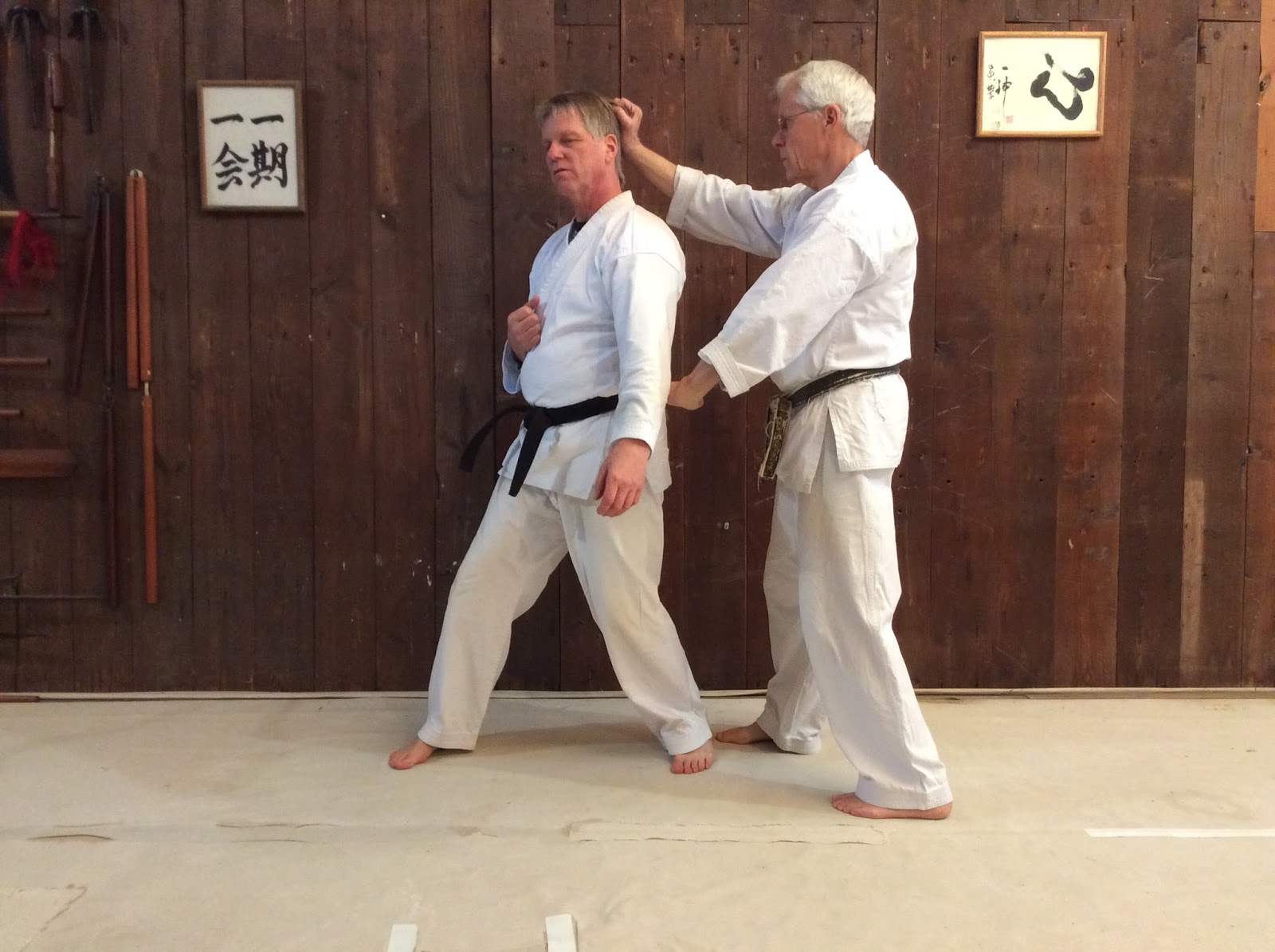
Continuing with the pull down
technique from Saifa kata.

[Me with Bill Diggle from photos
we did for the book, The Kata and
Bunkai of Goju-Ryu
.]


Or, once to the back of the opponent, the defender could grab both shoulders, as we see in Saifa kata, and pull the attacker down onto the knee and attack with the hammer fist strike. 

I think it is important to see the connections, but we can only really be comfortable with these kinds of connections when we understand the sequences of a kata and see the themes or principles contained within them. Once we are able to do that, the attack becomes relentless, sort of like the attack of the wooly adelgid on these stately Hemlock trees, I think. 

Hemlock tree after it has
been attacked by the
wooly adelgid, borer
beetles, and woodpeckers.


Friday, September 22, 2017

When a tree falls in the forest...and other thoughts on bunkai.

A single leaf at the end of
a new shoot.
If a tree falls in the forest and there’s no one there to hear it….does it really matter? It will lead to all sorts of unexpected outcomes. The tree will fall. There will be an opening in the canopy overhead. Sunlight will reach the forest floor where it hadn’t, where it had been shady for years. A small seedling will begin to sprout or an acorn lying dormant under a blanket of leaves will feel the sun. The next thing you know, there will be little twig-sized slips of oak or maple or aspen, two over-sized leaves on a slender stick the size of a toothpick. Of course, the grass takes over first, it seems, followed by the weeds and the ground creepers, but the trees are there--a balsam fir or a white pine or a spruce. They each send up these little, central shoots with a more or less symmetrical arrangement of branches. It begins with a cluster of buds at the tip of the shoot. The central bud becomes the trunk of the new tree and the buds that surround it grow laterally into branches. And each year's growth follows the same pattern, unless the deer come and nibble off the buds or the central bud gets damaged somehow. If it does, the tree is programmed in such a way that one of the lateral buds that had been destined to become a branch takes over the role of the central bud and becomes the trunk. 


First entry or receiving technique
from Kururunfa kata.
I've been reading a lot of Bernd Heinrich lately. He writes about birds and trees and running, among other things. I hope I'm not over-simplifying what he says about trees too much, but it's this changing aspect of the new tree that got me thinking about its relationship to the martial arts as I was out in the woods the other day. We approach the study of kata as if it's something sacrosanct, a ritualized performance piece. And yet we look at bunkai as if the movements are so fluid and dynamic that they supposedly have countless ways of interpreting or applying them. This point of view is, in fact, so widespread that it almost seems as though it has fostered the growth of a whole new industry based on seminars and the discovery of new and ever-more-outlandish applications. 
Initial technique from Seipai kata.

So I would suggest that it may be time to simplify things a bit. We could start with a simple statement about the structure of a kata. Kata are composed of different kinds of techniques--entry or receiving techniques, bridging or controlling techniques, and finishing techniques. Each entry technique is part of a sequence, but because of the exigencies of any given situation—how the attacker responds to the initial block or receiving technique, one's balance, the strength of the opponent—you may need to change things up at some point, sort of like the new shoot when a deer comes along and nibbles off the central bud.

Sliding down the back of the arm
and grabbing the head.
For example, if you respond to an attack with the opening receiving technique from Kururunfa, something unforeseen could happen that causes you to change the sequence and instead continue with the initial technique from Seipai kata. That is, from the forearm attack to the neck in the initial technique of Kururunfa, you might straighten out the right arm, pushing the attacker's head down. Then, you might continue with the first sequence of Seipai by stepping through with the left palm-attack to the chin, going on to twist the head. Or, alternatively, from the initial Kururunfa technique, you might drop the right arm down along the back of the opponent's right arm to move behind him, as we do in Seisan.  Once you’re to the back of the opponent, you could continue with this sequence from Seisan, grabbing the back of the head with the left hand and stepping in to grab the chin with the right hand. Or, you could simply grab the opponent’s trapezius muscles from the back and pull him down onto the front knee, as we do in Saifa kata.
Pulling down by grabbing the
trapezius muscles in Saifa.

Kata itself is a repository of technique, and each technique functions differently. But once we understand this, we can take them apart and put them together in different ways, all depending on what happens in any given situation. In that sense, the system of self defense we know as Goju-Ryu becomes both smaller and larger at the same time. It is smaller because it becomes more manageable--there are, for instance, a finite number of receiving techniques and the same might be said of the bridging and finishing techniques as well. In other words, one doesn't need to become a master of what at one time must have seemed like an encyclopedic number of techniques. But it is also larger because if we truly understand the system and its kata then we can see an almost infinite number of ways that the individual techniques can be taken apart and put back together. That is, the entry technique from one kata might be combined with the bridging technique of another kata and the finishing technique of yet another kata. 

So what if a tree falls in the forest. Stuff happens. Another tree will come along and take its place.