Entrance to the Barn Dojo....
Showing posts with label sanseiru. Show all posts

Tuesday, April 17, 2018

Connections

The temperature hit 50 degrees F. (10 degrees C.). Spring seemed just around the corner even though the paths through the woods were still covered with ice. The last snowfall had been packed down along the most travelled paths from countless boots and dog paws, melting in the daytime and then refreezing at night. The snow was gone alongside the trails. Even in under the shade of the evergreens, it looked like fall, with a blanket of dead leaves spread out everywhere. You could hear the squirrels hurrying about, surprised, I suppose, that anyone was out in the woods today--it was really too icy to navigate the trails. It was a day to bushwhack off to the side of the main trails, looking for landmarks, heading up the hill in the general direction of the ridge with its outcropping of rocks.

Off in the woods in the late winter and early spring, the trees stand quietly, no wind rustling through the leaves, as if they are patiently or perhaps stoically waiting for warmer weather, for the longer days that will tell them it's time to wake up, to "shake off this downy sleep, death's counterfeit," though I don't know why Shakespeare's words should come to mind now. The woods in winter seem far more prosaic, or at least I do, plodding along the trails.

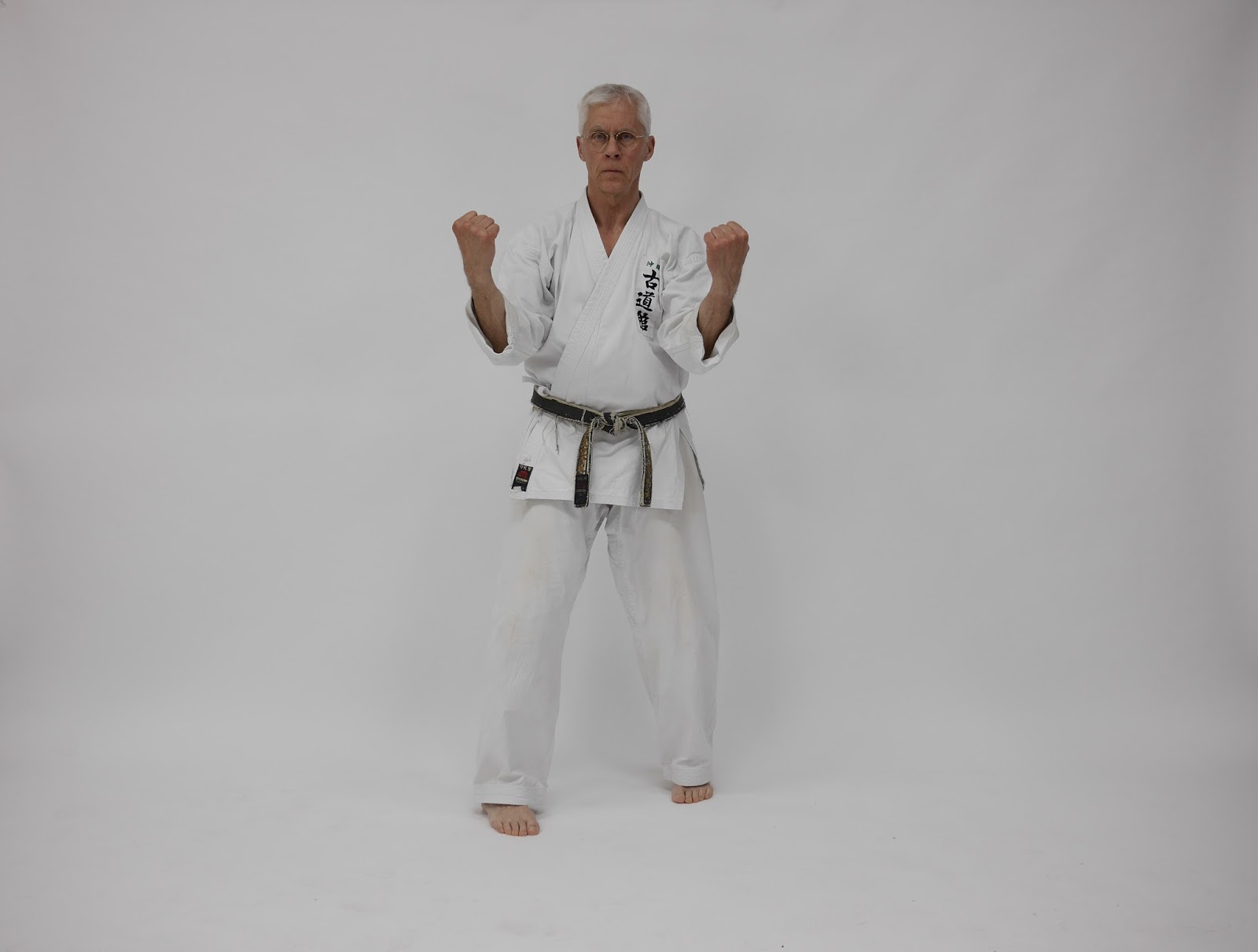
The double-arm kamae shared by
all four kata.
Without the leaves and underbrush, you tend to notice the trees themselves more. Most of the lower branches have dropped, scattered across the forest floor. The ones that have fallen on the trails have been picked up and thrown off into the woods, keeping the trails clear for hikers. The bark is the only thing that tends to distinguish one tree from another in the winter, though there are the odd aspens and small oak saplings that seem to have hung onto a few of their dry, brown leaves. There are oaks here, but they confuse me at this time of year. There are red oaks and pin oaks and eastern white oaks and maybe a chinquapin scrub oak, but I can't tell the difference just from the bark. I'd need to see the leaves, and even then I'd have to bring along Sibley's tree guide. The birches are another story, what with the horizontal striations up and down their trunks, and there are a lot of birches, scattered in their own little groves along the trail. There's the familiar paper birch, though sometimes from a distance the smaller ones look an awful lot like quaking aspens. Then there's the yellow birch and the river birch and the black birch, also known as sweet birch, I believe, because they used the sap for making birch beer.

I used to have two large European white birch trees in back of the house. One had a trunk almost three feet in diameter and must have been over sixty feet tall. But we lost them both to borer beetles and had to cut them down.

Suparinpei.
The birches are all related, of course--you can see the lenticels on the bark quite easily--but I think it's rare that they inter-breed. Yet the fact that there are so many related species here calls to mind that old discussion about Goju kata origins that seemed to rage for years, and still seems to crop up now and again. The argument that many put forward suggested that originally there were only four kata that comprised the classical curriculum of Goju-ryu: Sanchin, Sanseiru, Seisan, and Suparinpei. The other kata, it was argued, were either from different sources or were added later by Miyagi Chojun sensei, but they were not part of the original system taught by Kanryo Higashionna. It's an easy argument to put forward since there seems to be no documentary proof either way and there is an obvious similarity between the techniques of those four kata. In fact, it wouldn't be too far-fetched to suggest that Suparinpei itself is a sort of composite of the three other kata, which for me, as heretical as it may be, always calls to mind the old chicken and egg question: Which came first, Suparinpei or Seisan and Sanseiru?
One of the similarities between
Seiunchin and Suparinpei.

But those three kata--Sanchin, Sanseiru, and Seisan--are so obviously related to Suparinpei, why not Seiunchin? There are similarities there, too. Look at the opening mawashi series in Suparinpei and compare it to the opening series in Seiunchin, the right hand head grab and left hand "nukite" to the chin or neck. It may not be identical--Suparinpei comes off a mawashi-uke technique while Seiunchin comes off an arm-bar technique--but the application is the same. And neither one is an end in itself--that is, the finishing technique in Seiunchin is only shown after the third repetition and the possible finishing techniques in Suparinpei are shown separately, later in the kata.

The angle technique from Suparinpei.
And what about the opening technique in Seiunchin, the left hand grab release that begins the kata? We see this same technique (admittedly with only a single hand) used later in Suparinpei, one of four steps into shiko dachi done along the  northwest-southeast and southwest-northeast angles. In both cases, the key principle is the dropping of the elbow as the left hand is rotated up and the defender drops into shiko dachi. Both look very much like release techniques from an attacker's cross-hand grab. The difference is that Seiunchin kata is a good deal clearer than Suparinpei, but only because the structure of Seiunchin clearly shows a bunkai sequence with a beginning, middle, and end, or an initial receiving technique, a controlling or bridging technique, and a finishing technique. Suparinpei, because of the uniqueness of its somewhat fragmented structure, only shows the initial technique and the bridging technique, moving from a left-foot forward shiko dachi to a step into a right-foot forward shiko dachi. The interesting thing is that the logical finishing technique for this is the step back into a left-foot forward shiko dachi, attacking with a left arm gedan barai or what is often called a down block. We see this in Seiunchin kata as the finishing technique for each of the four angle sequences.

The forearm attack from Seiunchin,
also done on the angles.
So should Seiunchin kata be included in the "original" kata of Goju-ryu, since it too shows distinct similarities to Suparinpei? And if Seiunchin, why not Shisochin and Seipai and Kururunfa? After all, I'd be hard pressed to tell the difference between the leaf of a black birch and an American beech tree, and birches are related to alders and hazels and hornbeams as well. These origin debates may seem pretty fruitless and academic to most people, but a comparison of seemingly different techniques may, in fact, help explain certain techniques that may at first glance seem utterly baffling.


Thursday, February 15, 2018

Just because it's a convention doesn't mean it's right!

[I wrote this last month, but I somewhat arbitrarily forgot to post it. But then again, what difference does a day make, or a week, or a month for that matter?]


Welcome to a new year--January 1st--and yet off in the woods the new year looks pretty much like the old one did a few days ago. The blue jays are scolding me as I trudge by on the trail and the squirrels pause to look up and jump behind a tree, waiting to see whether I'm a threat. I've read that squirrels are very territorial, so I suppose these are the same squirrels that were scurrying around last
First technique of Saifa kata.
week, digging up acorns that they had buried last fall. I wonder whether squirrels are really as busy as they seem to be or whether they might be a bit like office workers rearranging the papers on their desks into neater piles, just looking busy in case the boss comes by or the wives ask where they've been all day.

But the days are already getting longer, past the winter solstice. We've turned another page on the calendar. And yet all of this business of time and calendars is a human construct, isn't it? A mass delusion, or if not a delusion at least something that we all culturally have come to agree on; that is, there's little rhyme or reason to any of it, it's just accepted. I mean, we've had lunar calendars and solar calendars and some combination of the two. Not even the seven-day week is
First technique of Seiunchin kata.
anything but arbitrary, something we have just come to agree on. In fact, for a good deal of human history we haven't even agreed upon a 24-hour day. Daniel Boorstin's book, The Discoverers, has an interesting section on all of this. Way back in 1582, they took 10 days out to correct the old Julian calendar that was off by 11 minutes and 14 seconds each year, so really I'm not even sure of the date. And in America, we didn't even accept this restructuring until Colonial times.

Anyway, all of this got me thinking about what we accept as a society, what we take for granted as we carry on with our daily lives. Actually I was thinking about all of this because I had been reading Kazuo Ishiguro's book, The Buried Giant. He describes a medieval England where strangers are  feared and the forests are filled with ogres, and mists shroud the land and bring an eerie forgetfulness. And it's all accepted as perfectly natural.
Initial technique of the first
sequence of Sanseiru kata.

It made me wonder about all of the things we accept in karate without question, all supported and bolstered by the bulwark of convention or lineage or rank. Of course,  we practice all sorts of harmless conventions in the martial arts, from the karate gi to the formalities of seiza and bowing to the shrine and pictures of those teachers who have preceded us to the use of Japanese terminology and the practice of kata. But we also practice what I can only call conventional interpretations of kata technique. And these conventional interpretations (bunkai) get passed on with very little questioning of their practicality, as if we are hesitant to question anything that most everyone else seems to be doing.

First technique of Seipai kata.
And these problematic inter-pretations are everywhere in Goju-ryu. For example: The opening technique of Saifa does
not use both of the defender's hands to pull away from an attacker's wrist grab. Why disconnect from the attacker? The opening technique of Seiunchin kata does not use both hands to release the opponent's choke hold. Why would you step towards someone who was choking you? The opening technique of Sanseiru (after the three slow punches, that is) is not used in order to block an opponent's kick and then grab the kicking foot and muscle the attacker to the ground. Why would you lean forward with your head undefended as an attacker was coming at you and then even attempt to grab a kick? The opening technique of Seipai is not a nukite to the opponent's chest--it's not a nukite at all--nor an elaborate wrist release. Why would you even think of attacking a hard target with the finger tips? And why would you take the time to weave your hands in and out of the arms of an opponent grabbing you with both hands using the techniques that follow it, as the conventional interpretation shows? There is no response to a full-nelson in Kururunfa. Try it sometime against an uncooperative opponent who's bigger and stronger.
Convention suggests that this
technique from Kururunfa is
a release from a full-nelson.

And yet these are all conventional interpretations of kata techniques. The problem is they don't make a whole lot of sense for a variety of reasons: they are too slow or they leave the defender open to attack or they don't really follow kata or they are easily thwarted by the opponent, etc. Their only reason for being is that they are the conventional interpretations, and conventions are rarely questioned.
This is not to suggest that all conventions are useless or without merit. Clocks and calendars are very useful even if they are a somewhat arbitrary means of marking time. But conventional wisdom once suggested that the earth was flat, that there was witchcraft at work in Salem, that you'd catch your death if you walked around with wet feet.

Most of the conventional interpretations of kata, I think, are, at the very least, useful in pointing out some of the pitfalls one may encounter with interpretations of kata, as ironic as that may be. And by example, they can steer us off into better directions, bushwhacking through the woods in search of a better trail.

[For a more detailed discussion of these techniques see my book, The Kata and Bunkai of Goju-Ryu, here.]


Tuesday, December 12, 2017

It's a system, like the trees in the forest

The forest was wet today. Droplets of water collected in the leaves here and there, and the moss looked a bit brighter green after the rain we had overnight. But the temperature is dropping gradually, the days are getting shorter, and most of the trees are bare. It's hard to tell which trees are dead this time of year. The only thing that seems to be thriving is the lichen and small colonies of mushrooms clinging to the old tree trunks that lay rotting by the side of the trail. 


Saifa kata
Seipai kata
When I'm out in the woods these days, I don't usually think of the forest as an eco-system, though I know it is. I know that when the larger trees fall, after a strong rain or a heavy storm with high winds, they leave a hole in the canopy overhead and the wild grasses, the ground cover, and the acorns lying buried beneath the leaves, some waiting patiently for years, will start to grow in the spring, reaching for the sunlight that's finally been able to make its way through the leaves of the taller trees. 


Suparinpei kata
Seiunchin kata
No, when I'm out walking in the woods these days, I'm just looking for the seemingly random beauty you can find when you go out "forest bathing." Nothing seems so systematic. Everything seems chaotic and haphazard. But, of course, it is a system, just like any martial art, despite what some may imply when they suggest that a style like Goju ryu, for example, is a random collection of kata that come from different sources andwere created by different people at different periods in the past.


Kururunfa kata
Seipai kata
While this may be true (and probably is given that the structure of the Goju classical subjects varies considerably), it does not change the fact that it's a system. The different kata show variations as if they were jazz compositions, as if different composers were given the same melody and told to improvise. One need only compare techniques from different kata to see the variations, to appreciate how different techniques explore similar themes. Certainly there are differences--any given self-defense scenario may vary depending on one's position in relationship to the attacker or, for that matter, what the initial attack is--but the apparent similarity of some techniques and the fact that they are used in a very similar manner (the application or bunkai) underscores the notion that they are all part of the same system, regardless of whether or not the different classical subjects may have had different origins.

Sanseiru kata
Shisochin kata
The key here, of course, is to understand (or "see") the applications. You can't rely solely on the appearance of the techniques. This is admittedly a challenge. We have to first let go of our expectations, which may include not only what the technique appears to be, but also
what we may have been told--in other words, the conventional interpretation of the techniques in question. The problem may be compounded by texts and pictures that seem to record "end" positions; that is, it's difficult to convey in pictures or words what happens in-between the pictures one generally sees in karate manuals or texts which discuss kata, and it's often in the space between one move and the next that we see how a given technique is applied.

Saifa kata
Seipai kata
And you need the whole system. You need all eight classical kata in order to address different scenarios on the one hand and, on the other, to be able to see how to move from one technique in one kata to a similar technique in another kata if the dynamics of the situation change--and they are likely to change. That is, you need to see the similarities and variations in order to alter your counterattack. You may begin with the opening or receiving technique from Saifa (as pictured above), but you have to be able to change to the controlling or bridging technique from Seipai, for example (the bridging technique from Seipai being the technique which follows the Seipai opening technique pictured above). In other words, once you "see" the similarities and variations, you should be able to move back and forth between the techniques of each sequence of moves. This is the way a system works. Of course, you have to also be aware of the sequences. And if you can see the sequences, then you realize that the techniques within a sequence function in specific ways--that is, they can't just mean whatever you want them to mean.

Some have suggested that any single kata is a complete system of self-defense in itself. This is a rather silly notion, as is the idea that any given technique has multiple interpretations or applications. Either one of these notions gets in the way of "seeing" the whole system and being able to comfortably work within the system. Both of these views are short-sighted. Metaphorically, they're like being lost in the woods, failing to see the forest for the trees.


Sunday, November 26, 2017

Things aren't always what they seem

The other day I decided to take a break and head out for a hike up Mt. Tom. I had spent most of the week ripping up the old mat in the dojo and laying down a new wood floor. The canvas cover I  scrounged from an Aikido school years ago was old when I got it, but we needed something to cover the old wrestling mat that looked more like a patchwork quilt made of duct tape than anything else. Patching up the canvas cover had taken a few more rolls of duct tape the past few years, so it just seemed like the time to move back to a wood floor. I had gotten to the point where we had finished cutting and laying down the wood floor, so it seemed like a good time to take a break.

The woods were damp from the recent rains and the first yellow leaves were beginning to fall. A few trees had come down in the last storm, their roots not deep enough as they stretched out over the outcropping of rocks along the path. I was coming down the mountain on a path that wound its way around a small, rocky crag when I noticed a dog coming up the other way. He paused for a moment just in front of me, sniffing the ground, and as I stopped to pet him I looked ahead to see his owner leap wildly to the side of the path, jumping from one foot to the other, waving his arms frantically as if he were trying to escape a giant spider's web. After a moment he stopped and continued up the mountain. When he looked up, he must have noticed the quizzical look on my face. "Snake," he said. "I hate snakes." And then we both continued on the trail; he going up and me going down, but both of us, I'm sure, on the look out for more snakes hiding on the bare rock, hard to pick out amongst the meandering tree roots.

It reminded me of that sketch on Saturday Night Live with Bill Murray and Steve Martin. They stare
Opening technique of Seiunchin.
straight into the camera and just keep repeating, "What the hell is that!?" Maybe we just don't expect things or maybe things just aren't always what they seem to be. Kata is a lot like that. We see a move in kata and assume that it's one thing because it looks like that's what it ought to be. We think, well, it looks like a down block, so it must be a down block. It looks like a double punch so it must be a double punch.

What we're often missing, I think, is the Tristram Shandy effect, for lack of a better term. Tristram, the title character in The Life and Opinions of Tristram Shandy, an 18th century novel by Laurence Sterne, attributes all of his troubles to what happened the moment he was conceived. Just at the crucial point, his mother interrupts his father to ask if he has remembered to wind the hall clock. If I'm remembering it correctly--it's been many years since I last encountered it--the rest of the 500 or so pages of the story and it's hilarious sequence of events can all be attributed to this critical moment, this momentus interruptus, if you will.
Palm up technique from Seiunchin.

Fiction, certainly, but there are connections that are important. Kata is composed of sequences that constitute self defense scenarios. And each sequence is composed of entry techniques (uke), bridging techniques, and finishing techniques. Too often teachers and students trying to find bunkai ignore the sequences, as if the techniques are disconnected and unrelated. I think this is why we don't see the right applications sometimes, why we judge things strictly on appearance rather than a technique's function within a given self defense sequence.

Beginning of the end mawashi
from Saifa.
For example: we might look at the opening technique of Seiunchin and imagine that it must be a release from a two-handed grab or choke hold because both hands look the same--if they look the same, they must be doing the same thing. And the folks that interpret the opening of Seiunchin this way, imagine that the next technique--when the right palm is raised up and the left hand is brought up into chamber--is meant to block and grab the opponent's next punch. This is the disconnect between these two techniques of the sequence. Somehow the opponent must have pulled away from the previous technique in order to punch. But this interpretation works only in contradiction of the age-old martial principle of ikken hissatsu (one punch kill) or is it ippon kumite (one point fighting)? Perhaps it's all the same concept; that is, one should move in such a way as to allow your opponent only the one, initial attack--the one punch being your opponent's, not yours. (They get the initial attack, of course, because "there's no first attack in karate.") Or we might look at the opening technique of Sanseiru (after the three "punches") and imagine that it must be blocking and grabbing a kick because we're reaching down, knee level. Or we look at the end mawashi technique of Saifa and imagine that it's a ridge-hand strike, as many would say, simply because we don't see how it's connected to the previous sequence of moves.
At Mt. Tom looking across
the reservoir. 

It always makes me think of that old admonition about missing the forest for the trees. I suppose it's natural but it's also good to remember that things aren't always what they seem. (And no, it's not common knowledge, nor is it how everyone else looks at kata, no matter how much lip service we pay the old aphorisms we here in the dojo.)


Tuesday, August 15, 2017

Does nobody ask why?

It was early Spring and the woods were wet. It had rained pretty steadily for two days. And before that it had been cloudy and drizzling more often than not. The path along the swamp was flooded over and every dip in the trail was damp from slowly drying puddles of standing water. But plants were starting to sprout. In places, ferns and broad-leaf marsh plants hid the rocks and threatened to obscure the trail. Small, delicate looking wild flowers sprang up in places where the sun managed to get through the canopy of new leaves overhead. It reminded me of that part in Robert Fulghum's book, All I Really Need to Know I Learned in Kindergarten, where he says: "Remember the little seed in the Styrofoam cup. The roots go down and the plant goes up, and nobody really knows how or why...."

But then I thought, really? Really nobody knows how or why plants send their roots down into the

soil and the plant slowly pushes up through the forest floor? Really? Maybe Fulghum was not looking for a scientific explanation. Maybe it was a sort of rhetorical question--even though it seemed to be a statement--some sort of ontological inquiry and the little plants were only meant to be stand-ins. Inquiring minds want to know.
The slow "punch" from the beginning
of Sanseiru kata.

I thought of this because I was watching a video the other day on the Goju Ryu kata Sanseiru and its bunkai, or at least what was purported to be bunkai. I always thought that bunkai was "the analysis of kata" and therefore had to follow the movements and techniques of the kata. So you can't change the kata movements, it seems to me, when you're trying to explain how they are used. And yet, here was a well-respected teacher of Okinawa Goju-ryu demonstrating his "bunkai" or explanation of the three slow punches at the beginning of the kata, only in his application the punches were not slow at all but fast chudan punches to the opponent's ribs. And the open hand technique that follows the third punch was used to check the opponent's chambered punch--blocking the opponent's chambered fist with the extended palm before he even thinks of punching! And this was followed by a fast punch (though in kata there is no punch of any kind after this open hand!).

Does no one ever ask why the punches at the beginning of Sanseiru are done slowly and the punches at the beginning of Seisan are fast? If the techniques are done differently in kata--slow in Sanseiru and fast in Seisan--shouldn't the explanation of their application be different as well? Is it possible that the "punches" in Sanseiru are not meant to be punches at all? (And while we're at it, what about the double-arm posture? Is this a hold over from the days of the Marquis de Queensbury or is there a message here?) Sometimes I feel like I'm in Bizarro World waiting for Superman to come straighten everything out.

The first technique in Seiunchin kata.
Years ago now, I came across an explanation (read "bunkai") of the first technique in Seiunchin where the defender was stepping back, using both hands to release the attacker's choke hold. The teacher explained that the kata steps forward on a more-or-less 45-degree angle but in application one is meant to step back. I found this particularly confusing. Does that mean that the kata is showing everything in reverse, opposite to what the defender is supposed to do in application?! Rather than searching for some ridiculous rationalization for an interpretation, shouldn't we be questioning the interpretation? Instead of trying to justify things that don't make a whole lot of sense in the first place, shouldn't we simply follow the kata and, in the case of Seiunchin for example, ask what could be happening if the kata is telling us to step forward along a 45-degree angle? (Obviously not a release from a chokehold!)


There is a lot of mystery in the world. There are also things that we just plain don't know yet. But there's also a lot that we can figure out. A good deal of it is just plain logical. After all, the roots go down and the plant grows up...and the wheels on the bus go round and round. Just follow the kata.

Wednesday, June 14, 2017

Well, that's about the size of it.

"Well, that's about the size of it," he said. I realized I hadn't been paying attention. I knew he was summing something up, but I didn't remember what he had been talking about. I was thinking about the conservation area where we found ourselves. I had stopped on the trail to watch a pileated woodpecker and he had been coming up from the other direction when he paused to see what had caught my attention.

The conservation area isn't very big--about 625 acres with over a hundred different bird species and five miles of trails--but it's enough to get away from the sounds of traffic and the general insanity of the world for an hour or two. But as we separated, I found myself thinking about the size of things. After all, the Fitzgerald Lake area is only a fraction of the size of the new Katahdin Woods and Waters National Monument that President Obama designated last year, all 87,500 acres, and that's supposedly only 1% of Maine's woodlands. I can't really even picture things that size. All you can say is, it's H-U-G-E.

But that got me to thinking about martial arts stuff and different systems of self defense. I once knew a guy who said he had studied Kempo (that's the only designation he gave it) for five years or so, and in that time he had learned 300,000 forms. Now, I'm thinking, there's no way in hell this is true, so I asked him to elaborate. His first "form" consisted of a head block and punch. His second "form" consisted of a chest block and punch. And so on and so on. Still, 300,000?!

One of the finishing techniques of
Shisochin kata.
I visited a Shito Ryu dojo once where they told me that their curriculum included over 50 kata. The funny thing was that when one of the black belts was asked to demonstrate a particular kata (Seipai), he demurred, saying he hadn't practiced it for quite a while and worried that he couldn't remember it.

And on the other end of the spectrum, we have Uechi with its three classical kata--Sanchin, Sanseiru, and Seisan.

So how big is Goju Ryu? There are eight classical kata--kata of ancient origin that show bunkai and embody the principles of the system--and, of course, Sanchin and Tensho (and a number of other modern training kata developed by various teachers in the 20th century). Each of the classical "bunkai" kata, for lack of a better term, explores a theme or themes of self defense and illustrates
Double-arm receiving technique
of Sanseiru kata.
them with anywhere from three to five scenarios, each sequence beginning with an uke or receiving technique and progressing to a finishing technique. Some of the themes are more obvious than others--like the double-arm receiving technique of Sanseiru paired with a couple of different controlling or bridging techniques and two or three different finishing techniques. Or the five techniques against cross-hand grabs and pushes we see in Seiunchin, though one might also look at the downward forearm strike as one of the themes of the kata since it is used in a number of the sequences.

So how big is Goju Ryu? It's hard to say. Seipai is fairly straightforward with five bunkai sequences, while Saifa has four, though one of the four is a close variation. Kururunfa also has four sequences. And Suparinpei, though it shows three complete bunkai sequences, is largely made up of the repetition of fundamental techniques, various entry and controlling techniques. How do you count fundamental or basic techniques?
One of the grab release techniques
of Seiunchin kata.

And then there's the question of structure. The sort of fragmented (or complex?) structure of some kata, like Shisochin or Sanseiru, makes them difficult to size up. Shisochin seems to show  four release techniques against a clinch or two-handed grab, with one bridging technique and two different finishes, one short and one significantly longer. But each of these sequences can be taken apart and put together in various ways. The structure itself seems to suggest variations. And really it's all about variations. Seisan kata has only three bunkai sequences but each is a variation of the same fundamental techniques--the same entry, bridging, and finishing techniques.

The really interesting aspect of this idea of themes and variations, however, is that once you see them you can not only change from one sequence to another within a given kata but also from one technique to another between different kata, moving from a receiving technique in one kata to a completely different controlling or finishing technique from another kata. So in that sense, Goju Ryu is fairly small, composed of only eight bunkai kata with a combined total of around 30 or so bunkai sequences, but almost infinitely large if you consider how the different sequences can be broken down and recombined, dependent on the dynamics of a changing situation and the exigencies of a given self defense scenario.

Too big? The fact that it is all based on themes and variations--as opposed to its being an encyclopedic collection of individual techniques--makes it manageable. Provided, that is, you can see the forest for the trees.


Sunday, May 14, 2017

A block is not always a block...

I was sitting on a rock in the woods the other day, taking a few minutes to lament the relentless march of time and the inescapable encroachment of modern life--they're putting up a couple of million-dollar homes not a stone's throw from the entrance trail and I'm feeling like the proverbial curmudgeon complaining about it--thinking what a nice seat I had found there, positioned as it was under the trees. I could replace the old Adirondack chairs with a few of these, I thought. They'd certainly last longer and weather the New England winters a bit better. I was reminded of a boulder on the way to Lake Oscawana with a naturally worn out indentation in it that my mother always wanted to take home and use as a bird bath. It was about five feet high and must have weighed quite a few tons!

The final position of what is sometimes
referred to as the right ridge hand
from the end of Saifa kata.
Of course, that boulder is probably still sitting by the side of the road, where it was dropped some time during the last ice age. And the rock I was sitting on would never really replace a good Adirondack chair. There were no benches in this part of the woods as there was no scenic place to sit and bathe in the natural beauties of the world, someone determined, but it would serve in a pinch. However, it was still a rock, and only relatively comfortable given that there wasn't any alternative. It was still a rock.

And for some reason, thinking about that rock made me think about the old dojo admonition: "A block is not always a block, and a punch is not always a punch." Or, as it is sometimes understood: "A punch is a block and a block is a punch." And I thought, which is it? The two are vastly different if you think about it.
Some have referred to this as a
kamae posture in Seiunchin
and Seipai katas since it is
executed stepping back.

I tried to think of an appropriate analogy. Analogies always help me to understand things a little bit better. For instance, a pie plate could be used as a frisbee. I think they started out that way actually.But a pie plate isn't a very good frisbee, and a frisbee is certainly not a pie plate. I can't imagine any respectable chef serving up an apple pie in a frisbee.

I think it's the same in karate. Take what I like to refer to as the dreaded ridge-hand strike (haito uchi), done with the opposite side of the hand as the shuto attack, with the point of contact on the side of the index finger knuckle of the hand when the hand is brought across, palm down. Some people find this strike beginning the last mawashi technique of Saifa kata. But it's a lousy way to attack anything. Could it be used as a strike, this technique that begins the mawashi/tora guchi at the end of Saifa? Certainly it could, but was that its original intention, given that it's not a very effective strike and probably more likely to injure the person using it than the person it is used on?
The double "punch" from
 Sanseiru and Suparinpei.

I think what they really mean when they say that "a block is not always a block" is that things aren't always what they seem. Take the down block (gedan barai), for example. It just looks like a down block, but in the classical subjects of Goju-ryu it isn't used as a block at all. You could call it a block.You could even use it as a block in some yakusoku kumite drill. But if we base our interpretation of the technique on how it is used in the sequences of the classical Goju-ryu kata, then it isn't a block. And to compound the difficulty--and I would certainly agree that a punch is not always a punch--but then sometimes it's not a block either. Look at the double punch that we find in Sanseiru and Suparinpei. From its position in the sequences of both kata, it would seem to be neither a punch nor a block.

We tend to love cryptic sayings; they seem to hint at unplumbed depths of hidden meaning. I can just hear old Master Po whispering softly into Kwai Chang Caine's ear: "A block is not always a block, Grasshopper." And all he meant to suggest is that it may look like a block in kata, but appearances can be deceiving.

But to say that a punch is a block and a block is a punch...well, it would be sort of like calling that rock there a tree. It's clearly not.


Thursday, April 27, 2017

"Don't hit anyone..."

Sometimes I head off into the woods just to escape. Even here, a little more than a mile from downtown, I can get far enough up the trails that I can't hear the highway. Once and awhile an airplane will fly overhead, but even then, after my initial irritation has passed, I can imagine some sort of primitive connection to the aboriginal people in that old movie, "The Gods Must Be Crazy." Above the canopy of trees, it's hard to see the airplane. Perhaps it's just the flatulence of the gods.

The trees, of course, are peaceful beings. If you walk in the woods often enough, especially in the spring, you can see them come alive again after a long winter. There aren't too many examples of living things that simply exist in harmony with their environment, living peacefully. Trees seem to. Oh, I know trees aren't sentient beings. Of course not. Certainly there's a lot we don't know about our world--it would be arrogant to
Miyagi Chojun sensei.
think otherwise--but I'm pretty sure trees aren't conscious or self-aware, though I'll keep an open mind on the subject. But at least in some imaginative or metaphorical way they present us with a wonderful example of peaceful co-existence, like that tree in the Shel Silverstein book.

I was thinking about all of this because we seem to be living in strange times...though that's only a euphemism for all the anger and nastiness and distrust and aggressively antagonistic posturing. I'm reminded of the words of Miyagi Chojun sensei that often accompany a frequently reproduced portrait of him: "Do not strike others; do not be struck by others." Wonderful sentiment. I think the trees would approve. But this from a Goju master? Is there something just a bit ironic in this statement? What was he thinking?

Receiving technique from Sanseiru.
I wonder sometimes if he was at all bothered by the violent nature of the martial arts and particularly
some of the violent head-twisting techniques found in the classical kata of Goju-ryu. I wonder myself sometimes if there is any way to minimize the violence inherent in the kata. There have been times when I have explained the bunkai of a kata to people and they will say, "We can't do that. I can't break someone's neck if I get into a fight." But it may say more about how we look to interact with other people, I think. We live in an angry age, where everyone seems ready to pick a fight. Is it at all ironic that if we lived in a kinder and gentler age, our self-defense would only be used in life-threatening situations? Or in ancient times when a confrontation really was life-threatening?
Controlling technique from Sanseiru.

But I still think if we adhere to Miyagi sensei's advice, then what we should spend the most time studying and training in the classical subjects are the receiving techniques and the controlling or bridging techniques. If we can really learn the receiving techniques shown in the kata--how to avoid and "block" the incoming attack--and bridge the distance to control the attacker, then we won't get hit and we won't necessarily need to hit anyone. After all, the finishes are easy; the hard part is how to receive (uke) the attack safely and control the situation so that it doesn't go any further. Whether I use a head-twisting technique to break someone's neck or merely throw someone to the ground is really a matter of how much force or intention is put into the technique.

Of course, in this day and age, it's very unlikely that I would be faced with any situation where I would have to make that choice. Well...unless someone were to jump out from behind that big old hemlock tree and threaten me.


Sunday, January 15, 2017

Trails and Suparinpei

I was out in the woods the other day, off the northern end of Fitzgerald Lake, and took a wrong turn. I was looking down, careful not to step on any rocks hidden under the blanket of oak leaves, and I missed the hill trail. I don't usually come in from the northern end, so, lost in thought, I missed the turn off and just kept on up the lower trail that goes around the edge of the lake. It's still a nice trail, but it's not as isolated, and for some reason I don't find it quite as beautiful. But heading into winter changes things; there's less vegetation. Some days the trees look as if they're suspended on strings from low hanging clouds. Stripped of their leaves, they could be members of some army standing guard along the trail dressed in their grey fatigues. Where the forest is thickest, the trunks are fairly straight with few branches to break the uniformity of this vertical maze that recedes into the distance.

I'm always tempted to head up along a ridge and bushwhack through the bare undergrowth this time of year, but there's something I really like about trails. I don't know whether it's the perception that they go somewhere, that they impose a sort of order on the otherwise chaotic wooded world, or whether it's a natural human desire for perspective, something the early Renaissance painters realized might satisfy some vague human longing. Who knows? I suspect that trails remind us of that temporal aspect to life--we begin in one place, look as far down the road as we can, and then walk towards that end. In other words, some sort of order. One thing follows another as predictably as our feet follow the trail, and everything is just as it should be, just as if we were sitting in a concert hall waiting for that final chord to resolve predictably on the tonic or Shakespeare to dish out everyone's just desserts in the final scene. We are afforded a spectator's view of the wild and untamed as we brush by the tangles of bushes and errant limbs along the trail.
This double "punch"
occurs in both Sanseiru
and Suparinpei kata.

In the same way, we have imposed a sort of order on the classical canon of Goju-ryu. And yet, for the most part, it's completely arbitrary. About the only thing that we can say, because there is some variation between various schools, is that Sanchin is first, always followed by Saifa kata, and Suparinpei is last. But why? There are things here it feels like we will never know. Just as the relationship between Suparinpei and Sanchin and Seisan and Sanseiru--these four. They all begin from a double-arm closed-fist kamae in basic stance. They all begin with "blocks" and "punches." Many of the techniques in Suparinpei can be found in some form in these three other kata. There are the double "punches" of Suparinpei and Sanseiru. There is the ending "crane's beak" technique in shiko dachi (Sanseiru and Suparinpei), not to mention the techniques just before the ending of Suparinpei that look like Seisan. Then there are the opening mawashi techniques in basic stance that only occur in Sanchin and Suparinpei (in basic stance). And there are certainly others. There are, of course, techniques in Suparinpei that remind one of Seiunchin, and Shisochin also begins with a double-arm kamae and three "punches," but the similarities between Sanchin, Sanseiru, Seisan, and Suparinpei are all too obvious.

The "crane's beak" from
Sanseiru and Suparinpei.
And yet I have no idea what it implies other than some sort of historical connection. Were these four kata the original or somehow older kata of an Okinawan-based system? I think Mario McKenna implied something like that in an old post on his website when he suggested that these were the original kata taught by Higashionna sensei. But what I'm curious about is whether or not there is proof, anything more than just a feeling that there's a connection. Do they all begin from a double-arm kamae because there was some sort of link to the old indigenous form of Okinawan sumo? And if that's the case, does it affect how we should be looking at the bunkai for each of these kata? If the other subjects were not part of this original syllabus, why were they incorporated into the system? Is the connection thematic (the tendency to twist the head is certainly common to all of them) or completely arbitrary? If the "other" kata--Saifa, Seiunchin, Shisochin, and Kururunfa (I am omitting Tensho for obvious reasons)--are really from another source, is that why they are, with the exception of Kururunfa, stuck together at the beginning of the curriculum in many schools or is that also coincidental? For that matter, why do Uechi and Goju both share Sanchin, Sanseiru, and Seisan, and not the other kata?
This open-hand block and
attack occurs in both
Seisan and Suparinpei. 

And why is the structure of Suparinpei so different from the other three kata? Seisan and Sanseiru are bunkai kata; that is, they are composed of three bunkai sequences shown in their entirety, with basic techniques tacked onto the beginning of each kata--the slow "punches" in the case of Sanseiru and the three sets of three basic techniques in Seisan. Sanchin, on the other hand, is an almost laboriously repetitive kata with its slow punches returning to the double-arm kamae posture, though here also there are coincidentally three techniques: the slow punches and blocks, the grab and pull-in coupled with the open-hand pushing out and down technique (also found in Seisan), and the end mawashi technique. Suparinpei, on the other hand, is composed largely of individual techniques which are not shown as part of a bunkai sequence, some of which are entry techniques and some controlling techniques. There are three bunkai sequences here also, but two of them are very similar and the third (the sequence that ends the kata) borrows techniques from Seisan and Sanseiru. And Suparinpei is the only kata besides Sanchin where you will find the mawashi uke in basic stance or sanchin dachi--that is, the only place it is really used as an "uke" or receiving technique. Comparatively speaking, it seems like a bit of an odd duck, structurally at least.

This may all be much ado about nothing, as Shakespeare might have observed, but it's curious when each of the classical subjects seems to present unique self-defense scenarios, subtle variations of theme but no redundancy of movement...except Suparinpei. Even if we were to only consider these seemingly-related kata, there are apparently three somewhat unique kata and then Suparinpei, which seems to have borrowed from each. What's with that? Am I looking for things to fit together too neatly when they most likely came from disparate sources, developing over time? After all, the trails through the woods veer off in all sorts of different directions. Who's to say what's a wrong trail anyway? But then again, it's food for thought.


Wednesday, May 25, 2016

Kamae!

More typical fighting
posture readiness.
   The thought occurred to me the other day--I suppose I've been wrestling with this a long time--but I found myself thinking about training in the old days, when I used to wear a gi and everything was rather formal. We'd line up according to seniority and then kneel and sit in seiza. "Mokuso!" Of course, it was all very precise, sort of like the Japanese tea ceremony without the tea cups.
   "Mokuso yamae!"
   "Sensei ni, rei!" the senior student would bark out. And, after all the formal bows, the teacher would take over.
   "Kiyotsuke. Rei. Yoi," the teacher would say, pausing between commands as the students responded. And then...
   Then we began practicing kata. But here's where it gets interesting.
   "Kata Saifa. Yoi. Hajime (begin)." Next was Seiunchin. "Yoi. Hajime." And then Shisochin. "Yoi. Kamae. Hajime." You see, there's that extra word--kamae. We used kamae not in the general sense of "posture" or even as a command--"kamae-te"--but in the connotative sense of "ready to fight." We generally understood it as a ready position, but no one every asked why the other kata (Saifa, Seiunchin, Seipai, and Kururunfa) didn't begin with a kamae or ready position. Why don't they?
Kamae posture found
in a number of kata.
   In Goju-ryu, putting aside Sanchin and Tensho for obvious reasons, there are four kata that begin with this double-arm kamae posture and four kata that don't. Each of these four double-arm kamae postures begins with three basic techniques that are repeated. Each of the other four kata begins immediately with a bunkai sequence (sometimes in threes and sometimes not). Why the difference? If all of the kata are part of the same system (supposing for the moment that they are from the same system), wouldn't we expect that they would conform to the same structure or pattern? Well...unless there is a message in the pattern or structure.
   Saifa begins with a  self-defense scenario (bunkai) against a same-side wrist grab (opponent's left to defender's right). Seiunchin begins with a self-defense scenario (bunkai) against a cross-hand wrist grab (opponent's right to defender's left). Seipai begins with the opponent grabbing one's shoulder or lapel. Each of these kata shows defensive scenarios (bunkai sequences) against grabs or pushes, while Kururunfa, it seems to me, shows responses to an opponent's punch. The other four kata, however, show defenses and responses to an altogether different situation--one that begins from a wrestling clinch or, if you will, the posture one sees at the beginning of a Judo match. Just compare the postures.
One of Judo's beginning
postures. 
   It's almost as if there is a flag or label tacked onto the beginning of the kata, stating "the techniques of this kata begin from a grappling position," and we are meant to apply the entry techniques at least with this in mind.
   So, does this change the way one sees the bunkai of these kata? Does it open up new possibilities? Do we need to re-think the opening "punches" (if that's even what they are!?) in Seisan and Sanseiru or question the "nukite" or "shotei-tsuki" techniques at the beginning of Shisochin? At the very least, we should question why so much of the bunkai people find in the Goju-ryu classical kata looks the same--most of it beginning with two people squared off, facing each other, until the attacker lunges in with a punch--when clearly, just from the way they begin, there is an implied difference.
   It also makes me wonder about the three kata--sometimes said to be older or perhaps more related to each other (Sanseiru, Seisan, and Suparinpei)--having the same beginning "kamae" posture, as if they were based on a more grappling-oriented martial art, something like Okinawan sumo, for instance, though that's just a wild conjecture.
   So anyway, before you start shouting, "No, Goju is about blocking and punching and kicking...after all, it's karate, not judo"....just wrestle with the idea for a bit. I think this is where it starts to get interesting.