Entrance to the Barn Dojo....
Showing posts with label stances in karate.. Show all posts

Tuesday, February 17, 2015

Ya can't get they-ahh from hee-yahhh


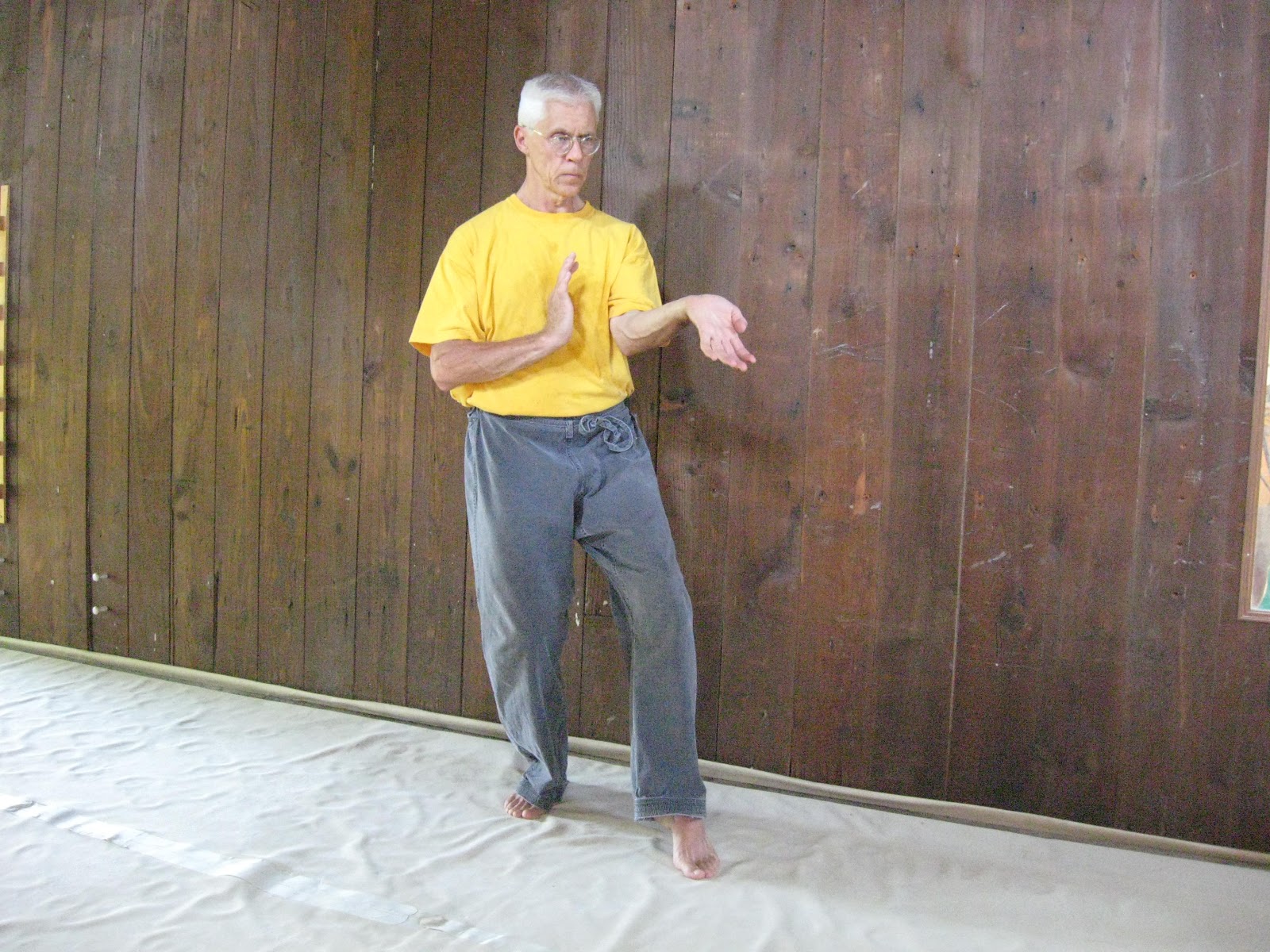
Goju-ryu posture very similar to the
opening posture in one of the first two
Pinan kata. In the Shotokan Heian
version, the stance is much longer
and much less mobile.

I came across an interesting post the other day on an Internet forum. It was by a guy who was a bit disillusioned but still searching for meaning in his kata--kata that he had been practicing for more than twenty years, I think. He was asking all the right questions, it seems to me: what message was contained in the repetition of techniques in kata? Are there patterns or sequences of techniques, and if so what do they signify? Are there themes that certain kata focus on? The problem was that he practiced Shotokan karate--a style, it seems to me, that is so far removed from its Okinawan origins as to make it nearly impossible to determine the original intent (or original bunkai) of any of the movements that make up the kata.
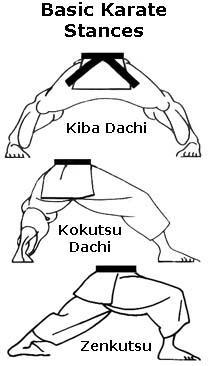
The stances of Shotokan
are generally wider and longer
than their Shorin antecedents.
After doing a little foraging on the Internet, I found that this searching into the meaning of Shotokan kata is not really new at all. Apparently certain Shotokan practitioners have been bucking the system for years--I'm only hinting at the chilling effects powerful international organizations may have on individual initiative and any questioning of the official line--practitioners like Bryce Fleming, Elmar Schmeisser, Bill Burgar, and John Vengel. Fleming even cites some of my own thoughts on kata analysis in a nicely written article titled "Bunkai: Returning Kata to the core of Karate," though I'm not sure he understood what I was trying to say in every case, which may very well be my own fault, as I'm not sure any of my ideas are applicable to any other art than Goju-ryu. But it is interesting to me that there is an attempt to place kata and the study of kata applications back in the forefront of popular karate study, and Shotokan may very well be the most popular karate style in the world. The problem is, how do you reconstruct the original intent (bunkai) of a kata after the kata has been changed? It's like trying to figure out what Shakespeare was saying in Macbeth after only watching the episode of The Simpsons that referenced it, or as someone once put it, reconstructing the original hits when all you have are the Weird Al Yankovic versions. Well, maybe not quite that bad, but still.

Of course, not all of the movements have been altered, but if one movement in a sequence is altered enough, it will alter how one may interpret the rest of the sequence. Correct me if I'm wrong, since I'm certainly no authority on Shorin-ryu, but if you change a neko-ashi-dachi (cat stance) to a kokutsu dachi (back stance), as Shotokan does with its Heian versions of the Pinan series, it seems to me that you will be hard pressed to "see" the kick (whether a kick with the knee or the foot) in the sequence. And once you change the cat stance to a back stance, the upper body and arms are also re-oriented in relation to the possible attacker, so they may further alter how one interprets the techniques. One could certainly argue, as many do, that there's no guarantee that even any school of Okinawan karate--Goju, Uechi, or Shorin--has preserved the original way that any particular kata was performed; they've all undergone change (though that's just an assumption in itself and with no more certitude really than to argue that nothing has changed). But that still doesn't mean that all changes are equal--that the bunkai you find in Shotokan is as valid as the bunkai you find in Shorin kata.
All of this, of course, begs the question: Are all versions of kata equally valid? Is the Shotokan version of a kata (and by implication the bunkai) as valid as the Shorin version of the same kata? Is the Isshinryu version of a kata as valid as the Goju version of the same kata? What about more minor differences we find in Meibukan or Shodokan or Jundokan or Shoreikan versions of the same kata? Is it all equally valid because you can, with varying degrees of effort and imaginative interpretation, manage to make a bunkai that fits the kata movements? It won't be the same bunkai necessarily, but so what?! You got a problem with that?

Well, yes. I actually think these are troubling questions, though I know they don't seem to bother the vast majority of karate practitioners out there. Explaining kata movement, or at least the debate over it, is as popular among Shotokan practitioners as it is among the practitioners of the various Okinawan styles apparently, at least after you tire of the tournaments and such. And it would seem that the majority of people who practice karate are pretty satisfied with what they're getting. Otherwise, I can only hope, there would be more people out there pointing fingers and declaring that "the emperor has no clothes," because it's fairly obvious that a lot of the bunkai out there is crap.  The problem is that even though you may have a bunkai to explain a technique that has been altered--as the example of the change in neko-ashi-dachi above--in altering the kata, you have not only altered the bunkai, but you more than likely have altered the themes the kata is exploring and probably the principles of the system as well.

And it can get even more problematic than that. Fleming, citing Harry Cook, writes that "Gusukuma, an original student of Ankoh Itosu," (one of the early Shorin masters) said that "Itosu didn't know all the applications and felt that some of the movements [of kata] were just for show" (Fleming). If Itosu didn't know the applications for all of the moves in the classical kata of Shorin-ryu, how did he go about creating the Pinan series of kata? If you don't know what all of the applications are then how do you know which techniques to use in the Pinan series and which to leave out? Are you taking isolated techniques out, techniques that are actually part of sequences? What themes and principles are you going to use as the basis of these new kata if you're not sure of the applications in the first place? If the embusen (pattern) of the original kata don't carry any message that might demonstrate tai sabaki (off-line movement) because the applications are not fully understood, for instance, what message, if
any, will students be able to extract from the "H" or "I" pattern of the Pinan kata? And when you don't understand something, the very human tendency to change it to something you do understand--or create something you do understand--often steps in and takes over. Not to throw all of Shorin-ryu out with the bath water, but the Pinan series forms a large part of the curriculum in Shorin as well as Shotokan schools, so if you are learning to decipher kata through an analysis of the Pinan kata, you see the problem.

I read stuff over and over again from Shotokan practitioners who say that kata has no purpose other than as a performance art, that it's pointless to even look for meaning in kata. And no wonder, given its history. Certainly it's worth trying to find meaning in kata, but if you're practicing an art that is so far removed from its origins, it's going to be a hard slog at best. If you ask me, which of course you didn't, and me being from New England, I'd have to say, "Ya can't get they-ahh from hee-yahhh."


Wednesday, January 23, 2013

You call that a cat stance?!

I've got two cats. One of them is a frisky orange cat that looks as though she has a bit of Maine coon cat in her. She's a pretty good mouser and she's always curious and getting into things. Sometimes this gets her into quite a bit of trouble. The other is an old tiger cat. He used to jump up on my shoulder if I happened to walk by and was in reach. Now I think he'd just prefer to sleep all day.  And the funny thing is that I've never seen either one of them assume a "cat stance."

Now I know that these are just figurative descriptions, but when I come across people getting downright poetic about describing techniques I wonder whether this tendency to describe movements and techniques confuses more than it elucidates. I came across one guy on the Internet saying that just "as the name suggest [sic], the animal form is the cat and the practitioner should keep in mind the nature of the cat when using this stance." What is the "nature of the cat"?

Another person on the Internet says that the cat stance is "designed for pivoting, night walking, returning to the rear, blocking and weapons fighting." Why would you assume a cat stance before pivoting? Just pivot. Try walking at night or in the dark and see if you use a cat stance. Certainly when you are stepping back you shift the weight, but is it a cat stance? And a stance for blocking? Or weapons fighting?

Cat stance at end of Seiunchin.

I think there are two things going on here. In one sense, when you give a name to techniques--the more picturesque the better--the techniques are easier to remember, but it also provides a short cut for training; that is, you can just refer to the name of the technique you want people to practice. It's a lot easier to say, "Go practice 'single whip'," than it is to tell someone to practice the ninth technique in the form.  But does calling a technique "embrace tiger and return to the mountain" really shed light on the technique? Do you really "repulse a monkey" that way? And what would it mean to tell someone to keep in mind the nature of the mountain? Needlessly cryptic, it seems to me, and no more useful than telling someone they should keep in mind the nature of the cat.

The temptation to translate cryptic or figurative language literally is understandable. We are looking for meaning where meaning is not clear. And so when we see pivoting from a cat stance in Seipai kata, we say cat stance is "designed for pivoting." When we see a step back into cat stance in Seiunchin kata, for example, we say that the cat stance is for "returning to the rear." When we see a cat stance accompanied by a block in Kururunfa kata, we say that the cat stance is "designed for...blocking."

Cat stance in Kururunfa kata.
But what's missing is a more complete understanding of kata and bunkai (the analysis of kata). As someone perhaps with a little more experience or understanding on the Internet wrote: "...stances are actually more about shifting position and body weight. In other words they are not static positions that we assume...." When we name and codify techniques--and this is certainly true of stances as well--we make it easier to teach but we may also be leaving things open to all manner of misinterpretations. Stepping back into "cat stance" at the end of Seiunchin is not so much an assuming of a particular stance as it is shifting the weight onto the rear leg and off of the front leg in order to attack the head (which the defender--using yama uke or mountain block--has in both hands) by raising the knee sharply into the opponent's face. Blocking in cat stance at the beginning of Kururunfa kata is not so much an assuming of a particular stance as it is stepping off line and shifting the weight in order to kick. We block the opponent's punch and kick to the opponent's knee. The diagonal sequences near the beginning of Kururunfa show good examples of high-low attacks. And we don't assume the cat stance and then kick--this is too slow. As soon as we can shift the weight, we kick. The whole point of shifting the weight is to kick--whether with the knee or the foot--not to assume a cat stance.

I can remember hearing criticism about different schools. People would say, "Oh, their cat stances are too low." Or, "Their cat stances are too high." Or, "In that style they turn their knees in a little in cat stance in order to protect the groin." But all of this makes sense only if you sit in the cat stance as if it were a kamae posture waiting for an attack. But it's not. Most stances in Goju-ryu are transitional and used in attacking the opponent in various ways. Of course, if you want to merely assume a stance there's always basic stance.