Entrance to the Barn Dojo....
Showing posts with label seiunchin. Show all posts

Thursday, June 07, 2018

The hemlock trees are dying

It was wet in the woods the other day. Actually, I think this was two or three weeks ago now--it's been quite busy lately and I lose track of the time. Spring had arrived and everything was alive. Even the spiders were out. I could hear the stream that runs down the hill to the reservoir. In places where the evergreens were thickest, the forest didn't look all that different in the spring as it did in the midst of winter. But the maples and the oaks and the birches and hickories were starting to leaf out and it was easier to see which trees had died over the winter, opening up patches in the canopy. On the ground beneath them, you could see seedlings ready to take over. On the part of the trail where it's widest and there seems to be the most sunlight, small hemlock saplings, no more than a foot or two high, had sprung up along each side of the path. Further up the trail, the giant hemlocks stood, many of them over a hundred feet tall by the look of them, and stately--they seemed to have no need for spreading branches to establish their places like the spruce trees or the balsam pines.

In the first technique of Seiunchin,
both arms are initially brought up
to the outside of the attacker's arm.
But the older hemlock trees are dying. I could count dozens of them along the trail and more off in the woods, the bark stripped off in places, left like red mulch around the base of the tree. They've been hit by the wooly adelgid. It's an invasive species for which the hemlock has no natural resistance. The wooly adelgid brings the borer beetle, which feeds on it, and then, after the borer beetles have burrowed beneath the bark of the tree, the woodpeckers attack, stripping the bark to get at the beetles. Fungus begins to grow around the roots of the diseased tree, and before long, the tree falls. The cold New England temperatures kept the pest at bay for years, but now they're heading north as the winters warm, and the hemlock may go the way of the American chestnut. It shows, I think, it's all tied together; a chain of events that seems to connect things in a way that's difficult to see at the start--one thing leading to another or, if not so singularly predictable, a step in one direction changing the expected outcome while opening up any number of different possibilities, like a small alteration in the environment opening an existential niche that may not have been there before. 

The initial counter from the first
sequence of Kururunfa.
For some reason, all of this made me think of how we string the various techniques of a kata together. But I wasn’t thinking about the sequences of techniques in the standard way in which it is shown in kata—beginning with the receiving (uke) technique, then progressing with the controlling or bridging technique, and finishing with a throw or an attack to the neck or head--as much as I was thinking about how an understanding of the structure and themes of a kata allows one to move between the techniques of different kata within the system. Because the Goju-ryu classical kata are composed of sequences—with entry techniques and bridging techniques and finishing techniques—it’s fairly easy to begin with a technique from one kata and then, depending on how the attacker is moving or responding to your initial receiving technique, move into a bridging technique from another kata and, again, tack on a finishing technique from yet another kata. Understanding the themes or principles of the various classical subjects also helps facilitate this sort of flexibility, especially when each kata seems to be exploring a different theme or response to a different sort of attack--that is, the receiving techniques seem to show the most variation. How one bridges the distance in order to control the opponent may also show a certain amount of variation but the idea here is basically to maintain contact after the initial receiving technique and, without putting oneself in further danger, moving to the opponent’s head or neck to finish the encounter. 
Continuing with the first technique
from Seipai (on the non-kata side).

For example, in the opening move of Seiunchin kata—and in fact in many of the other techniques of this kata—both arms are brought to the outside of the opponent’s attacking arm, whether we see this attack as a wrist grab or a punch or a grab of one’s clothing. If one were to continue the sequence, the defender’s left hand would rotate in order to grab the attacker’s left wrist as the right forearm was brought down on the attacker’s elbow. This is the position in kata that looks like two down blocks in shiko dachi (horse stance) done at a 45 degree angle.

However, if one is thinking about variations, it is easy to see how the defender might move from this initial position in Seiunchin kata to the first attack in Kururunfa kata. The defender need only maintain contact with his right arm on the attacker’s left arm, releasing the left grab, and bring the left forearm up into the neck of the attacker. This is then followed by a left knee kick. 
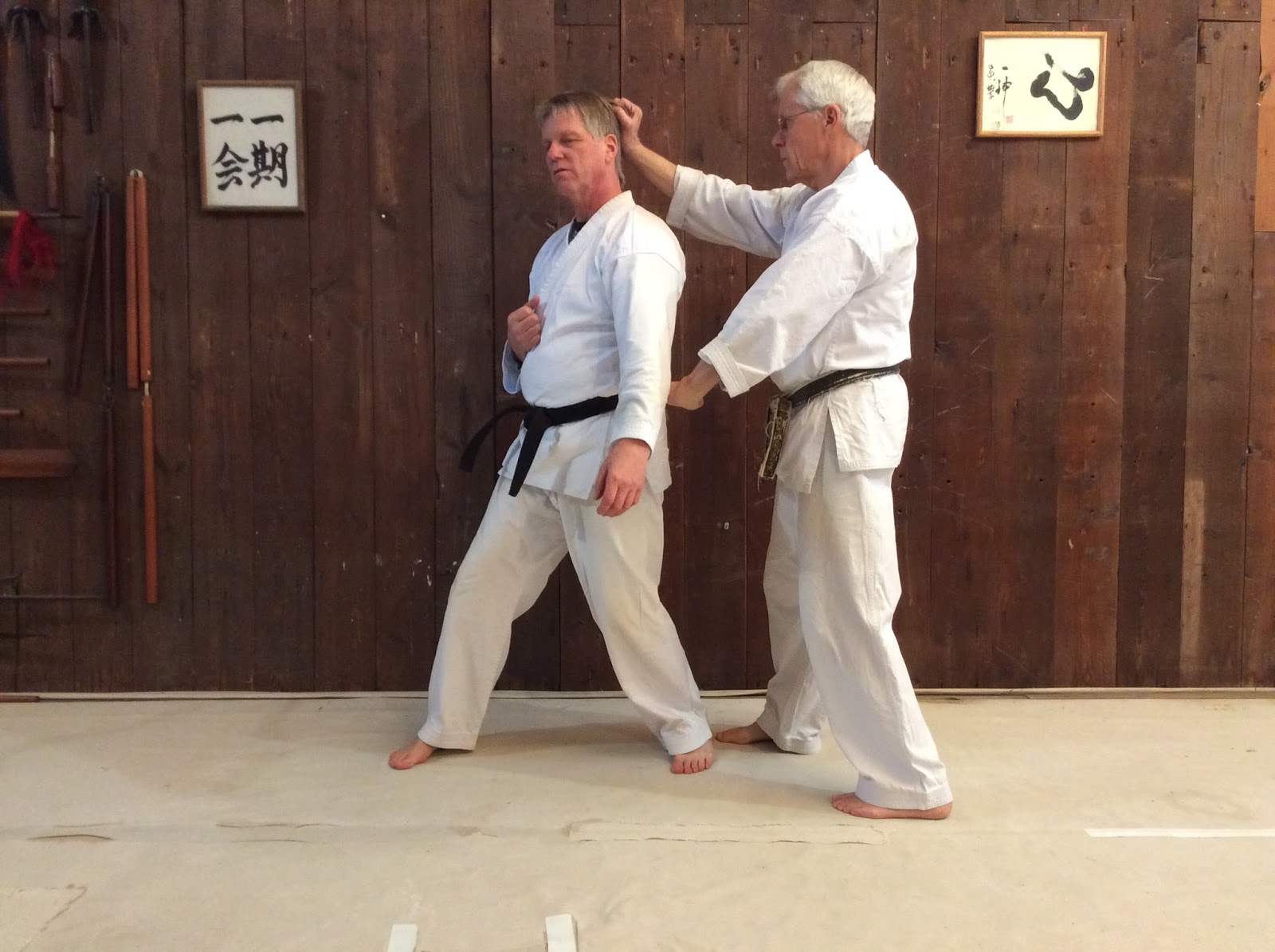
Continuing with this technique from
Seisan kata by dropping the left arm
and stepping in behind the opponent.

But if these counter attacks are somehow thwarted, the defender can then tack on the first technique in Seipai kata (though it would be from the non-kata side), with the left forearm brought up alongside the neck, since the initial straight arm technique begins from this position with the elbow or forearm attacking the opponent’s face or neck. 

Or, by dropping the left forearm down along the back of the opponent’s left arm and moving to the back, the defender could continue with the bridging and finishing techniques from the first sequence of Seisan kata. 


Continuing with the pull down
technique from Saifa kata.

[Me with Bill Diggle from photos
we did for the book, The Kata and
Bunkai of Goju-Ryu
.]


Or, once to the back of the opponent, the defender could grab both shoulders, as we see in Saifa kata, and pull the attacker down onto the knee and attack with the hammer fist strike. 

I think it is important to see the connections, but we can only really be comfortable with these kinds of connections when we understand the sequences of a kata and see the themes or principles contained within them. Once we are able to do that, the attack becomes relentless, sort of like the attack of the wooly adelgid on these stately Hemlock trees, I think. 

Hemlock tree after it has
been attacked by the
wooly adelgid, borer
beetles, and woodpeckers.


Wednesday, February 28, 2018

Patterns or structure of kata

Snow showers. I'm not even sure what that means, but they left a light, powdery coating of snow on everything. A dusting, they call it. The trail cuts a white, meandering path through the woods, and even the rocks along the path catch the snow in places, like white shadows clinging to small indentations, protected for the moment from the winter sun or gusts of wind. It almost looks as though no one has passed this way, no footprints to mark the trail and scuff up bits of leaves and gravel. I might be the only one who has passed this way, at least today, because, of course, it's a trail. Someone made it, carved it out of the forest, cut saplings and cleared brush.

I'm thinking metaphorically again, walking along the trail, mentally practicing kata, thinking about bunkai and imagining the other side, the side that's so hard to picture; the attacking side. This sort of metaphorical thinking reminds me of that book by Murakami, What I Talk About When I Talk About Running. Or that line from Il Postino where Mario asks Neruda, "You mean then that...the whole world is the metaphor for something else?" And with a abashed look, Mario says, "I'm talking crap." And Neruda says, "No, not at all."

Someone made kata, these patterns of movement that we use to remember techniques of self defense, that we use to learn the martial principles of movement. But the patterns are confusing and seemingly as haphazardly composed as a meandering trail heading off into the woods. No two trails exactly the same. No two kata alike in structure, conforming to the same rules one might use to decipher their patterns. And yet someone passed this way before, left marks, however faint, that would point the way, like trail markers, and explain how we might go about figuring out these seemingly arcane and esoteric movements.

Are they arcane and esoteric? Certainly they are, to us, a bit anachronistic, in a way, a part of a cultural milieu and time period when one might have needed to defend one's life, fighting to the death with lethal techniques, as anachronistic as many of the techniques that seem to depend on one grabbing the topknot or queue of one's attacker. But esoteric? The effectiveness of most techniques, arguably, is based largely on their simplicity, not their complexity or the difficulty one might have in learning them. The difficulty lies mainly in trying to explain movements and techniques that we can only half see. With kata, we only see the defender's response to an attack. We can only imagine the other side, and this often influences how we interpret the techniques of kata.

And whoever created these kata, certainly did not make it easy. If a single person put the techniques of these kata together--I'm thinking of the classical subjects of Goju-ryu from Saifa to Suparinpei--then I would expect the patterns to be as uniform and predictable as the set of Pinan kata or the Gekisai kata of the 20th century. But they're not. Seipai kata, for example, is largely asymmetrical--with at least the first three sequences not showing any repetition--using the left hand to "block" and the right hand for the initial attack (which is also true of the fourth sequence, though that sequence is repeated on the other side). Each of the first four sequences--there are seemingly five total sequences, though the fifth sequence shows a variation, in part, on the other side--is shown in its entirety; that is, with an initial receiving, a controlling or bridging technique, and a finishing technique. This is not the same pattern we see in Seiunchin, for example, which, aside from its set of three opening techniques in shiko dachi, repeats most of its techniques on both the right and left sides--that is, in response to a right or left attack--whereas Seipai only repeats the fourth sequence. But even in Seiunchin we have a pattern that is "interrupted," where some of the sequences, unlike most of the sequences of Seipai, only show the final techniques tacked onto the second or final repetition. This is true of the opening sequence of moves, the high-low techniques in shiko dachi, and the "elbow" techniques--that is, the first sequence, the third sequence, and the final sequence.
Core receiving technique
from Sanseiru when used
with the stepping turn.

Sanseiru kata, on the other hand, shows significant repetition in its middle section, repeating this "core" movement--chest "block," kick, "elbow," "punch," kick series--three times, and using an opening sequence that is merely a variation of similar techniques. And Seisan is entirely different again, showing three variations of what is essentially the same bunkai in the three sequences that follow the opening series of repetitive basic techniques--the three punches, three circular blocks, and three palm-up/palm-down techniques with knee kicks followed by a grab and kick.

There are so many structural variations, in fact, in just these four kata that it certainly seems to suggest different origins or sources, and it certainly adds to the difficulty one has in trying to understand the original bunkai of the different kata. And yet, different kata structures do not change
The bridging technique
of the final sequence
in Sanseiru.
the basic martial principles involved, and these principles are retained regardless of which kata one is looking at or which structure has been used to string together the techniques of the kata. In fact, one of the more interesting aspects of this structural awareness, "seeing the pattern" if you will, is perhaps a sort of radical realization that at least some aspects of the structure of any given kata are completely arbitrary.

This may seem heretical or at the very least blasphemous, but it's merely another way of seeing the sequences of a kata, another way of practicing kata bunkai. For example: If we take the first sequence of Seiunchin kata described above, we see that the first two opening shiko dachi techniques are incomplete, with the finishing technique only attached to the third repetition--this is the push forward with the "supported punch" and elbow attack. If we attach the finishing technique to the first of these steps into shiko dachi (same as the third) and/or the second of these (on the opposite side), we are not really altering the intent of the kata. We're merely illustrating it in another way, completing the sequences that are only shown in part. We could do the same thing with the core double arm receiving techniques of Sanseiru, attaching them to the open hand bridging techniques we find towards the end of the kata.

Certainly what we find is that the flow of kata that we have become accustomed to is interrupted, but the real intent of kata is to act as a repository for self-defense techniques, not to be practiced as a performance piece. In fact, the less we see kata as a performance piece for winning trophies at tournaments, the more we may begin to understand its patterns, its structure, and thereby its bunkai.

[For a more detailed discussion of these techniques see my book, The Kata and Bunkai of Goju-Ryu, here.]

Thursday, February 15, 2018

Just because it's a convention doesn't mean it's right!

[I wrote this last month, but I somewhat arbitrarily forgot to post it. But then again, what difference does a day make, or a week, or a month for that matter?]


Welcome to a new year--January 1st--and yet off in the woods the new year looks pretty much like the old one did a few days ago. The blue jays are scolding me as I trudge by on the trail and the squirrels pause to look up and jump behind a tree, waiting to see whether I'm a threat. I've read that squirrels are very territorial, so I suppose these are the same squirrels that were scurrying around last
First technique of Saifa kata.
week, digging up acorns that they had buried last fall. I wonder whether squirrels are really as busy as they seem to be or whether they might be a bit like office workers rearranging the papers on their desks into neater piles, just looking busy in case the boss comes by or the wives ask where they've been all day.

But the days are already getting longer, past the winter solstice. We've turned another page on the calendar. And yet all of this business of time and calendars is a human construct, isn't it? A mass delusion, or if not a delusion at least something that we all culturally have come to agree on; that is, there's little rhyme or reason to any of it, it's just accepted. I mean, we've had lunar calendars and solar calendars and some combination of the two. Not even the seven-day week is
First technique of Seiunchin kata.
anything but arbitrary, something we have just come to agree on. In fact, for a good deal of human history we haven't even agreed upon a 24-hour day. Daniel Boorstin's book, The Discoverers, has an interesting section on all of this. Way back in 1582, they took 10 days out to correct the old Julian calendar that was off by 11 minutes and 14 seconds each year, so really I'm not even sure of the date. And in America, we didn't even accept this restructuring until Colonial times.

Anyway, all of this got me thinking about what we accept as a society, what we take for granted as we carry on with our daily lives. Actually I was thinking about all of this because I had been reading Kazuo Ishiguro's book, The Buried Giant. He describes a medieval England where strangers are  feared and the forests are filled with ogres, and mists shroud the land and bring an eerie forgetfulness. And it's all accepted as perfectly natural.
Initial technique of the first
sequence of Sanseiru kata.

It made me wonder about all of the things we accept in karate without question, all supported and bolstered by the bulwark of convention or lineage or rank. Of course,  we practice all sorts of harmless conventions in the martial arts, from the karate gi to the formalities of seiza and bowing to the shrine and pictures of those teachers who have preceded us to the use of Japanese terminology and the practice of kata. But we also practice what I can only call conventional interpretations of kata technique. And these conventional interpretations (bunkai) get passed on with very little questioning of their practicality, as if we are hesitant to question anything that most everyone else seems to be doing.

First technique of Seipai kata.
And these problematic inter-pretations are everywhere in Goju-ryu. For example: The opening technique of Saifa does
not use both of the defender's hands to pull away from an attacker's wrist grab. Why disconnect from the attacker? The opening technique of Seiunchin kata does not use both hands to release the opponent's choke hold. Why would you step towards someone who was choking you? The opening technique of Sanseiru (after the three slow punches, that is) is not used in order to block an opponent's kick and then grab the kicking foot and muscle the attacker to the ground. Why would you lean forward with your head undefended as an attacker was coming at you and then even attempt to grab a kick? The opening technique of Seipai is not a nukite to the opponent's chest--it's not a nukite at all--nor an elaborate wrist release. Why would you even think of attacking a hard target with the finger tips? And why would you take the time to weave your hands in and out of the arms of an opponent grabbing you with both hands using the techniques that follow it, as the conventional interpretation shows? There is no response to a full-nelson in Kururunfa. Try it sometime against an uncooperative opponent who's bigger and stronger.
Convention suggests that this
technique from Kururunfa is
a release from a full-nelson.

And yet these are all conventional interpretations of kata techniques. The problem is they don't make a whole lot of sense for a variety of reasons: they are too slow or they leave the defender open to attack or they don't really follow kata or they are easily thwarted by the opponent, etc. Their only reason for being is that they are the conventional interpretations, and conventions are rarely questioned.
This is not to suggest that all conventions are useless or without merit. Clocks and calendars are very useful even if they are a somewhat arbitrary means of marking time. But conventional wisdom once suggested that the earth was flat, that there was witchcraft at work in Salem, that you'd catch your death if you walked around with wet feet.

Most of the conventional interpretations of kata, I think, are, at the very least, useful in pointing out some of the pitfalls one may encounter with interpretations of kata, as ironic as that may be. And by example, they can steer us off into better directions, bushwhacking through the woods in search of a better trail.

[For a more detailed discussion of these techniques see my book, The Kata and Bunkai of Goju-Ryu, here.]


Thursday, December 28, 2017

Seiunchin once again

Off in the woods the other day, admiring the mushrooms and toadstools that seemed to have sprung up overnight, and generally marveling at the magical quality of the woods after a rainstorm, I found myself thinking about a news story I had heard on the radio a few days earlier. The story summarized an article published in Nature about the supernova known as iPTF14hls. (Now there's a catchy name!) It's 500 million light-years away--astounding to me but that's not what the astronomers found so interesting. What was unusual, apparently, was that they expected it to act like any other supernova and gradually dim until it would fade from view--something that takes around 100 days for your average supernova. This one has exploded multiple times since 1954 and this current "explosion," if I understand it correctly, has lasted three years. What I thought was interesting, however, was that the scientists said that it defied their understanding of how stars die--that current theories couldn't fully explain what was happening. In other words, they'd have to go back to the drawing board. And that's why they sounded so excited!

Gedan finishing technique for
the four angle sequences.
I wonder how many people get that excited when they get it wrong? And why? Does it take a certain thirst for discovery or is it a simpler pleasure, a sort of pleasure in the realization that one doesn't have all the answers, that there are new frontiers, new things to learn? Or perhaps it's the moment we realize that the structure or the rules or what have you are more complex and intriguing than we first imagined.

I was thinking about all of this while I was practicing Seiunchin. I like the movements of Seiunchin, but I thought that at least this kata was one that I felt fairly secure about, that I knew the bunkai. There are, after all, only five sequences in the kata (not counting repetitions).  And it's fairly clear, I think, that the counterattacks (or receiving techniques, if you will) are all against either cross-hand grabs or two-handed pushes. Of course, if you don't see the sequences, then even this part won't make sense. But that's a whole other issue.
The beginning of the second
of the north-south sequences.

Anyway, I realized that I may have failed, after all these years, to notice something about the structure of the kata. If you understand the structure of a kata, it can explain a lot about the techniques themselves. The problem is that at least in some cases there may be a fair amount of guesswork, though just as in any scientific inquiry there are some things that indicate at the very least whether you're on the right track or not.

But what I noticed was that the sequences on the angles--since this part of the kata is constructed in an "X" pattern, the angle sequences move to the northeast, the northwest, the southwest, and the southeast, in that order--all end with a downward forearm strike to the back of the opponent's neck. (This is the technique that is sometimes referred to as a gedan barai or gedan uke.) There are four of these angles but only two different sequences since each is repeated on both the right and left sides. What is of interest here is that the downward forearm strike to the back of the neck is a finishing technique, just as it is in Seipai kata.
The beginning of the third
of the north-south sequences.

The other three sequences of the kata all occur on the north-south axis. The first of these, of course, is the opening sequence, which is partially repeated three times, with the "finishing" technique tacked onto the third repetition--the left hand wrapped around the opponent's chin and the vertical right elbow attack coming up into the back of the opponent's neck. (I've written about this in an article in the Journal of Asian Martial Arts, 2005, vol. 14, no. 2.)

The second of the north-south sequences is the high-low technique done in shiko dachi and shown on both the right and left sides. The second of these, with the right arm up and the left arm down, shows a right hand grab of the opponent's right arm and a left, low nukite attack to the opponent's ribs. This technique seems to finish with a right forearm attack and downward elbow (and one should emphasize seems).

The technique that ends the
second north-south sequence
but seems less than satisfying
as a finish technique.
The third and last of these north-south sequences is often described as two elbow attacks. (I've tried to explain this misunderstanding in my new book, The Kata and Bunkai of Goju-Ryu, due out in February 2018.) The finishing technique for this sequence is the knee attack to the head, the last technique of the kata, often described as a yama uke in cat stance (neko ashi dachi).

But structure is everything. The structure or pattern of a kata is often the key to understanding the techniques--in this case, the sequences of the kata. I had always felt that the "finishing" techniques in the first two
north-south sequences, while good, seemed less conclusive, less lethal, than many of the finishing techniques in the other classical kata or even in the third of these sequences, and this was what I was thinking a few weeks ago while I practiced Seiunchin. And then I realized that the two patterns of the kata--the "X" pattern of the angle sequences and the north-south line of the other three sequences--might show two different finishing techniques, but only two. The first one is the use of the downward forearm strike. The second is the knee kick to the head in cat stance. The supposition is that the "yama uke" and knee kick in cat stance--the last technique of the kata--is the finishing technique for all three of the north-south sequences, only it's just shown once, tacked onto the third sequence. This structure--of showing the finishing technique tacked onto the final repetition--is typical of the classical kata. It also makes the end of each sequence more lethal, finishing the sequence with a more decisive blow, if you will. And it fits. That is, it's easy to move into this final technique from the end of either of the first two north-south sequences.
The technique that may, in fact,
be the finish technique for each
of the north-south sequences.

I found this realization, though admittedly only an educated guess on my part, to be exciting, even if I had been wrong in how I had been thinking about Seiunchin all these years. Live and learn. I still don't know, however, whether it was the discovery that I found interesting or the realization that the structure of the kata was more complex than I originally thought, that whoever created this kata had been so clever at hiding something and yet keeping it right out there in plain view at the same time. It was all so fascinating. And, of course, it also reminds me that there is always so much more to learn.


Tuesday, December 12, 2017

It's a system, like the trees in the forest

The forest was wet today. Droplets of water collected in the leaves here and there, and the moss looked a bit brighter green after the rain we had overnight. But the temperature is dropping gradually, the days are getting shorter, and most of the trees are bare. It's hard to tell which trees are dead this time of year. The only thing that seems to be thriving is the lichen and small colonies of mushrooms clinging to the old tree trunks that lay rotting by the side of the trail. 


Saifa kata
Seipai kata
When I'm out in the woods these days, I don't usually think of the forest as an eco-system, though I know it is. I know that when the larger trees fall, after a strong rain or a heavy storm with high winds, they leave a hole in the canopy overhead and the wild grasses, the ground cover, and the acorns lying buried beneath the leaves, some waiting patiently for years, will start to grow in the spring, reaching for the sunlight that's finally been able to make its way through the leaves of the taller trees. 


Suparinpei kata
Seiunchin kata
No, when I'm out walking in the woods these days, I'm just looking for the seemingly random beauty you can find when you go out "forest bathing." Nothing seems so systematic. Everything seems chaotic and haphazard. But, of course, it is a system, just like any martial art, despite what some may imply when they suggest that a style like Goju ryu, for example, is a random collection of kata that come from different sources andwere created by different people at different periods in the past.


Kururunfa kata
Seipai kata
While this may be true (and probably is given that the structure of the Goju classical subjects varies considerably), it does not change the fact that it's a system. The different kata show variations as if they were jazz compositions, as if different composers were given the same melody and told to improvise. One need only compare techniques from different kata to see the variations, to appreciate how different techniques explore similar themes. Certainly there are differences--any given self-defense scenario may vary depending on one's position in relationship to the attacker or, for that matter, what the initial attack is--but the apparent similarity of some techniques and the fact that they are used in a very similar manner (the application or bunkai) underscores the notion that they are all part of the same system, regardless of whether or not the different classical subjects may have had different origins.

Sanseiru kata
Shisochin kata
The key here, of course, is to understand (or "see") the applications. You can't rely solely on the appearance of the techniques. This is admittedly a challenge. We have to first let go of our expectations, which may include not only what the technique appears to be, but also
what we may have been told--in other words, the conventional interpretation of the techniques in question. The problem may be compounded by texts and pictures that seem to record "end" positions; that is, it's difficult to convey in pictures or words what happens in-between the pictures one generally sees in karate manuals or texts which discuss kata, and it's often in the space between one move and the next that we see how a given technique is applied.

Saifa kata
Seipai kata
And you need the whole system. You need all eight classical kata in order to address different scenarios on the one hand and, on the other, to be able to see how to move from one technique in one kata to a similar technique in another kata if the dynamics of the situation change--and they are likely to change. That is, you need to see the similarities and variations in order to alter your counterattack. You may begin with the opening or receiving technique from Saifa (as pictured above), but you have to be able to change to the controlling or bridging technique from Seipai, for example (the bridging technique from Seipai being the technique which follows the Seipai opening technique pictured above). In other words, once you "see" the similarities and variations, you should be able to move back and forth between the techniques of each sequence of moves. This is the way a system works. Of course, you have to also be aware of the sequences. And if you can see the sequences, then you realize that the techniques within a sequence function in specific ways--that is, they can't just mean whatever you want them to mean.

Some have suggested that any single kata is a complete system of self-defense in itself. This is a rather silly notion, as is the idea that any given technique has multiple interpretations or applications. Either one of these notions gets in the way of "seeing" the whole system and being able to comfortably work within the system. Both of these views are short-sighted. Metaphorically, they're like being lost in the woods, failing to see the forest for the trees.


Sunday, November 26, 2017

Things aren't always what they seem

The other day I decided to take a break and head out for a hike up Mt. Tom. I had spent most of the week ripping up the old mat in the dojo and laying down a new wood floor. The canvas cover I  scrounged from an Aikido school years ago was old when I got it, but we needed something to cover the old wrestling mat that looked more like a patchwork quilt made of duct tape than anything else. Patching up the canvas cover had taken a few more rolls of duct tape the past few years, so it just seemed like the time to move back to a wood floor. I had gotten to the point where we had finished cutting and laying down the wood floor, so it seemed like a good time to take a break.

The woods were damp from the recent rains and the first yellow leaves were beginning to fall. A few trees had come down in the last storm, their roots not deep enough as they stretched out over the outcropping of rocks along the path. I was coming down the mountain on a path that wound its way around a small, rocky crag when I noticed a dog coming up the other way. He paused for a moment just in front of me, sniffing the ground, and as I stopped to pet him I looked ahead to see his owner leap wildly to the side of the path, jumping from one foot to the other, waving his arms frantically as if he were trying to escape a giant spider's web. After a moment he stopped and continued up the mountain. When he looked up, he must have noticed the quizzical look on my face. "Snake," he said. "I hate snakes." And then we both continued on the trail; he going up and me going down, but both of us, I'm sure, on the look out for more snakes hiding on the bare rock, hard to pick out amongst the meandering tree roots.

It reminded me of that sketch on Saturday Night Live with Bill Murray and Steve Martin. They stare
Opening technique of Seiunchin.
straight into the camera and just keep repeating, "What the hell is that!?" Maybe we just don't expect things or maybe things just aren't always what they seem to be. Kata is a lot like that. We see a move in kata and assume that it's one thing because it looks like that's what it ought to be. We think, well, it looks like a down block, so it must be a down block. It looks like a double punch so it must be a double punch.

What we're often missing, I think, is the Tristram Shandy effect, for lack of a better term. Tristram, the title character in The Life and Opinions of Tristram Shandy, an 18th century novel by Laurence Sterne, attributes all of his troubles to what happened the moment he was conceived. Just at the crucial point, his mother interrupts his father to ask if he has remembered to wind the hall clock. If I'm remembering it correctly--it's been many years since I last encountered it--the rest of the 500 or so pages of the story and it's hilarious sequence of events can all be attributed to this critical moment, this momentus interruptus, if you will.
Palm up technique from Seiunchin.

Fiction, certainly, but there are connections that are important. Kata is composed of sequences that constitute self defense scenarios. And each sequence is composed of entry techniques (uke), bridging techniques, and finishing techniques. Too often teachers and students trying to find bunkai ignore the sequences, as if the techniques are disconnected and unrelated. I think this is why we don't see the right applications sometimes, why we judge things strictly on appearance rather than a technique's function within a given self defense sequence.

Beginning of the end mawashi
from Saifa.
For example: we might look at the opening technique of Seiunchin and imagine that it must be a release from a two-handed grab or choke hold because both hands look the same--if they look the same, they must be doing the same thing. And the folks that interpret the opening of Seiunchin this way, imagine that the next technique--when the right palm is raised up and the left hand is brought up into chamber--is meant to block and grab the opponent's next punch. This is the disconnect between these two techniques of the sequence. Somehow the opponent must have pulled away from the previous technique in order to punch. But this interpretation works only in contradiction of the age-old martial principle of ikken hissatsu (one punch kill) or is it ippon kumite (one point fighting)? Perhaps it's all the same concept; that is, one should move in such a way as to allow your opponent only the one, initial attack--the one punch being your opponent's, not yours. (They get the initial attack, of course, because "there's no first attack in karate.") Or we might look at the opening technique of Sanseiru (after the three "punches") and imagine that it must be blocking and grabbing a kick because we're reaching down, knee level. Or we look at the end mawashi technique of Saifa and imagine that it's a ridge-hand strike, as many would say, simply because we don't see how it's connected to the previous sequence of moves.
At Mt. Tom looking across
the reservoir. 

It always makes me think of that old admonition about missing the forest for the trees. I suppose it's natural but it's also good to remember that things aren't always what they seem. (And no, it's not common knowledge, nor is it how everyone else looks at kata, no matter how much lip service we pay the old aphorisms we here in the dojo.)


Wednesday, June 14, 2017

Well, that's about the size of it.

"Well, that's about the size of it," he said. I realized I hadn't been paying attention. I knew he was summing something up, but I didn't remember what he had been talking about. I was thinking about the conservation area where we found ourselves. I had stopped on the trail to watch a pileated woodpecker and he had been coming up from the other direction when he paused to see what had caught my attention.

The conservation area isn't very big--about 625 acres with over a hundred different bird species and five miles of trails--but it's enough to get away from the sounds of traffic and the general insanity of the world for an hour or two. But as we separated, I found myself thinking about the size of things. After all, the Fitzgerald Lake area is only a fraction of the size of the new Katahdin Woods and Waters National Monument that President Obama designated last year, all 87,500 acres, and that's supposedly only 1% of Maine's woodlands. I can't really even picture things that size. All you can say is, it's H-U-G-E.

But that got me to thinking about martial arts stuff and different systems of self defense. I once knew a guy who said he had studied Kempo (that's the only designation he gave it) for five years or so, and in that time he had learned 300,000 forms. Now, I'm thinking, there's no way in hell this is true, so I asked him to elaborate. His first "form" consisted of a head block and punch. His second "form" consisted of a chest block and punch. And so on and so on. Still, 300,000?!

One of the finishing techniques of
Shisochin kata.
I visited a Shito Ryu dojo once where they told me that their curriculum included over 50 kata. The funny thing was that when one of the black belts was asked to demonstrate a particular kata (Seipai), he demurred, saying he hadn't practiced it for quite a while and worried that he couldn't remember it.

And on the other end of the spectrum, we have Uechi with its three classical kata--Sanchin, Sanseiru, and Seisan.

So how big is Goju Ryu? There are eight classical kata--kata of ancient origin that show bunkai and embody the principles of the system--and, of course, Sanchin and Tensho (and a number of other modern training kata developed by various teachers in the 20th century). Each of the classical "bunkai" kata, for lack of a better term, explores a theme or themes of self defense and illustrates
Double-arm receiving technique
of Sanseiru kata.
them with anywhere from three to five scenarios, each sequence beginning with an uke or receiving technique and progressing to a finishing technique. Some of the themes are more obvious than others--like the double-arm receiving technique of Sanseiru paired with a couple of different controlling or bridging techniques and two or three different finishing techniques. Or the five techniques against cross-hand grabs and pushes we see in Seiunchin, though one might also look at the downward forearm strike as one of the themes of the kata since it is used in a number of the sequences.

So how big is Goju Ryu? It's hard to say. Seipai is fairly straightforward with five bunkai sequences, while Saifa has four, though one of the four is a close variation. Kururunfa also has four sequences. And Suparinpei, though it shows three complete bunkai sequences, is largely made up of the repetition of fundamental techniques, various entry and controlling techniques. How do you count fundamental or basic techniques?
One of the grab release techniques
of Seiunchin kata.

And then there's the question of structure. The sort of fragmented (or complex?) structure of some kata, like Shisochin or Sanseiru, makes them difficult to size up. Shisochin seems to show  four release techniques against a clinch or two-handed grab, with one bridging technique and two different finishes, one short and one significantly longer. But each of these sequences can be taken apart and put together in various ways. The structure itself seems to suggest variations. And really it's all about variations. Seisan kata has only three bunkai sequences but each is a variation of the same fundamental techniques--the same entry, bridging, and finishing techniques.

The really interesting aspect of this idea of themes and variations, however, is that once you see them you can not only change from one sequence to another within a given kata but also from one technique to another between different kata, moving from a receiving technique in one kata to a completely different controlling or finishing technique from another kata. So in that sense, Goju Ryu is fairly small, composed of only eight bunkai kata with a combined total of around 30 or so bunkai sequences, but almost infinitely large if you consider how the different sequences can be broken down and recombined, dependent on the dynamics of a changing situation and the exigencies of a given self defense scenario.

Too big? The fact that it is all based on themes and variations--as opposed to its being an encyclopedic collection of individual techniques--makes it manageable. Provided, that is, you can see the forest for the trees.


Tuesday, December 13, 2016

The Principle of Keeping the Elbows Down

Native American Trail Marker tree.
It was wet in the woods the other day. The rocks were slick on the trails and there were puddles here and there where the rain collected in small depressions lined with leaves. It began to rain again just as I started up the trail. Everything was uniformly grey and misty, making the trees stand out like etched outlines on paper. Most of the trees seem young along here, stretching up like telephone poles, with few if any branches at this level, but here and there you can still see an old gnarled pine or maybe a red maple with its limbs all twisted as if its fending off beasts or would-be loggers. I'm on the lookout for these old codgers. I'm hoping to find one of those old twisted Native American Trail Marker trees, the kind that looks sort of like someone's arm held up and bent at the elbow. Some say that they don't exist in New England--the tree itself has to be 200 or 300 years old--but others have already identified a few.

It's a curious thought. The process, they say, may take years. You find a likely sapling and then bend it over with a cord or rope, pointing in the direction of a water source or a natural stream crossing. Then, years later, after the tree has grown to accommodate this bent nature, you come back and release it from its shackles and allow it to straighten up. Only it doesn't straighten completely; it leaves a crook like an elbow in its trunk.

The arms in Sanchin posture.
Of course, that's the connection: the elbow. There's a passage in the Chinese classics that runs, "All the joints of the arms should be completely relaxed, with the shoulders sunk and elbows folded down" (Yang Ch'eng-fu, quoted in T'ai-Chi Touchstones, compiled and translated by D. Wile). We practice this in Goju-ryu, of course, with the arms held in Sanchin posture, but it's such an important concept in the martial arts that it should not just be looked at as a position one takes up in the execution of a particular kata; rather, it's a principle that one needs to absorb. Perhaps we should tie the limbs down to train this posture, to grow into it, as the Native Americans tied down the trunks of young saplings to create their trail markers. There are some who have creatively thought of hanging weights from the elbows while the student is doing Sanchin kata.

The other question for me, however, is whether we can fully appreciate these principles without understanding the bunkai--that is, you can do it in order to assume the correct appearance and form in kata, but can you really "grow into" this technique, can you really absorb the principle, if you don't see the necessity of moving this way by having to use it against another person, in other words, by doing the bunkai? Which means the bunkai you have "discovered" has to necessitate the use of this principle.

First movement in Seiunchin kata.
For example: Take the first movement in Seiunchin kata--stepping out on a northeast angle into a right-foot-forward horse stance (shiko dachi) with both hands brought up back to back and with the elbows down. If this technique is executed against a two-handed choke hold or lapel grab, as many interpret it, you won't see the necessity of keeping the elbows down. (I won't even bring up the question of why you would step forward against either one of these attacks!) But if you try this against a cross-hand grab--the attacker grabbing your left wrist with his left hand--then the necessity of keeping the elbow down should become apparent and the principle will be thereby reinforced.

First movement of second sequence
in Seiunchin kata.
Another example: Take the first movement of the second sequence in Seiunchin kata, the "assisted block." In this move, the defender is doing what looks like a closed-fist middle-level block with the right arm and the left hand is assisting by pushing on the side of the right wrist or fist. If this is really being used as an assisting block against a strong opponent, then there seems to be little reason to keep the right elbow down. However, if once again the attacker is using a cross-hand grab--the opponent grabbing your right wrist with his right hand--then the necessity of keeping the elbow down is apparent. You drop the elbow and rotate the hand and bring the left hand in to trap the opponent's fingers so that he can't let go. Then you push out towards his center. All of this works against his wrist, and if you understand the principle of keeping the elbow down, then you're not trying to out-muscle the opponent.

The turn-around technique
from Seisan kata.
But some might argue that these are select cases or that I'm trying to find techniques that fit my hypothesis. Then why not another "principle"? In the same Douglas Wile collection, this time from the Yang Family Manuscripts Collected by Li Ying-ang, we are told to "avoid the frontal and advance from the side, seizing changing conditions." If we don't understand the structure of kata, we may miss this one. If we assume that the turns and stepping in kata have no meaning--or no more meaning than that people training indoors ran out of room--then we won't think of using this principle when we analyze kata. If we imagine that the first turn around technique in Seisan kata is meant to be applied against an attack from the rear or that we simply turn to face the on-coming attack, then we will not learn this principle. However, if we imagine that the attacker is stepping in from the west with a left punch, then the bunkai would have us step off-line to intercept the attack at a 90-degree angle, the right arm blocking and the left open hand attacking. And if we practice this enough, we may even begin to learn the principle, to incorporate the idea into all of our movements, so that when we face an attacker (in ippon kumite practice, for instance) we will naturally step to the side into a 90-degree relationship to the incoming attack.

That's the Ri of Shu-Ha-Ri, or, in a metaphorical sense, that's the part about "growing into" the technique, in the same way that a Native American Trail Marker tree had to grow into these fantastic shapes, marking the paths and pointing in the right direction. I suppose they could have just put up signs, but it wouldn't have been quite the same, I think.


Wednesday, May 25, 2016

Kamae!

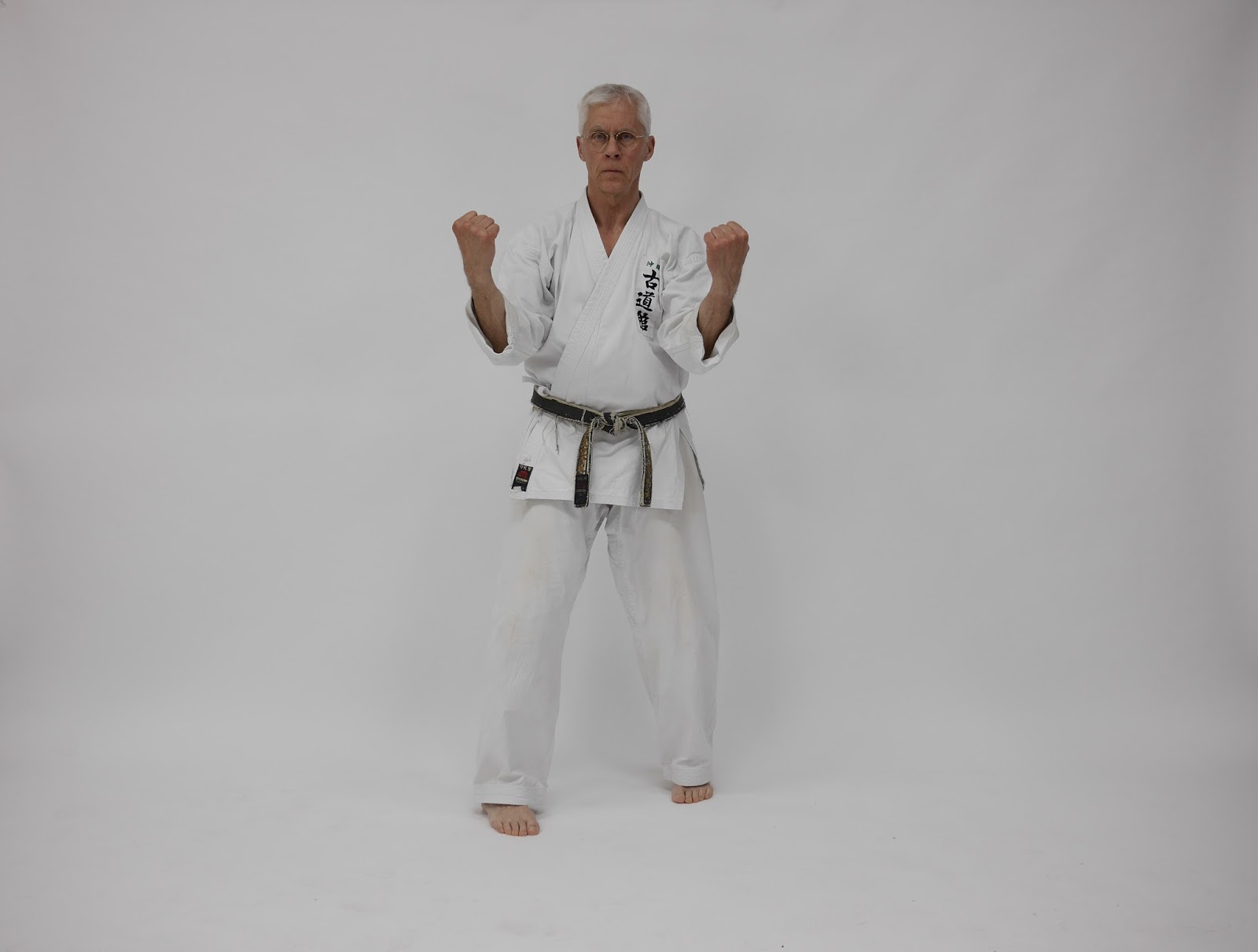
More typical fighting
posture readiness.
   The thought occurred to me the other day--I suppose I've been wrestling with this a long time--but I found myself thinking about training in the old days, when I used to wear a gi and everything was rather formal. We'd line up according to seniority and then kneel and sit in seiza. "Mokuso!" Of course, it was all very precise, sort of like the Japanese tea ceremony without the tea cups.
   "Mokuso yamae!"
   "Sensei ni, rei!" the senior student would bark out. And, after all the formal bows, the teacher would take over.
   "Kiyotsuke. Rei. Yoi," the teacher would say, pausing between commands as the students responded. And then...
   Then we began practicing kata. But here's where it gets interesting.
   "Kata Saifa. Yoi. Hajime (begin)." Next was Seiunchin. "Yoi. Hajime." And then Shisochin. "Yoi. Kamae. Hajime." You see, there's that extra word--kamae. We used kamae not in the general sense of "posture" or even as a command--"kamae-te"--but in the connotative sense of "ready to fight." We generally understood it as a ready position, but no one every asked why the other kata (Saifa, Seiunchin, Seipai, and Kururunfa) didn't begin with a kamae or ready position. Why don't they?
Kamae posture found
in a number of kata.
   In Goju-ryu, putting aside Sanchin and Tensho for obvious reasons, there are four kata that begin with this double-arm kamae posture and four kata that don't. Each of these four double-arm kamae postures begins with three basic techniques that are repeated. Each of the other four kata begins immediately with a bunkai sequence (sometimes in threes and sometimes not). Why the difference? If all of the kata are part of the same system (supposing for the moment that they are from the same system), wouldn't we expect that they would conform to the same structure or pattern? Well...unless there is a message in the pattern or structure.
   Saifa begins with a  self-defense scenario (bunkai) against a same-side wrist grab (opponent's left to defender's right). Seiunchin begins with a self-defense scenario (bunkai) against a cross-hand wrist grab (opponent's right to defender's left). Seipai begins with the opponent grabbing one's shoulder or lapel. Each of these kata shows defensive scenarios (bunkai sequences) against grabs or pushes, while Kururunfa, it seems to me, shows responses to an opponent's punch. The other four kata, however, show defenses and responses to an altogether different situation--one that begins from a wrestling clinch or, if you will, the posture one sees at the beginning of a Judo match. Just compare the postures.
One of Judo's beginning
postures. 
   It's almost as if there is a flag or label tacked onto the beginning of the kata, stating "the techniques of this kata begin from a grappling position," and we are meant to apply the entry techniques at least with this in mind.
   So, does this change the way one sees the bunkai of these kata? Does it open up new possibilities? Do we need to re-think the opening "punches" (if that's even what they are!?) in Seisan and Sanseiru or question the "nukite" or "shotei-tsuki" techniques at the beginning of Shisochin? At the very least, we should question why so much of the bunkai people find in the Goju-ryu classical kata looks the same--most of it beginning with two people squared off, facing each other, until the attacker lunges in with a punch--when clearly, just from the way they begin, there is an implied difference.
   It also makes me wonder about the three kata--sometimes said to be older or perhaps more related to each other (Sanseiru, Seisan, and Suparinpei)--having the same beginning "kamae" posture, as if they were based on a more grappling-oriented martial art, something like Okinawan sumo, for instance, though that's just a wild conjecture.
   So anyway, before you start shouting, "No, Goju is about blocking and punching and kicking...after all, it's karate, not judo"....just wrestle with the idea for a bit. I think this is where it starts to get interesting.