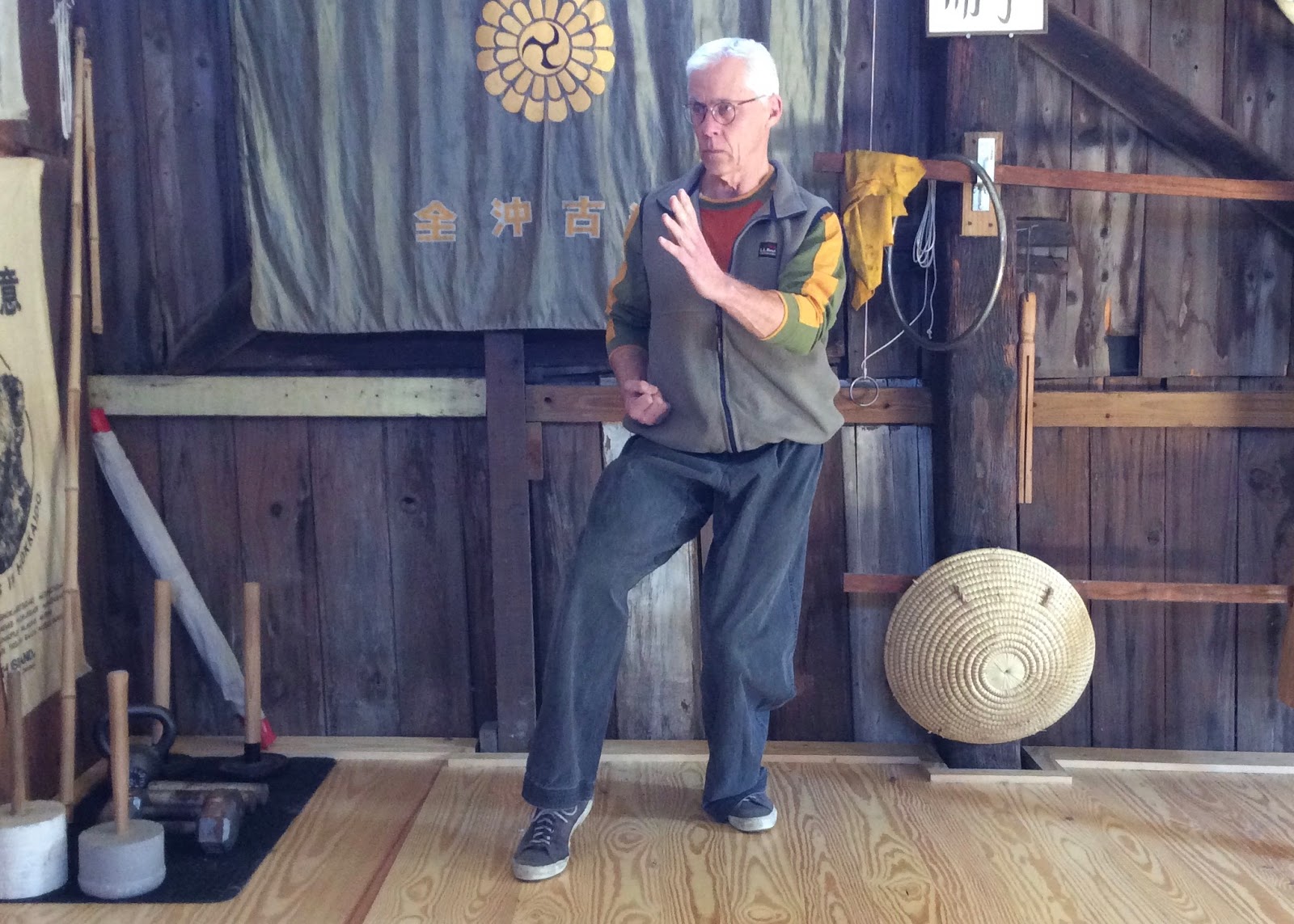
Entrance to the Barn Dojo....
Showing posts with label saifa. Show all posts

Monday, April 02, 2018

A step at a time...maybe that's the problem

It rained all day. And then it stopped. The sun came out and the clouds drifted off to the southeast. The water just sits there, collecting in pools. I suppose the ground is still mostly frozen. Everywhere you look there are puddles reflecting the skeletal images of winter trees and bare bushes drooping by the side of the trail. Off in the woods, it's damp and the swamp has overflowed the old gravel and dirt road that cuts through the conservation area on its way to the lake. But last year they put some stumps along the side and nailed down some planks so you can make it around the flooded part if you're careful and take your time--the planks are narrow and a little twisted, and the stumps shift a bit in the ground.
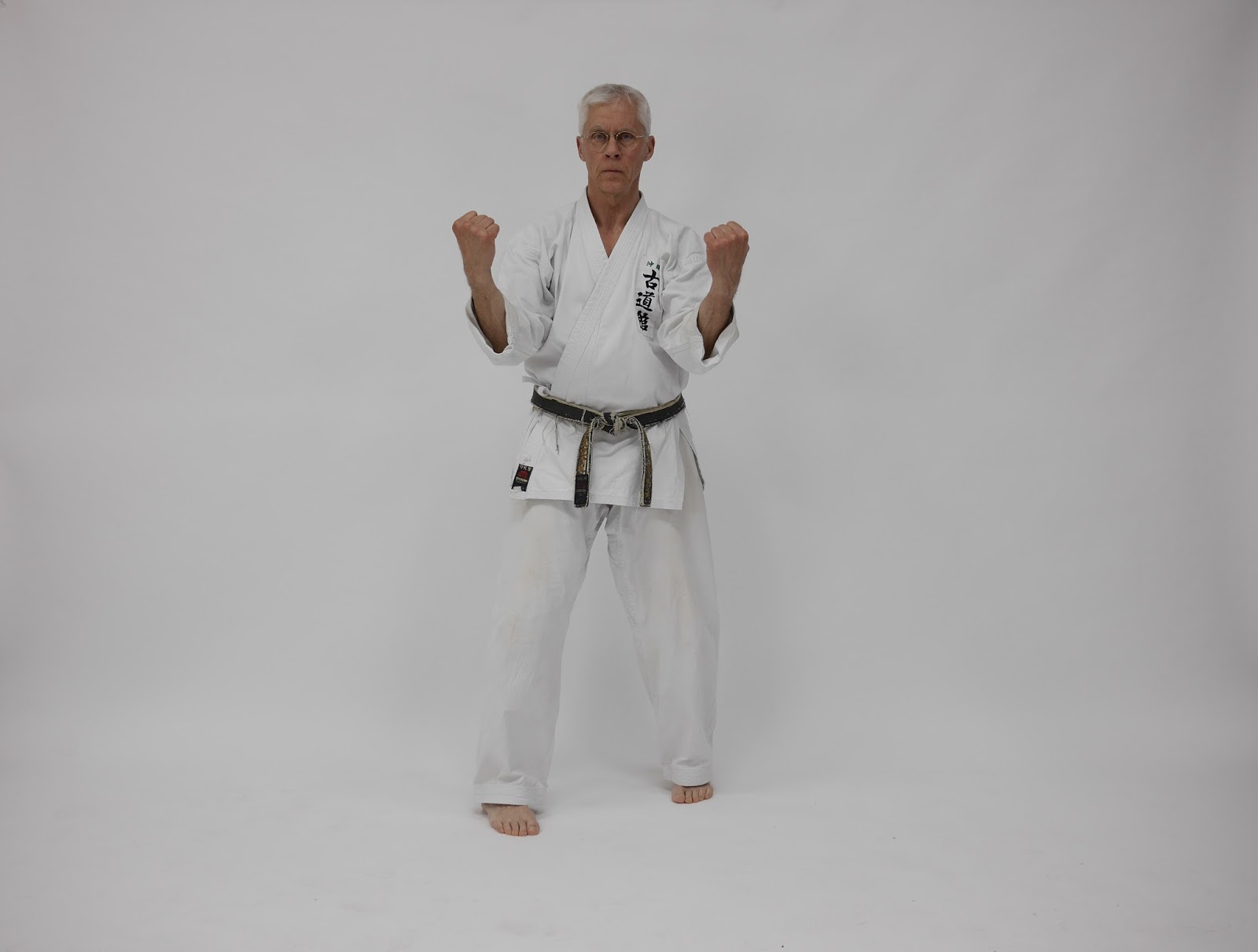
How the last mawashi technique in
Saifa often begins.

On the north trail, you have to step carefully from rock to rock to avoid the mud and standing water. In the spring this stretch of the trail is swampy, with skunk cabbage and small wild flowers that cover the rocks and provide a home to a host of little insects, but in the summer it all dries up again, and then the hikers chart a "social path" around the rocks, reconnecting with the trail as it begins to climb up the nearest hill. With the damp and the cold temperatures, however, the rocks are slippery. You have to pick your way cautiously across this little boggy area, scouting out your route, balancing on each slick stone, looking for flat surfaces or somewhere you can get a purchase, as they say, carefully placing one foot in front of the other.

One step and then pause, and then the hands come up, almost like a counter-weight. For some reason it made me think of open training time in Okinawa, when you watched senior students toiling with the nigiri-game (gripping jars) across the dojo floor. At least that's what it reminded me of with the slow and careful placement of each step, keeping balanced and steady. Beginners were over to the side, carefully trying to match their steps with the footprints outlined in white on the floor, shifting their weight from one foot to the other as they practiced walking in sanchin dachi.

I wondered how this sort of care--focusing on one step at a time, one thing at a time--informed our practice of kata and, ultimately, our understanding of the techniques of kata, bunkai. I understand the need to break complex movements down into smaller, more manageable bits, sometimes separating the steps and movements of the feet from whatever the hands and arms seem to be doing, particularly when we're learning something, but I wonder whether this piecemeal approach to the teaching of kata has a detrimental effect on someone's ability to understand the applications of the techniques themselves?

I have often watched senior students, and even teachers, do kata in this sort of fragmented, staccato manner: First they step, then pivot, then the left hand moves, then the right hand moves, then the right hand moves again, turning over as it drops to the knee, then the right hand is brought up to the hip, then the left hand rotates as the body turns squarely to the front, and finally they both push forward. This is how you might describe the last technique in Saifa kata, the step into cat stance (neko ashi dachi) with the mawashi-like arm movements, as it is often demonstrated. The problem is that in attempting to analyze kata movement when it is performed in this fashion--the way we learn kata as a beginner--we often assume that there should be an explanation or bunkai for each separate movement. And this is a problem.

When we do kata this way--breaking each technique into smaller and smaller pieces--and then attempt to assign meaning to each of these pieces, we fail to see the technique as a whole. We fail to see how the arms and legs--indeed the whole body--functions as a whole. We have, in fact, put breaks or gaps into what should be a single, fluid movement. What should be seen as a final, head-twisting technique attached to the previous series of moves (beginning with the sweep and over-hand hammer fist) is instead seen as a series of individual blocks against multiple attacks, culminating in a final push.

It's fine to take the movements and techniques of kata apart in order to teach them. This is the way we learn most things. But you have to put them back together at some point. There really should be no gaps. Someone who has just learned a kata looks as if they are picking their way across a boggy meadow, stepping carefully from rock to rock. Someone who has been practicing the same kata for years, however, should be fluid, without any discontinuity in their movements--you see the connection between the arms and the legs. When they step into the last technique of Saifa kata, for
example, turning to the front in cat stance, there are really only two movements: one to gather the opponent's head, one hand on the chin and the other on the back of the head; and the second to twist the head and attack it with a knee kick. Two techniques. If you were beating time on a drum, you would hear two thumps, and that's it--one, two. Of course, the way most people perform kata they look as though their feet had sunk in the mud and their hands were carefully parting the reeds to get a better view. If we're aware of this, however, if we keep this in mind, maybe it will help when we go back to look at kata applications, and, in fact, maybe it will help us avoid looking as though we're picking our way over half-submerged rocks in a marsh.


Wednesday, February 28, 2018

Patterns or structure of kata

Snow showers. I'm not even sure what that means, but they left a light, powdery coating of snow on everything. A dusting, they call it. The trail cuts a white, meandering path through the woods, and even the rocks along the path catch the snow in places, like white shadows clinging to small indentations, protected for the moment from the winter sun or gusts of wind. It almost looks as though no one has passed this way, no footprints to mark the trail and scuff up bits of leaves and gravel. I might be the only one who has passed this way, at least today, because, of course, it's a trail. Someone made it, carved it out of the forest, cut saplings and cleared brush.

I'm thinking metaphorically again, walking along the trail, mentally practicing kata, thinking about bunkai and imagining the other side, the side that's so hard to picture; the attacking side. This sort of metaphorical thinking reminds me of that book by Murakami, What I Talk About When I Talk About Running. Or that line from Il Postino where Mario asks Neruda, "You mean then that...the whole world is the metaphor for something else?" And with a abashed look, Mario says, "I'm talking crap." And Neruda says, "No, not at all."

Someone made kata, these patterns of movement that we use to remember techniques of self defense, that we use to learn the martial principles of movement. But the patterns are confusing and seemingly as haphazardly composed as a meandering trail heading off into the woods. No two trails exactly the same. No two kata alike in structure, conforming to the same rules one might use to decipher their patterns. And yet someone passed this way before, left marks, however faint, that would point the way, like trail markers, and explain how we might go about figuring out these seemingly arcane and esoteric movements.

Are they arcane and esoteric? Certainly they are, to us, a bit anachronistic, in a way, a part of a cultural milieu and time period when one might have needed to defend one's life, fighting to the death with lethal techniques, as anachronistic as many of the techniques that seem to depend on one grabbing the topknot or queue of one's attacker. But esoteric? The effectiveness of most techniques, arguably, is based largely on their simplicity, not their complexity or the difficulty one might have in learning them. The difficulty lies mainly in trying to explain movements and techniques that we can only half see. With kata, we only see the defender's response to an attack. We can only imagine the other side, and this often influences how we interpret the techniques of kata.

And whoever created these kata, certainly did not make it easy. If a single person put the techniques of these kata together--I'm thinking of the classical subjects of Goju-ryu from Saifa to Suparinpei--then I would expect the patterns to be as uniform and predictable as the set of Pinan kata or the Gekisai kata of the 20th century. But they're not. Seipai kata, for example, is largely asymmetrical--with at least the first three sequences not showing any repetition--using the left hand to "block" and the right hand for the initial attack (which is also true of the fourth sequence, though that sequence is repeated on the other side). Each of the first four sequences--there are seemingly five total sequences, though the fifth sequence shows a variation, in part, on the other side--is shown in its entirety; that is, with an initial receiving, a controlling or bridging technique, and a finishing technique. This is not the same pattern we see in Seiunchin, for example, which, aside from its set of three opening techniques in shiko dachi, repeats most of its techniques on both the right and left sides--that is, in response to a right or left attack--whereas Seipai only repeats the fourth sequence. But even in Seiunchin we have a pattern that is "interrupted," where some of the sequences, unlike most of the sequences of Seipai, only show the final techniques tacked onto the second or final repetition. This is true of the opening sequence of moves, the high-low techniques in shiko dachi, and the "elbow" techniques--that is, the first sequence, the third sequence, and the final sequence.
Core receiving technique
from Sanseiru when used
with the stepping turn.

Sanseiru kata, on the other hand, shows significant repetition in its middle section, repeating this "core" movement--chest "block," kick, "elbow," "punch," kick series--three times, and using an opening sequence that is merely a variation of similar techniques. And Seisan is entirely different again, showing three variations of what is essentially the same bunkai in the three sequences that follow the opening series of repetitive basic techniques--the three punches, three circular blocks, and three palm-up/palm-down techniques with knee kicks followed by a grab and kick.

There are so many structural variations, in fact, in just these four kata that it certainly seems to suggest different origins or sources, and it certainly adds to the difficulty one has in trying to understand the original bunkai of the different kata. And yet, different kata structures do not change
The bridging technique
of the final sequence
in Sanseiru.
the basic martial principles involved, and these principles are retained regardless of which kata one is looking at or which structure has been used to string together the techniques of the kata. In fact, one of the more interesting aspects of this structural awareness, "seeing the pattern" if you will, is perhaps a sort of radical realization that at least some aspects of the structure of any given kata are completely arbitrary.

This may seem heretical or at the very least blasphemous, but it's merely another way of seeing the sequences of a kata, another way of practicing kata bunkai. For example: If we take the first sequence of Seiunchin kata described above, we see that the first two opening shiko dachi techniques are incomplete, with the finishing technique only attached to the third repetition--this is the push forward with the "supported punch" and elbow attack. If we attach the finishing technique to the first of these steps into shiko dachi (same as the third) and/or the second of these (on the opposite side), we are not really altering the intent of the kata. We're merely illustrating it in another way, completing the sequences that are only shown in part. We could do the same thing with the core double arm receiving techniques of Sanseiru, attaching them to the open hand bridging techniques we find towards the end of the kata.

Certainly what we find is that the flow of kata that we have become accustomed to is interrupted, but the real intent of kata is to act as a repository for self-defense techniques, not to be practiced as a performance piece. In fact, the less we see kata as a performance piece for winning trophies at tournaments, the more we may begin to understand its patterns, its structure, and thereby its bunkai.

[For a more detailed discussion of these techniques see my book, The Kata and Bunkai of Goju-Ryu, here.]

Thursday, February 15, 2018

Just because it's a convention doesn't mean it's right!

[I wrote this last month, but I somewhat arbitrarily forgot to post it. But then again, what difference does a day make, or a week, or a month for that matter?]


Welcome to a new year--January 1st--and yet off in the woods the new year looks pretty much like the old one did a few days ago. The blue jays are scolding me as I trudge by on the trail and the squirrels pause to look up and jump behind a tree, waiting to see whether I'm a threat. I've read that squirrels are very territorial, so I suppose these are the same squirrels that were scurrying around last
First technique of Saifa kata.
week, digging up acorns that they had buried last fall. I wonder whether squirrels are really as busy as they seem to be or whether they might be a bit like office workers rearranging the papers on their desks into neater piles, just looking busy in case the boss comes by or the wives ask where they've been all day.

But the days are already getting longer, past the winter solstice. We've turned another page on the calendar. And yet all of this business of time and calendars is a human construct, isn't it? A mass delusion, or if not a delusion at least something that we all culturally have come to agree on; that is, there's little rhyme or reason to any of it, it's just accepted. I mean, we've had lunar calendars and solar calendars and some combination of the two. Not even the seven-day week is
First technique of Seiunchin kata.
anything but arbitrary, something we have just come to agree on. In fact, for a good deal of human history we haven't even agreed upon a 24-hour day. Daniel Boorstin's book, The Discoverers, has an interesting section on all of this. Way back in 1582, they took 10 days out to correct the old Julian calendar that was off by 11 minutes and 14 seconds each year, so really I'm not even sure of the date. And in America, we didn't even accept this restructuring until Colonial times.

Anyway, all of this got me thinking about what we accept as a society, what we take for granted as we carry on with our daily lives. Actually I was thinking about all of this because I had been reading Kazuo Ishiguro's book, The Buried Giant. He describes a medieval England where strangers are  feared and the forests are filled with ogres, and mists shroud the land and bring an eerie forgetfulness. And it's all accepted as perfectly natural.
Initial technique of the first
sequence of Sanseiru kata.

It made me wonder about all of the things we accept in karate without question, all supported and bolstered by the bulwark of convention or lineage or rank. Of course,  we practice all sorts of harmless conventions in the martial arts, from the karate gi to the formalities of seiza and bowing to the shrine and pictures of those teachers who have preceded us to the use of Japanese terminology and the practice of kata. But we also practice what I can only call conventional interpretations of kata technique. And these conventional interpretations (bunkai) get passed on with very little questioning of their practicality, as if we are hesitant to question anything that most everyone else seems to be doing.

First technique of Seipai kata.
And these problematic inter-pretations are everywhere in Goju-ryu. For example: The opening technique of Saifa does
not use both of the defender's hands to pull away from an attacker's wrist grab. Why disconnect from the attacker? The opening technique of Seiunchin kata does not use both hands to release the opponent's choke hold. Why would you step towards someone who was choking you? The opening technique of Sanseiru (after the three slow punches, that is) is not used in order to block an opponent's kick and then grab the kicking foot and muscle the attacker to the ground. Why would you lean forward with your head undefended as an attacker was coming at you and then even attempt to grab a kick? The opening technique of Seipai is not a nukite to the opponent's chest--it's not a nukite at all--nor an elaborate wrist release. Why would you even think of attacking a hard target with the finger tips? And why would you take the time to weave your hands in and out of the arms of an opponent grabbing you with both hands using the techniques that follow it, as the conventional interpretation shows? There is no response to a full-nelson in Kururunfa. Try it sometime against an uncooperative opponent who's bigger and stronger.
Convention suggests that this
technique from Kururunfa is
a release from a full-nelson.

And yet these are all conventional interpretations of kata techniques. The problem is they don't make a whole lot of sense for a variety of reasons: they are too slow or they leave the defender open to attack or they don't really follow kata or they are easily thwarted by the opponent, etc. Their only reason for being is that they are the conventional interpretations, and conventions are rarely questioned.
This is not to suggest that all conventions are useless or without merit. Clocks and calendars are very useful even if they are a somewhat arbitrary means of marking time. But conventional wisdom once suggested that the earth was flat, that there was witchcraft at work in Salem, that you'd catch your death if you walked around with wet feet.

Most of the conventional interpretations of kata, I think, are, at the very least, useful in pointing out some of the pitfalls one may encounter with interpretations of kata, as ironic as that may be. And by example, they can steer us off into better directions, bushwhacking through the woods in search of a better trail.

[For a more detailed discussion of these techniques see my book, The Kata and Bunkai of Goju-Ryu, here.]


Tuesday, December 12, 2017

It's a system, like the trees in the forest

The forest was wet today. Droplets of water collected in the leaves here and there, and the moss looked a bit brighter green after the rain we had overnight. But the temperature is dropping gradually, the days are getting shorter, and most of the trees are bare. It's hard to tell which trees are dead this time of year. The only thing that seems to be thriving is the lichen and small colonies of mushrooms clinging to the old tree trunks that lay rotting by the side of the trail. 


Saifa kata
Seipai kata
When I'm out in the woods these days, I don't usually think of the forest as an eco-system, though I know it is. I know that when the larger trees fall, after a strong rain or a heavy storm with high winds, they leave a hole in the canopy overhead and the wild grasses, the ground cover, and the acorns lying buried beneath the leaves, some waiting patiently for years, will start to grow in the spring, reaching for the sunlight that's finally been able to make its way through the leaves of the taller trees. 


Suparinpei kata
Seiunchin kata
No, when I'm out walking in the woods these days, I'm just looking for the seemingly random beauty you can find when you go out "forest bathing." Nothing seems so systematic. Everything seems chaotic and haphazard. But, of course, it is a system, just like any martial art, despite what some may imply when they suggest that a style like Goju ryu, for example, is a random collection of kata that come from different sources andwere created by different people at different periods in the past.


Kururunfa kata
Seipai kata
While this may be true (and probably is given that the structure of the Goju classical subjects varies considerably), it does not change the fact that it's a system. The different kata show variations as if they were jazz compositions, as if different composers were given the same melody and told to improvise. One need only compare techniques from different kata to see the variations, to appreciate how different techniques explore similar themes. Certainly there are differences--any given self-defense scenario may vary depending on one's position in relationship to the attacker or, for that matter, what the initial attack is--but the apparent similarity of some techniques and the fact that they are used in a very similar manner (the application or bunkai) underscores the notion that they are all part of the same system, regardless of whether or not the different classical subjects may have had different origins.

Sanseiru kata
Shisochin kata
The key here, of course, is to understand (or "see") the applications. You can't rely solely on the appearance of the techniques. This is admittedly a challenge. We have to first let go of our expectations, which may include not only what the technique appears to be, but also
what we may have been told--in other words, the conventional interpretation of the techniques in question. The problem may be compounded by texts and pictures that seem to record "end" positions; that is, it's difficult to convey in pictures or words what happens in-between the pictures one generally sees in karate manuals or texts which discuss kata, and it's often in the space between one move and the next that we see how a given technique is applied.

Saifa kata
Seipai kata
And you need the whole system. You need all eight classical kata in order to address different scenarios on the one hand and, on the other, to be able to see how to move from one technique in one kata to a similar technique in another kata if the dynamics of the situation change--and they are likely to change. That is, you need to see the similarities and variations in order to alter your counterattack. You may begin with the opening or receiving technique from Saifa (as pictured above), but you have to be able to change to the controlling or bridging technique from Seipai, for example (the bridging technique from Seipai being the technique which follows the Seipai opening technique pictured above). In other words, once you "see" the similarities and variations, you should be able to move back and forth between the techniques of each sequence of moves. This is the way a system works. Of course, you have to also be aware of the sequences. And if you can see the sequences, then you realize that the techniques within a sequence function in specific ways--that is, they can't just mean whatever you want them to mean.

Some have suggested that any single kata is a complete system of self-defense in itself. This is a rather silly notion, as is the idea that any given technique has multiple interpretations or applications. Either one of these notions gets in the way of "seeing" the whole system and being able to comfortably work within the system. Both of these views are short-sighted. Metaphorically, they're like being lost in the woods, failing to see the forest for the trees.


Sunday, November 26, 2017

Things aren't always what they seem

The other day I decided to take a break and head out for a hike up Mt. Tom. I had spent most of the week ripping up the old mat in the dojo and laying down a new wood floor. The canvas cover I  scrounged from an Aikido school years ago was old when I got it, but we needed something to cover the old wrestling mat that looked more like a patchwork quilt made of duct tape than anything else. Patching up the canvas cover had taken a few more rolls of duct tape the past few years, so it just seemed like the time to move back to a wood floor. I had gotten to the point where we had finished cutting and laying down the wood floor, so it seemed like a good time to take a break.

The woods were damp from the recent rains and the first yellow leaves were beginning to fall. A few trees had come down in the last storm, their roots not deep enough as they stretched out over the outcropping of rocks along the path. I was coming down the mountain on a path that wound its way around a small, rocky crag when I noticed a dog coming up the other way. He paused for a moment just in front of me, sniffing the ground, and as I stopped to pet him I looked ahead to see his owner leap wildly to the side of the path, jumping from one foot to the other, waving his arms frantically as if he were trying to escape a giant spider's web. After a moment he stopped and continued up the mountain. When he looked up, he must have noticed the quizzical look on my face. "Snake," he said. "I hate snakes." And then we both continued on the trail; he going up and me going down, but both of us, I'm sure, on the look out for more snakes hiding on the bare rock, hard to pick out amongst the meandering tree roots.

It reminded me of that sketch on Saturday Night Live with Bill Murray and Steve Martin. They stare
Opening technique of Seiunchin.
straight into the camera and just keep repeating, "What the hell is that!?" Maybe we just don't expect things or maybe things just aren't always what they seem to be. Kata is a lot like that. We see a move in kata and assume that it's one thing because it looks like that's what it ought to be. We think, well, it looks like a down block, so it must be a down block. It looks like a double punch so it must be a double punch.

What we're often missing, I think, is the Tristram Shandy effect, for lack of a better term. Tristram, the title character in The Life and Opinions of Tristram Shandy, an 18th century novel by Laurence Sterne, attributes all of his troubles to what happened the moment he was conceived. Just at the crucial point, his mother interrupts his father to ask if he has remembered to wind the hall clock. If I'm remembering it correctly--it's been many years since I last encountered it--the rest of the 500 or so pages of the story and it's hilarious sequence of events can all be attributed to this critical moment, this momentus interruptus, if you will.
Palm up technique from Seiunchin.

Fiction, certainly, but there are connections that are important. Kata is composed of sequences that constitute self defense scenarios. And each sequence is composed of entry techniques (uke), bridging techniques, and finishing techniques. Too often teachers and students trying to find bunkai ignore the sequences, as if the techniques are disconnected and unrelated. I think this is why we don't see the right applications sometimes, why we judge things strictly on appearance rather than a technique's function within a given self defense sequence.

Beginning of the end mawashi
from Saifa.
For example: we might look at the opening technique of Seiunchin and imagine that it must be a release from a two-handed grab or choke hold because both hands look the same--if they look the same, they must be doing the same thing. And the folks that interpret the opening of Seiunchin this way, imagine that the next technique--when the right palm is raised up and the left hand is brought up into chamber--is meant to block and grab the opponent's next punch. This is the disconnect between these two techniques of the sequence. Somehow the opponent must have pulled away from the previous technique in order to punch. But this interpretation works only in contradiction of the age-old martial principle of ikken hissatsu (one punch kill) or is it ippon kumite (one point fighting)? Perhaps it's all the same concept; that is, one should move in such a way as to allow your opponent only the one, initial attack--the one punch being your opponent's, not yours. (They get the initial attack, of course, because "there's no first attack in karate.") Or we might look at the opening technique of Sanseiru (after the three "punches") and imagine that it must be blocking and grabbing a kick because we're reaching down, knee level. Or we look at the end mawashi technique of Saifa and imagine that it's a ridge-hand strike, as many would say, simply because we don't see how it's connected to the previous sequence of moves.
At Mt. Tom looking across
the reservoir. 

It always makes me think of that old admonition about missing the forest for the trees. I suppose it's natural but it's also good to remember that things aren't always what they seem. (And no, it's not common knowledge, nor is it how everyone else looks at kata, no matter how much lip service we pay the old aphorisms we here in the dojo.)


Wednesday, June 14, 2017

Well, that's about the size of it.

"Well, that's about the size of it," he said. I realized I hadn't been paying attention. I knew he was summing something up, but I didn't remember what he had been talking about. I was thinking about the conservation area where we found ourselves. I had stopped on the trail to watch a pileated woodpecker and he had been coming up from the other direction when he paused to see what had caught my attention.

The conservation area isn't very big--about 625 acres with over a hundred different bird species and five miles of trails--but it's enough to get away from the sounds of traffic and the general insanity of the world for an hour or two. But as we separated, I found myself thinking about the size of things. After all, the Fitzgerald Lake area is only a fraction of the size of the new Katahdin Woods and Waters National Monument that President Obama designated last year, all 87,500 acres, and that's supposedly only 1% of Maine's woodlands. I can't really even picture things that size. All you can say is, it's H-U-G-E.

But that got me to thinking about martial arts stuff and different systems of self defense. I once knew a guy who said he had studied Kempo (that's the only designation he gave it) for five years or so, and in that time he had learned 300,000 forms. Now, I'm thinking, there's no way in hell this is true, so I asked him to elaborate. His first "form" consisted of a head block and punch. His second "form" consisted of a chest block and punch. And so on and so on. Still, 300,000?!

One of the finishing techniques of
Shisochin kata.
I visited a Shito Ryu dojo once where they told me that their curriculum included over 50 kata. The funny thing was that when one of the black belts was asked to demonstrate a particular kata (Seipai), he demurred, saying he hadn't practiced it for quite a while and worried that he couldn't remember it.

And on the other end of the spectrum, we have Uechi with its three classical kata--Sanchin, Sanseiru, and Seisan.

So how big is Goju Ryu? There are eight classical kata--kata of ancient origin that show bunkai and embody the principles of the system--and, of course, Sanchin and Tensho (and a number of other modern training kata developed by various teachers in the 20th century). Each of the classical "bunkai" kata, for lack of a better term, explores a theme or themes of self defense and illustrates
Double-arm receiving technique
of Sanseiru kata.
them with anywhere from three to five scenarios, each sequence beginning with an uke or receiving technique and progressing to a finishing technique. Some of the themes are more obvious than others--like the double-arm receiving technique of Sanseiru paired with a couple of different controlling or bridging techniques and two or three different finishing techniques. Or the five techniques against cross-hand grabs and pushes we see in Seiunchin, though one might also look at the downward forearm strike as one of the themes of the kata since it is used in a number of the sequences.

So how big is Goju Ryu? It's hard to say. Seipai is fairly straightforward with five bunkai sequences, while Saifa has four, though one of the four is a close variation. Kururunfa also has four sequences. And Suparinpei, though it shows three complete bunkai sequences, is largely made up of the repetition of fundamental techniques, various entry and controlling techniques. How do you count fundamental or basic techniques?
One of the grab release techniques
of Seiunchin kata.

And then there's the question of structure. The sort of fragmented (or complex?) structure of some kata, like Shisochin or Sanseiru, makes them difficult to size up. Shisochin seems to show  four release techniques against a clinch or two-handed grab, with one bridging technique and two different finishes, one short and one significantly longer. But each of these sequences can be taken apart and put together in various ways. The structure itself seems to suggest variations. And really it's all about variations. Seisan kata has only three bunkai sequences but each is a variation of the same fundamental techniques--the same entry, bridging, and finishing techniques.

The really interesting aspect of this idea of themes and variations, however, is that once you see them you can not only change from one sequence to another within a given kata but also from one technique to another between different kata, moving from a receiving technique in one kata to a completely different controlling or finishing technique from another kata. So in that sense, Goju Ryu is fairly small, composed of only eight bunkai kata with a combined total of around 30 or so bunkai sequences, but almost infinitely large if you consider how the different sequences can be broken down and recombined, dependent on the dynamics of a changing situation and the exigencies of a given self defense scenario.

Too big? The fact that it is all based on themes and variations--as opposed to its being an encyclopedic collection of individual techniques--makes it manageable. Provided, that is, you can see the forest for the trees.


Sunday, May 14, 2017

A block is not always a block...

I was sitting on a rock in the woods the other day, taking a few minutes to lament the relentless march of time and the inescapable encroachment of modern life--they're putting up a couple of million-dollar homes not a stone's throw from the entrance trail and I'm feeling like the proverbial curmudgeon complaining about it--thinking what a nice seat I had found there, positioned as it was under the trees. I could replace the old Adirondack chairs with a few of these, I thought. They'd certainly last longer and weather the New England winters a bit better. I was reminded of a boulder on the way to Lake Oscawana with a naturally worn out indentation in it that my mother always wanted to take home and use as a bird bath. It was about five feet high and must have weighed quite a few tons!

The final position of what is sometimes
referred to as the right ridge hand
from the end of Saifa kata.
Of course, that boulder is probably still sitting by the side of the road, where it was dropped some time during the last ice age. And the rock I was sitting on would never really replace a good Adirondack chair. There were no benches in this part of the woods as there was no scenic place to sit and bathe in the natural beauties of the world, someone determined, but it would serve in a pinch. However, it was still a rock, and only relatively comfortable given that there wasn't any alternative. It was still a rock.

And for some reason, thinking about that rock made me think about the old dojo admonition: "A block is not always a block, and a punch is not always a punch." Or, as it is sometimes understood: "A punch is a block and a block is a punch." And I thought, which is it? The two are vastly different if you think about it.
Some have referred to this as a
kamae posture in Seiunchin
and Seipai katas since it is
executed stepping back.

I tried to think of an appropriate analogy. Analogies always help me to understand things a little bit better. For instance, a pie plate could be used as a frisbee. I think they started out that way actually.But a pie plate isn't a very good frisbee, and a frisbee is certainly not a pie plate. I can't imagine any respectable chef serving up an apple pie in a frisbee.

I think it's the same in karate. Take what I like to refer to as the dreaded ridge-hand strike (haito uchi), done with the opposite side of the hand as the shuto attack, with the point of contact on the side of the index finger knuckle of the hand when the hand is brought across, palm down. Some people find this strike beginning the last mawashi technique of Saifa kata. But it's a lousy way to attack anything. Could it be used as a strike, this technique that begins the mawashi/tora guchi at the end of Saifa? Certainly it could, but was that its original intention, given that it's not a very effective strike and probably more likely to injure the person using it than the person it is used on?
The double "punch" from
 Sanseiru and Suparinpei.

I think what they really mean when they say that "a block is not always a block" is that things aren't always what they seem. Take the down block (gedan barai), for example. It just looks like a down block, but in the classical subjects of Goju-ryu it isn't used as a block at all. You could call it a block.You could even use it as a block in some yakusoku kumite drill. But if we base our interpretation of the technique on how it is used in the sequences of the classical Goju-ryu kata, then it isn't a block. And to compound the difficulty--and I would certainly agree that a punch is not always a punch--but then sometimes it's not a block either. Look at the double punch that we find in Sanseiru and Suparinpei. From its position in the sequences of both kata, it would seem to be neither a punch nor a block.

We tend to love cryptic sayings; they seem to hint at unplumbed depths of hidden meaning. I can just hear old Master Po whispering softly into Kwai Chang Caine's ear: "A block is not always a block, Grasshopper." And all he meant to suggest is that it may look like a block in kata, but appearances can be deceiving.

But to say that a punch is a block and a block is a punch...well, it would be sort of like calling that rock there a tree. It's clearly not.


Wednesday, May 25, 2016

Kamae!

More typical fighting
posture readiness.
   The thought occurred to me the other day--I suppose I've been wrestling with this a long time--but I found myself thinking about training in the old days, when I used to wear a gi and everything was rather formal. We'd line up according to seniority and then kneel and sit in seiza. "Mokuso!" Of course, it was all very precise, sort of like the Japanese tea ceremony without the tea cups.
   "Mokuso yamae!"
   "Sensei ni, rei!" the senior student would bark out. And, after all the formal bows, the teacher would take over.
   "Kiyotsuke. Rei. Yoi," the teacher would say, pausing between commands as the students responded. And then...
   Then we began practicing kata. But here's where it gets interesting.
   "Kata Saifa. Yoi. Hajime (begin)." Next was Seiunchin. "Yoi. Hajime." And then Shisochin. "Yoi. Kamae. Hajime." You see, there's that extra word--kamae. We used kamae not in the general sense of "posture" or even as a command--"kamae-te"--but in the connotative sense of "ready to fight." We generally understood it as a ready position, but no one every asked why the other kata (Saifa, Seiunchin, Seipai, and Kururunfa) didn't begin with a kamae or ready position. Why don't they?
Kamae posture found
in a number of kata.
   In Goju-ryu, putting aside Sanchin and Tensho for obvious reasons, there are four kata that begin with this double-arm kamae posture and four kata that don't. Each of these four double-arm kamae postures begins with three basic techniques that are repeated. Each of the other four kata begins immediately with a bunkai sequence (sometimes in threes and sometimes not). Why the difference? If all of the kata are part of the same system (supposing for the moment that they are from the same system), wouldn't we expect that they would conform to the same structure or pattern? Well...unless there is a message in the pattern or structure.
   Saifa begins with a  self-defense scenario (bunkai) against a same-side wrist grab (opponent's left to defender's right). Seiunchin begins with a self-defense scenario (bunkai) against a cross-hand wrist grab (opponent's right to defender's left). Seipai begins with the opponent grabbing one's shoulder or lapel. Each of these kata shows defensive scenarios (bunkai sequences) against grabs or pushes, while Kururunfa, it seems to me, shows responses to an opponent's punch. The other four kata, however, show defenses and responses to an altogether different situation--one that begins from a wrestling clinch or, if you will, the posture one sees at the beginning of a Judo match. Just compare the postures.
One of Judo's beginning
postures. 
   It's almost as if there is a flag or label tacked onto the beginning of the kata, stating "the techniques of this kata begin from a grappling position," and we are meant to apply the entry techniques at least with this in mind.
   So, does this change the way one sees the bunkai of these kata? Does it open up new possibilities? Do we need to re-think the opening "punches" (if that's even what they are!?) in Seisan and Sanseiru or question the "nukite" or "shotei-tsuki" techniques at the beginning of Shisochin? At the very least, we should question why so much of the bunkai people find in the Goju-ryu classical kata looks the same--most of it beginning with two people squared off, facing each other, until the attacker lunges in with a punch--when clearly, just from the way they begin, there is an implied difference.
   It also makes me wonder about the three kata--sometimes said to be older or perhaps more related to each other (Sanseiru, Seisan, and Suparinpei)--having the same beginning "kamae" posture, as if they were based on a more grappling-oriented martial art, something like Okinawan sumo, for instance, though that's just a wild conjecture.
   So anyway, before you start shouting, "No, Goju is about blocking and punching and kicking...after all, it's karate, not judo"....just wrestle with the idea for a bit. I think this is where it starts to get interesting.


Tuesday, October 27, 2015

The Structure of Kata: putting two and two together...or not

Final technique of the opening
sequence of Seiunchin kata.
I was thinking about structure the other day--how we put things together. I suppose in some sense structure is how we make sense of our lives, how we connect things. Writers think about structure a lot, I imagine. You have to when you tell a story. You can begin at the beginning, slowly and painstakingly making your way to the end in the order that things occur, or you can meander this way and that way, filling in details, providing explanations, making sure there are no loose ends, but by all appearances a seemingly chaotic or at least random order. Very few stories, in fact, seem to stick to a linear model. Writers are always experimenting with narrative structure. They have to, I suppose,because they already know the end of the story.

There's a sort of narrative structure to Goju-ryu kata as well. The problem is that the structures differ; not all of the katas conform to the same structure, which, of course, is a strong argument to bolster any research that would suggest that the classical subjects of Goju-ryu, though part of a system, were created by different people at different times. If Goju classical kata were created by a single individual at one period in history--as the Pinan kata are said to have been the creation of Itosu--then they would probably conform to similar patterns, like the Pinan katas. But they don't.
Thematic double open
hand technique from
Shisochin kata.

That being said, there seem to be certain rules that each of the Goju kata do conform to. For example, techniques which are shown twice in a kata are shown on both the left and right sides, but the finishing technique of the sequence is only shown once, at the end of the second repetition. Techniques that are shown three times are usually base techniques (as we see at the beginning of Sanseiru) or thematic (as they seem to be in Shisochin) or indicative of the number of bunkai sequences seen in the kata (as in the case of Seisan and Sanseiru). And techniques that are shown four times (as in the elbow/forearm techniques of Seiunchin) should be treated as two pairs of techniques (though Suparinpei seems to be a whole other kettle of fish).

The other element of structure that seems to be followed in all of the Goju classical subjects is that the turns and changes of direction in kata are not arbitrary but instead indicate the direction of attack and how one should step off the line of attack. And certainly there are others.

Yet even when these "rules" are applied, we still see differences in kata structure within the Goju system as a whole. Saifa and Seiunchin begin with actual bunkai sequences--though two of the opening sequences of Seiunchin are incomplete, the finishing technique being shown only after the third sequence, which in itself is a structural difference from Saifa. Shisochin and Sanseiru begin with basic techniques (three open hand techniques in one and three closed hand techniques in the other), not bunkai sequences per se, that share a thematic connection with the rest of their respective katas. Seisan begins with three sets of three basic openings, while Kururunfa sticks its three basic techniques after the openings that are shown on both the right and left sides. And Seipai begins with a complete bunkai sequence, sort of like Saifa, but only shown once.

Furthermore, Saifa has only four complete bunkai sequences, while Seiunchin has five. Shisochin has
Controlling or bridging
technique from
Sanseiru kata.
three--though there is some variation and repetition even then--just as Sanseiru and Seisan, whereas Seipai has five and Kururunfa, four.

The problem is that you need to understand the structure of a kata in order to understand its bunkai and not fall into the kind of piecemeal analysis that so often characterizes what we see on the Internet and frequently leads to questionable interpretations of kata technique. For example, the last technique of Saifa kata--the step, turn, and mawashi--is probably the finishing technique of the previous sequence, which is itself shown on both sides, beginning with the block, sweep, and hammerfist strike, rather than an independent technique or additional bunkai sequence of its own. Why? Because that's the way the "mawashi uke" technique appears to be used in all of the other classical subjects of Goju-ryu. Not proof, of course, that there isn't an exception, but a strong argument perhaps.

But structure can also "hide" bunkai, and often does in Goju kata, particularly when the initial or opening technique (uke) is separated from what should follow it, the controlling/bridging technique and finishing techniques. This is what we see in Sanseiru kata. Or, when the opening techniques themselves get split up--something we see in the four-direction double arm movements of Shisochin
One of the four double
arm opening moves
of Shisochin kata.
kata--effectively "hiding" how the opening techniques and directional changes are employed.

The question, of course, is why the creators of these kata put them together this way. There's no question that it has led to a great deal of confusion. Did they do it to intentionally hide techniques? Or is it just the most efficient and fluid way to execute the techniques? I've tried to reconstruct kata, stringing complete bunkai sequences together, and it often gets awkward or doesn't finish facing the original front direction. Perhaps it was to emphasize that sequences and combinations could be taken apart and put back together in different ways. Or perhaps they were interested in showing an escalating level of violence--that is, the second of a paired sequence shows a much more violent response. For example, in the final sequence of Saifa kata, the first side shows a block, sweep, hammerfist strike, and undercut, but the second side adds a punch, head-twisting neck break (mawashi), and knee kick. So was the intention to hide technique, or was this common structure the most efficacious and time-saving method of preserving technique? These are, of course, questions that are impossible to answer, but the importance of understanding the structure of kata is obvious.

Monday, July 06, 2015

Very like a cloud...

Clouds rolling in over the tarn
on the fell. (Helvellyn)
So I was thinking about Hamlet the other day. It was in Act III, scene ii, or thereabouts. The conversation between Polonius and Hamlet. The Melancholy Dane says, quite apropos of nothing: "Do you see yonder cloud that's almost in shape like a camel?" The old man responds, "By the mass, and 'tis like a camel, indeed." To which Hamlet says, "Methinks it is like a weasel." Agreeably, Polonius responds, "It is backed like a weasel." Hamlet then playfully suggests, "Or like a whale," and Polonius knowingly, and famously, says, "Very like a whale." Of course, Hamlet realizes that the cloud in question cannot have all of these qualities--that Polonius is merely agreeing with the poor boy they all think is mad. They humor him for their own ends.
Beginning of Seipai
"jump" sequence.

I thought, isn't that the wonderful thing about clouds, these amorphous, evanescent conglomerations of water droplets; they can be all of these things, because in reality they are none of these things. And we know that. It's a game. We're not hallucinating. We are letting our imaginations play with the world around us. And it's perfectly okay--they're clouds.

But sometimes I think it's a lot like kata and bunkai; people begin to see whatever they want to see in it. Their imaginations run wild with interpretation. And I wonder, when did this begin? Different schools and teachers do things a bit differently in kata. Sometimes these differences are very slight and perhaps insignificant. At other times, however, the differences are pronounced and lead people to vastly different interpretations of application.

The "jump" in Seipai.
One I recently encountered was a discussion of the "jump" in Seipai kata. Some schools teach this as an actual jump--the farther, the better. But it's not a jump. The defender is merely stepping to the outside of the attacker, grabbing (that's the control technique), and unwinding or twisting in a counter-clockwise direction to throw the attacker to the east (assuming the front is north). Why is it not a jump? Because it's connected to the previous technique. Though they look similar--the previous cat stance double punch (and I say that only as a description of what it looks like, not what it actually is) and the cross-footed double punch--the kata is not showing opposite sides of the same technique. Why is it connected to the previous technique? Because the first technique is not lethal by itself, and the second technique (the "jump") doesn't show an entry technique. Combinations and sequences, that's just the way Goju kata were designed. It's a principle of understanding Goju bunkai, if you will.

Foreaarm attack to the
neck in Seiunchin, after
bringing the head down.
And there aren't any uraken (backfist) attacks either, at least not the way they are usually practiced in most dojos--not with the back of the fist or even the knuckles. Whether it's in Saifa kata or Seiunchin kata or Seipai kata or any other of the classical Goju kata, what looks like a uraken attack is really a strike with the forearm. That's why the Okinawan practice of kote-kitai (arm pounding) is so significant, because there are so many places in the Goju classical subjects where the forearm is used to attack.

Knee or thigh kick from
Seisan kata.
And while I'm on the subject of what isn't there: there aren't any back kicks in the Goju classical katas. That doesn't mean it isn't a good technique or even that one shouldn't practice it, only that it isn't a technique we find in Goju kata. Some schools and teachers will show a back kick in Seiunchin because their interpretation of these movements suggests an attack both from the rear (presumably with a bear hug) and the front. The problem is that none of these possibe attacks to the rear are lethal, not to mention the fact that they're not very realistic. Try it. Other schools show a back kick in the beginning of Seisan kata. But again, this is not correct. It is instead a knee or thigh kick to the groin done three times, as both hands are brought up (palm up) and then down as one advances. This is a close-quarters technique.

So there you have it: no jump in Seipai, no urakens in Saifa and Seiunchin, and no back kicks in Seiunchin or Seisan. But, you say, why do different schools see these things differently? I can only think that when we look up on a wonderfully balmy summer's day we see clouds, and from there it's anybody's guess.