Entrance to the Barn Dojo....
Showing posts with label neko ashi dachi. Show all posts

Wednesday, December 11, 2013

It's not what you thnik

I was reading To Kill a Mockingbird today with my students and we got up to the trial of Tom Robinson. There's this big outburst from the incredibly bigoted Bob Ewell. (I wonder whether Harper Lee used that name because so much of prejudice is based in the irrational and sheep-like following of others--hence the "ewe" part of the name--or whether she was thinking that, at least when she was writing, "y'all," meaning "you all," are prejudiced just like this guy.) Anyway, after the outburst, the judge raps his gavel and says, " People generally see what they look for and hear what they listen for..." And I thought, ain't that the truth?!

Pulling the attacker down onto
the front knee in Saifa kata.
People have all sorts of expectations when it comes to karate, and when those expectations are not met, or something comes along to challenge those expectations, they quickly drop into a defense mode--it's fight or flight. We cover our eyes and pretend it doesn't exist. We deny it. We dismiss it. Or we attack it.

But sometimes, it's just not what you think. Goju-ryu is a system of 10 "classical" kata--and I am using the term classical loosely enough to include Sanchin and Tensho. So if this is the case, I would suggest, it's not what people often think or at least not the way you often see it practiced.
Attacking to the back of the
opponent's neck in Seiunchin.

For example: There is no upper target punch in Goju-ryu. And even though you can walk into almost any dojo in the world and find students practicing a jodan tsuki, you won't find it in the classical katas. We don't punch up to the head--we bring the head down to punch it. All you have to do is look at the classical subjects and this disconnect is apparent. In most dojos, we practice "basics" that include an upper target punch. Why not practice "basics" that are actually taken from the classical subjects, not some generic techniques that only conform to someone's expectations of karate? Why not practice techniques that actually prepare students for the movements in the classical subjects?

Blocking and kicking in
Kururunfa kata.
If this sounds as though I'm nitpicking, consider that neither is there a down block (gedan uke), at least not the way you'll find it practiced in most dojos. It's a strike--a body-dropping forearm strike to the back of the neck in most of the classical katas. Who would bother going into shiko-dachi to block a kick like that anyway? Let's be logical.

In fact, the forearm is probably used to strike more often than the standard punch or the back fist. And yet in most Goju-ryu dojos you can find people spending hour after hour punching the makiwara, until their knuckles are hard and calloused. Perhaps we should appropriate the "wooden man" from the Chinese martial arts and start pounding it with our forearms.

And while we're on the subject of confounding expectations...There are probably more knee kicks (hiza-geri) used in the bunkai of Goju-ryu kata than actual kicks with the foot. And the kicks with the foot are more targeted to the opponent's knees than higher--higher targets are easier to block--though when you watch students practice the front kick in most Goju-ryu dojos you will see front kicks waist high...and few knee kicks.

How about that ubiquitous technique: the mawashi-uke? The mawashi-uke seems to me--though this may seem blasphemous--deceptively not so much a "receiving" technique (though we refer to it as an "uke") as it is a finishing technique. In the classical katas, it occurs most often at the end of combinations, and it's usually used to twist the head--i.e. break the neck.

There's no half-fist strike or clam shell fist in Saifa, even though you will find it described that way in any number of books on Goju-ryu. (See Morio Higaonna's Traditional Karate-Do: Okinawa Goju Ryu, Vol. 1: The Fundamental Techniques.) And you will see it used to attack the throat or the opponent's ribs. But it's a grab. It's a half-fist to simulate the look of the hand as it grabs the opponent's collar bone or trapezius
Painting by Magritte
muscles.

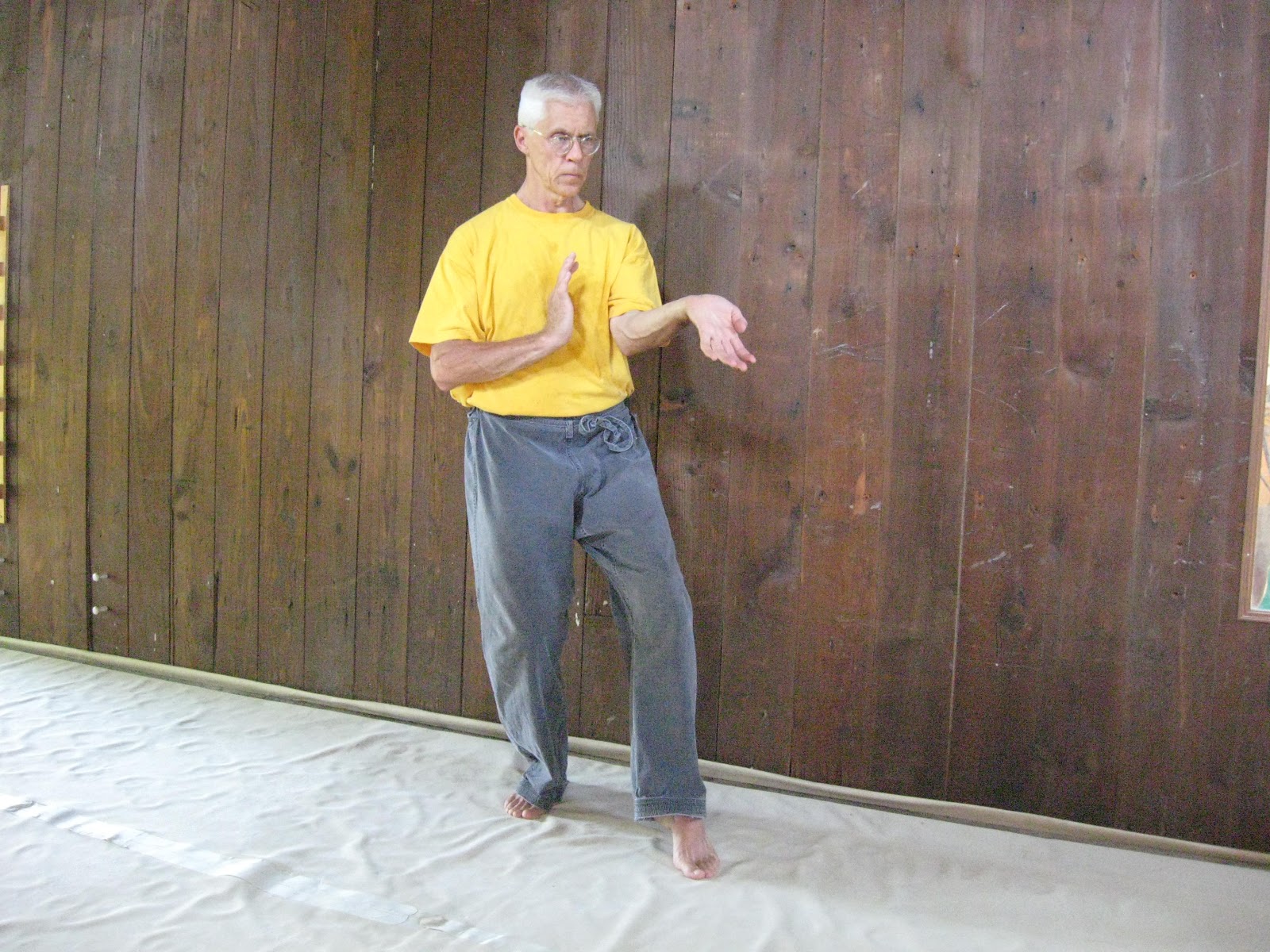
And there's no cat stance (neko ashi dachi). That is, it doesn't seem to be used for anything; it merely signifies where you kick, whether with a knee kick or a front kick. If you think that statement is "out in left field," just try kicking every time you stand in cat stance in the classical katas. See what it opens up for you with bunkai.

And there's no spear hand or nukite strike in Shisochin...or elbow attacks for that matter.

Something to think about when you don't get bogged down with too many expectations.

Wednesday, January 23, 2013

You call that a cat stance?!

I've got two cats. One of them is a frisky orange cat that looks as though she has a bit of Maine coon cat in her. She's a pretty good mouser and she's always curious and getting into things. Sometimes this gets her into quite a bit of trouble. The other is an old tiger cat. He used to jump up on my shoulder if I happened to walk by and was in reach. Now I think he'd just prefer to sleep all day.  And the funny thing is that I've never seen either one of them assume a "cat stance."

Now I know that these are just figurative descriptions, but when I come across people getting downright poetic about describing techniques I wonder whether this tendency to describe movements and techniques confuses more than it elucidates. I came across one guy on the Internet saying that just "as the name suggest [sic], the animal form is the cat and the practitioner should keep in mind the nature of the cat when using this stance." What is the "nature of the cat"?

Another person on the Internet says that the cat stance is "designed for pivoting, night walking, returning to the rear, blocking and weapons fighting." Why would you assume a cat stance before pivoting? Just pivot. Try walking at night or in the dark and see if you use a cat stance. Certainly when you are stepping back you shift the weight, but is it a cat stance? And a stance for blocking? Or weapons fighting?

Cat stance at end of Seiunchin.

I think there are two things going on here. In one sense, when you give a name to techniques--the more picturesque the better--the techniques are easier to remember, but it also provides a short cut for training; that is, you can just refer to the name of the technique you want people to practice. It's a lot easier to say, "Go practice 'single whip'," than it is to tell someone to practice the ninth technique in the form.  But does calling a technique "embrace tiger and return to the mountain" really shed light on the technique? Do you really "repulse a monkey" that way? And what would it mean to tell someone to keep in mind the nature of the mountain? Needlessly cryptic, it seems to me, and no more useful than telling someone they should keep in mind the nature of the cat.

The temptation to translate cryptic or figurative language literally is understandable. We are looking for meaning where meaning is not clear. And so when we see pivoting from a cat stance in Seipai kata, we say cat stance is "designed for pivoting." When we see a step back into cat stance in Seiunchin kata, for example, we say that the cat stance is for "returning to the rear." When we see a cat stance accompanied by a block in Kururunfa kata, we say that the cat stance is "designed for...blocking."

Cat stance in Kururunfa kata.
But what's missing is a more complete understanding of kata and bunkai (the analysis of kata). As someone perhaps with a little more experience or understanding on the Internet wrote: "...stances are actually more about shifting position and body weight. In other words they are not static positions that we assume...." When we name and codify techniques--and this is certainly true of stances as well--we make it easier to teach but we may also be leaving things open to all manner of misinterpretations. Stepping back into "cat stance" at the end of Seiunchin is not so much an assuming of a particular stance as it is shifting the weight onto the rear leg and off of the front leg in order to attack the head (which the defender--using yama uke or mountain block--has in both hands) by raising the knee sharply into the opponent's face. Blocking in cat stance at the beginning of Kururunfa kata is not so much an assuming of a particular stance as it is stepping off line and shifting the weight in order to kick. We block the opponent's punch and kick to the opponent's knee. The diagonal sequences near the beginning of Kururunfa show good examples of high-low attacks. And we don't assume the cat stance and then kick--this is too slow. As soon as we can shift the weight, we kick. The whole point of shifting the weight is to kick--whether with the knee or the foot--not to assume a cat stance.

I can remember hearing criticism about different schools. People would say, "Oh, their cat stances are too low." Or, "Their cat stances are too high." Or, "In that style they turn their knees in a little in cat stance in order to protect the groin." But all of this makes sense only if you sit in the cat stance as if it were a kamae posture waiting for an attack. But it's not. Most stances in Goju-ryu are transitional and used in attacking the opponent in various ways. Of course, if you want to merely assume a stance there's always basic stance.