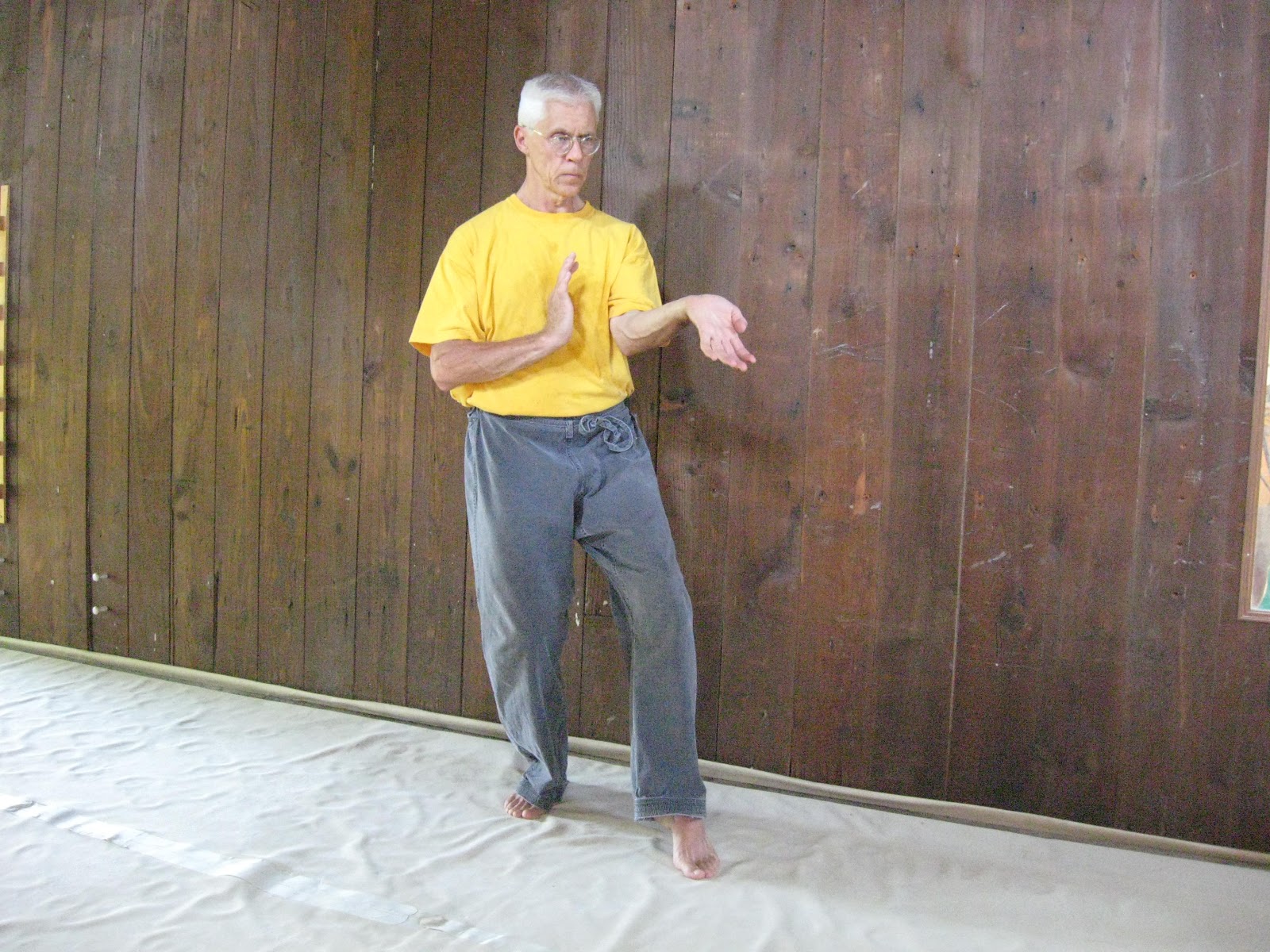
Entrance to the Barn Dojo....
Showing posts with label goju. Show all posts

Wednesday, February 28, 2018

Patterns or structure of kata

Snow showers. I'm not even sure what that means, but they left a light, powdery coating of snow on everything. A dusting, they call it. The trail cuts a white, meandering path through the woods, and even the rocks along the path catch the snow in places, like white shadows clinging to small indentations, protected for the moment from the winter sun or gusts of wind. It almost looks as though no one has passed this way, no footprints to mark the trail and scuff up bits of leaves and gravel. I might be the only one who has passed this way, at least today, because, of course, it's a trail. Someone made it, carved it out of the forest, cut saplings and cleared brush.

I'm thinking metaphorically again, walking along the trail, mentally practicing kata, thinking about bunkai and imagining the other side, the side that's so hard to picture; the attacking side. This sort of metaphorical thinking reminds me of that book by Murakami, What I Talk About When I Talk About Running. Or that line from Il Postino where Mario asks Neruda, "You mean then that...the whole world is the metaphor for something else?" And with a abashed look, Mario says, "I'm talking crap." And Neruda says, "No, not at all."

Someone made kata, these patterns of movement that we use to remember techniques of self defense, that we use to learn the martial principles of movement. But the patterns are confusing and seemingly as haphazardly composed as a meandering trail heading off into the woods. No two trails exactly the same. No two kata alike in structure, conforming to the same rules one might use to decipher their patterns. And yet someone passed this way before, left marks, however faint, that would point the way, like trail markers, and explain how we might go about figuring out these seemingly arcane and esoteric movements.

Are they arcane and esoteric? Certainly they are, to us, a bit anachronistic, in a way, a part of a cultural milieu and time period when one might have needed to defend one's life, fighting to the death with lethal techniques, as anachronistic as many of the techniques that seem to depend on one grabbing the topknot or queue of one's attacker. But esoteric? The effectiveness of most techniques, arguably, is based largely on their simplicity, not their complexity or the difficulty one might have in learning them. The difficulty lies mainly in trying to explain movements and techniques that we can only half see. With kata, we only see the defender's response to an attack. We can only imagine the other side, and this often influences how we interpret the techniques of kata.

And whoever created these kata, certainly did not make it easy. If a single person put the techniques of these kata together--I'm thinking of the classical subjects of Goju-ryu from Saifa to Suparinpei--then I would expect the patterns to be as uniform and predictable as the set of Pinan kata or the Gekisai kata of the 20th century. But they're not. Seipai kata, for example, is largely asymmetrical--with at least the first three sequences not showing any repetition--using the left hand to "block" and the right hand for the initial attack (which is also true of the fourth sequence, though that sequence is repeated on the other side). Each of the first four sequences--there are seemingly five total sequences, though the fifth sequence shows a variation, in part, on the other side--is shown in its entirety; that is, with an initial receiving, a controlling or bridging technique, and a finishing technique. This is not the same pattern we see in Seiunchin, for example, which, aside from its set of three opening techniques in shiko dachi, repeats most of its techniques on both the right and left sides--that is, in response to a right or left attack--whereas Seipai only repeats the fourth sequence. But even in Seiunchin we have a pattern that is "interrupted," where some of the sequences, unlike most of the sequences of Seipai, only show the final techniques tacked onto the second or final repetition. This is true of the opening sequence of moves, the high-low techniques in shiko dachi, and the "elbow" techniques--that is, the first sequence, the third sequence, and the final sequence.
Core receiving technique
from Sanseiru when used
with the stepping turn.

Sanseiru kata, on the other hand, shows significant repetition in its middle section, repeating this "core" movement--chest "block," kick, "elbow," "punch," kick series--three times, and using an opening sequence that is merely a variation of similar techniques. And Seisan is entirely different again, showing three variations of what is essentially the same bunkai in the three sequences that follow the opening series of repetitive basic techniques--the three punches, three circular blocks, and three palm-up/palm-down techniques with knee kicks followed by a grab and kick.

There are so many structural variations, in fact, in just these four kata that it certainly seems to suggest different origins or sources, and it certainly adds to the difficulty one has in trying to understand the original bunkai of the different kata. And yet, different kata structures do not change
The bridging technique
of the final sequence
in Sanseiru.
the basic martial principles involved, and these principles are retained regardless of which kata one is looking at or which structure has been used to string together the techniques of the kata. In fact, one of the more interesting aspects of this structural awareness, "seeing the pattern" if you will, is perhaps a sort of radical realization that at least some aspects of the structure of any given kata are completely arbitrary.

This may seem heretical or at the very least blasphemous, but it's merely another way of seeing the sequences of a kata, another way of practicing kata bunkai. For example: If we take the first sequence of Seiunchin kata described above, we see that the first two opening shiko dachi techniques are incomplete, with the finishing technique only attached to the third repetition--this is the push forward with the "supported punch" and elbow attack. If we attach the finishing technique to the first of these steps into shiko dachi (same as the third) and/or the second of these (on the opposite side), we are not really altering the intent of the kata. We're merely illustrating it in another way, completing the sequences that are only shown in part. We could do the same thing with the core double arm receiving techniques of Sanseiru, attaching them to the open hand bridging techniques we find towards the end of the kata.

Certainly what we find is that the flow of kata that we have become accustomed to is interrupted, but the real intent of kata is to act as a repository for self-defense techniques, not to be practiced as a performance piece. In fact, the less we see kata as a performance piece for winning trophies at tournaments, the more we may begin to understand its patterns, its structure, and thereby its bunkai.

[For a more detailed discussion of these techniques see my book, The Kata and Bunkai of Goju-Ryu, here.]

Sunday, November 26, 2017

Things aren't always what they seem

The other day I decided to take a break and head out for a hike up Mt. Tom. I had spent most of the week ripping up the old mat in the dojo and laying down a new wood floor. The canvas cover I  scrounged from an Aikido school years ago was old when I got it, but we needed something to cover the old wrestling mat that looked more like a patchwork quilt made of duct tape than anything else. Patching up the canvas cover had taken a few more rolls of duct tape the past few years, so it just seemed like the time to move back to a wood floor. I had gotten to the point where we had finished cutting and laying down the wood floor, so it seemed like a good time to take a break.

The woods were damp from the recent rains and the first yellow leaves were beginning to fall. A few trees had come down in the last storm, their roots not deep enough as they stretched out over the outcropping of rocks along the path. I was coming down the mountain on a path that wound its way around a small, rocky crag when I noticed a dog coming up the other way. He paused for a moment just in front of me, sniffing the ground, and as I stopped to pet him I looked ahead to see his owner leap wildly to the side of the path, jumping from one foot to the other, waving his arms frantically as if he were trying to escape a giant spider's web. After a moment he stopped and continued up the mountain. When he looked up, he must have noticed the quizzical look on my face. "Snake," he said. "I hate snakes." And then we both continued on the trail; he going up and me going down, but both of us, I'm sure, on the look out for more snakes hiding on the bare rock, hard to pick out amongst the meandering tree roots.

It reminded me of that sketch on Saturday Night Live with Bill Murray and Steve Martin. They stare
Opening technique of Seiunchin.
straight into the camera and just keep repeating, "What the hell is that!?" Maybe we just don't expect things or maybe things just aren't always what they seem to be. Kata is a lot like that. We see a move in kata and assume that it's one thing because it looks like that's what it ought to be. We think, well, it looks like a down block, so it must be a down block. It looks like a double punch so it must be a double punch.

What we're often missing, I think, is the Tristram Shandy effect, for lack of a better term. Tristram, the title character in The Life and Opinions of Tristram Shandy, an 18th century novel by Laurence Sterne, attributes all of his troubles to what happened the moment he was conceived. Just at the crucial point, his mother interrupts his father to ask if he has remembered to wind the hall clock. If I'm remembering it correctly--it's been many years since I last encountered it--the rest of the 500 or so pages of the story and it's hilarious sequence of events can all be attributed to this critical moment, this momentus interruptus, if you will.
Palm up technique from Seiunchin.

Fiction, certainly, but there are connections that are important. Kata is composed of sequences that constitute self defense scenarios. And each sequence is composed of entry techniques (uke), bridging techniques, and finishing techniques. Too often teachers and students trying to find bunkai ignore the sequences, as if the techniques are disconnected and unrelated. I think this is why we don't see the right applications sometimes, why we judge things strictly on appearance rather than a technique's function within a given self defense sequence.

Beginning of the end mawashi
from Saifa.
For example: we might look at the opening technique of Seiunchin and imagine that it must be a release from a two-handed grab or choke hold because both hands look the same--if they look the same, they must be doing the same thing. And the folks that interpret the opening of Seiunchin this way, imagine that the next technique--when the right palm is raised up and the left hand is brought up into chamber--is meant to block and grab the opponent's next punch. This is the disconnect between these two techniques of the sequence. Somehow the opponent must have pulled away from the previous technique in order to punch. But this interpretation works only in contradiction of the age-old martial principle of ikken hissatsu (one punch kill) or is it ippon kumite (one point fighting)? Perhaps it's all the same concept; that is, one should move in such a way as to allow your opponent only the one, initial attack--the one punch being your opponent's, not yours. (They get the initial attack, of course, because "there's no first attack in karate.") Or we might look at the opening technique of Sanseiru (after the three "punches") and imagine that it must be blocking and grabbing a kick because we're reaching down, knee level. Or we look at the end mawashi technique of Saifa and imagine that it's a ridge-hand strike, as many would say, simply because we don't see how it's connected to the previous sequence of moves.
At Mt. Tom looking across
the reservoir. 

It always makes me think of that old admonition about missing the forest for the trees. I suppose it's natural but it's also good to remember that things aren't always what they seem. (And no, it's not common knowledge, nor is it how everyone else looks at kata, no matter how much lip service we pay the old aphorisms we here in the dojo.)


Monday, October 09, 2017

On the dojo floor...what of traditions?

New dojo floor.
I put down a new floor in the dojo last week. We pulled up all of the old wrestling mat that we had inherited from the university and the old worn out canvas cover that I had finagled from one of the Aikido schools in town. I nailed down something like 450 square feet of southern yellow pine, sanded it, and then put a few coats of polyurethane on it, waited a few days and we were good to go. A couple of spots where the grain had come up in the sanding, but all in all it looks pretty good. The surprise came when I slipped off my training sneakers and did kata in bare feet. I haven't trained barefoot on a wooden floor in what seems like twenty years. And what with the cold weather setting in soon up here in New England, I will no doubt slip my sneakers back on for the winter.

But it reminded me, once again, of the traditions we practice, indeed take for granted, in the practice of karate. Slipping our shoes off, bowing to the shrine, all of the ritualized ceremony and language that becomes an accepted and integral part of training. Certainly in one sense, we are merely respectfully acknowledging the cultural traditions that gave rise to karate. But does the ritual and tradition overshadow the real martial intent of karate? I think it does for some. The "costumes" become more and more elaborate, festooned with colorful badges and elaborate embroidery of kanji characters that the average student (non-Japanese student) can't even read!

Hojo undo implements.
For some others, who fashion themselves "traditional-ists," the ritual of karate training seems to be focused on hojo undo or supplemental exercises performed with various traditional Okinawan training implements to develop a strong karate body. Some practitioners seem to emphasize this sort of ritualized use of traditional hojo undo implements as if it too satisfies a spiritual need, scoffing at those who put too much emphasis on the study of bunkai, not merely the more modern adjuncts like competition jiyu kumite or the performance of kata for small plastic trophies.

It's confusing; I'm not even sure what tradition and ritual in karate even means anymore. That's why the wood of the dojo floor felt so strange to me, I suppose. I think the last time I trained with any regularity on a polished wood dojo floor was in Okinawa. I suppose it makes more sense to take one's shoes off and practice on a bare wood floor in a tropical climate than it does in New England. But I've also dispensed with the traditional karate uniform, the belt, and, aside from an admittedly though no less heart-felt but perfunctory bow to the shrine, all of the pre-training ritual. I light incense when I have it and can remember, but we don't address each other with titles--no sensei, no sempai, no "osu" or other use of Japanese when a simple English term would suffice. You won't hear "Moku so," "Kiyotsuke," "Hajime" here. Heretical perhaps but since there are only a few of us old guys--all seniors--the ritual seems a bit unnecessary. And as far as bare feet and wearing a karate gi...well, it's pretty cold in New England at least five months out of the year.


Or does the practice of ritual and tradition actually free us, in some sense, to experience karate in a more spiritual way? After all, the practice of kata itself is a kind of ritual. The movements are clearly defined and taught in a very formal manner, with little room for individual differences, and since for most, at least initially, there is little understanding of what the movements mean or how they may be used, there would seem to be little difference between those who practice karate and those engaged in some arcane religious ceremony. A ritual, by definition, is "a series of actions performed according to a prescribed order." Does it make it more or less spiritual if you don't know what the movements are for? After all, if you didn't visualize what you were doing--that is, if we didn't have any understanding of bunkai or application--then we might be more apt to enjoy the act of movement itself, sort of like yoga perhaps. In this case, I sometimes wonder if meaning doesn't get in the way, if understanding bunkai doesn't somehow detract from one's enjoyment of the simple act of movement and exercise, and, in the process, a more spiritual experience.

And yet I wonder if all of this is not a modern overlay, something fashioned fairly recently and tacked onto what was once only a brutally efficient method of self defense. And kata? Merely a record of martial applications and fighting principles preserved in kata form for an ancient population that was largely illiterate.

And yet...there is something about slipping off one's shoes and stepping on the dojo floor, bowing to the shrine, all of the old teachers looking on, the incense burning, and beginning kata. Just kata. Kata for its own sake.


Saturday, March 04, 2017

The landscape is a-changin'

A week ago I was out snow shoeing through the woods on trails covered with 18 inches of snow and today the trails are almost bare. Small piles of snow seem to hide in the shadows or lie in under fallen tree on the north side of the hill. The leaves alongside the trail are wet and you can almost smell an early spring. In a few weeks, the landscape will be totally altered once again. The trees will leaf out and the weeds will cover the rocks in the marshy places. Everything will turn green and it will be hard to see off into the woods from the side of the trail. Phoebes and chickadees and wood thrushes will replace the crunching sound of feet plodding through the snow on the trails.

It's not as if the landscape doesn't constantly change--after all it's New England and these are seasonal changes that happen every year--but they seem more noticeable in anticipation, when they're just about to change, or, on the other end of it, in hind sight.

I was thinking about this the other day, as I walked along the trail, leaving the last remnants of packed-down ice in the middle of the trail to walk along the edge of the forest, kicking up the leaves that had been hidden under the snow since last fall. The landscape of the martial arts has also changed quite a bit from its beginnings hundreds of years ago, I imagine. Most people are involved in "sport" karate nowadays, it would seem. But even those who practice more traditional karate--or what they imagine to be more traditional--are probably not practicing kata and bunkai the way that it was originally intended. We live in a different world. The landscape has changed.

Tradition suggests that
this technique from
Sanseiru is used to
block and grab a kick,
but it makes much
more sense  as
an arm bar.
Can we say we are practicing traditional karate if we are not practicing the same way that earlier karate (or "te") was practiced? Is our approach "traditional" if much of what we're training is based on Gekisai kata or other training subjects instead of the core classical kata? I'm not sure I even know what the term "traditional" even refers to anymore, since it seems to be applied in so many different ways.

I'm a pretty strong advocate for the notion that there is one originally intended way to interpret kata and that the original bunkai is discoverable through the application of certain martial principles--that is, the techniques of kata are not open to multiple interpretations, however creative they may be. It can't mean anything and everything. Now I know this is controversial (though why that should be controversial is beyond me)--and I've certainly been through these arguments enough--but I found it rather curious when an editor of martial arts books asked me how I imagined the art (karate) was going to "progress" given my position. That is, he asked, how was Goju-ryu going to grow and change if there was only one way to understand the classical kata? In other words, how was the tradition going to change--and here one should understand that "change" was being used as a synonym for "improve."

Am I missing something? I thought that the very notion of tradition implied that we were attempting to preserve it or, for me, to discover what it was originally, before the landscape changed and the traditions were altered. I was once accused of being an "iconoclast" because of the position I was taking--that is, challenging what passed as tradition simply because the teacher said it or the teacher
Tradition suggests
that this technique
from Seipai is used
as an arm bar, but
it works  much more
sense around
 the neck.
taught this or that application. But regardless, why should a tradition "grow" or "improve"? I think the idea of passing on a tradition like karate (Goju-ryu, in my case) is for the individual to grow within that tradition, to learn and understand the principles upon which it is based and get better at them. The individual practitioner may change, perhaps even become a better person through training, but not the art.

Whenever I get into discussions of this sort, I'm reminded of a Tae Kwon Do teacher (he did Shotokan kata) I once encountered. He had changed the back stance (kokutsu dachi) to horse stance (kiba dachi) in all of his kata because he didn't see the point of the back stance. Horse stance, he said, seemed like a more stable stance. Now, of course, the back stance in Shotokan had itself been changed from a cat stance in Shorin-ryu, I think, but change is not always for the better and certainly change based on a limited understanding (this was a young teacher) is a bit suspect. When you have altered the kata so dramatically, have you retained the same principles? Do you have the same bunkai? Can you create a new tradition?

When I'm explaining an application for some technique in kata, I often find myself showing the "traditional" (conventional may be a better term here) bunkai for a technique, and then explaining why I don't find it to be a particularly good interpretation. Perhaps it doesn't really follow kata movement or it's not realistic for any number of reasons or it requires the attacker to simply stand there with his arm out while the defender applies his technique, all the while ignoring the attacker's other hand. Should we still call this traditional karate?

Perhaps the landscape of the martial arts changed when it moved into the dojo, when teachers started to popularize a deadly martial tradition and average people started stepping onto the tatami mats. And then we put on karate uniforms or judo gi's to formalize the distinction between when we are practicing a martial art and when we are simply living our lives. We incorporate rituals and special language, all of it becoming part of training in a "traditional" dojo.

But I suspect the landscape of the martial arts has changed a good deal over time, just as the seasons alter the landscape of the forests. And as it changes, I find myself still turning to look back down the trail to see if I can see where it all began.


Tuesday, December 13, 2016

The Principle of Keeping the Elbows Down

Native American Trail Marker tree.
It was wet in the woods the other day. The rocks were slick on the trails and there were puddles here and there where the rain collected in small depressions lined with leaves. It began to rain again just as I started up the trail. Everything was uniformly grey and misty, making the trees stand out like etched outlines on paper. Most of the trees seem young along here, stretching up like telephone poles, with few if any branches at this level, but here and there you can still see an old gnarled pine or maybe a red maple with its limbs all twisted as if its fending off beasts or would-be loggers. I'm on the lookout for these old codgers. I'm hoping to find one of those old twisted Native American Trail Marker trees, the kind that looks sort of like someone's arm held up and bent at the elbow. Some say that they don't exist in New England--the tree itself has to be 200 or 300 years old--but others have already identified a few.

It's a curious thought. The process, they say, may take years. You find a likely sapling and then bend it over with a cord or rope, pointing in the direction of a water source or a natural stream crossing. Then, years later, after the tree has grown to accommodate this bent nature, you come back and release it from its shackles and allow it to straighten up. Only it doesn't straighten completely; it leaves a crook like an elbow in its trunk.

The arms in Sanchin posture.
Of course, that's the connection: the elbow. There's a passage in the Chinese classics that runs, "All the joints of the arms should be completely relaxed, with the shoulders sunk and elbows folded down" (Yang Ch'eng-fu, quoted in T'ai-Chi Touchstones, compiled and translated by D. Wile). We practice this in Goju-ryu, of course, with the arms held in Sanchin posture, but it's such an important concept in the martial arts that it should not just be looked at as a position one takes up in the execution of a particular kata; rather, it's a principle that one needs to absorb. Perhaps we should tie the limbs down to train this posture, to grow into it, as the Native Americans tied down the trunks of young saplings to create their trail markers. There are some who have creatively thought of hanging weights from the elbows while the student is doing Sanchin kata.

The other question for me, however, is whether we can fully appreciate these principles without understanding the bunkai--that is, you can do it in order to assume the correct appearance and form in kata, but can you really "grow into" this technique, can you really absorb the principle, if you don't see the necessity of moving this way by having to use it against another person, in other words, by doing the bunkai? Which means the bunkai you have "discovered" has to necessitate the use of this principle.

First movement in Seiunchin kata.
For example: Take the first movement in Seiunchin kata--stepping out on a northeast angle into a right-foot-forward horse stance (shiko dachi) with both hands brought up back to back and with the elbows down. If this technique is executed against a two-handed choke hold or lapel grab, as many interpret it, you won't see the necessity of keeping the elbows down. (I won't even bring up the question of why you would step forward against either one of these attacks!) But if you try this against a cross-hand grab--the attacker grabbing your left wrist with his left hand--then the necessity of keeping the elbow down should become apparent and the principle will be thereby reinforced.

First movement of second sequence
in Seiunchin kata.
Another example: Take the first movement of the second sequence in Seiunchin kata, the "assisted block." In this move, the defender is doing what looks like a closed-fist middle-level block with the right arm and the left hand is assisting by pushing on the side of the right wrist or fist. If this is really being used as an assisting block against a strong opponent, then there seems to be little reason to keep the right elbow down. However, if once again the attacker is using a cross-hand grab--the opponent grabbing your right wrist with his right hand--then the necessity of keeping the elbow down is apparent. You drop the elbow and rotate the hand and bring the left hand in to trap the opponent's fingers so that he can't let go. Then you push out towards his center. All of this works against his wrist, and if you understand the principle of keeping the elbow down, then you're not trying to out-muscle the opponent.

The turn-around technique
from Seisan kata.
But some might argue that these are select cases or that I'm trying to find techniques that fit my hypothesis. Then why not another "principle"? In the same Douglas Wile collection, this time from the Yang Family Manuscripts Collected by Li Ying-ang, we are told to "avoid the frontal and advance from the side, seizing changing conditions." If we don't understand the structure of kata, we may miss this one. If we assume that the turns and stepping in kata have no meaning--or no more meaning than that people training indoors ran out of room--then we won't think of using this principle when we analyze kata. If we imagine that the first turn around technique in Seisan kata is meant to be applied against an attack from the rear or that we simply turn to face the on-coming attack, then we will not learn this principle. However, if we imagine that the attacker is stepping in from the west with a left punch, then the bunkai would have us step off-line to intercept the attack at a 90-degree angle, the right arm blocking and the left open hand attacking. And if we practice this enough, we may even begin to learn the principle, to incorporate the idea into all of our movements, so that when we face an attacker (in ippon kumite practice, for instance) we will naturally step to the side into a 90-degree relationship to the incoming attack.

That's the Ri of Shu-Ha-Ri, or, in a metaphorical sense, that's the part about "growing into" the technique, in the same way that a Native American Trail Marker tree had to grow into these fantastic shapes, marking the paths and pointing in the right direction. I suppose they could have just put up signs, but it wouldn't have been quite the same, I think.


Tuesday, November 15, 2016

The Homogenization of Technique

I was thinking about this the other day...our tendency to homogenize things that are similar, how over time we smooth out the edges and look for commonalities until we've erased the differences altogether. That may be overstating the case, but it got me to thinking.

I was out for a walk in the woods, engaging in a bit of "woods bathing," one of my favorite activities, when I found myself thinking about the time my father "borrowed" my rock collection. I think I must have been seven or eight years old. My father was helping out the Boy Scouts with their Klondike Derby. My older brother was in the scout troop--he would go on to become an eagle scout and I would become a scout dropout, never really comfortable with dressing up as a para-military youth gang, though the questionable leadership of our assistant scout master was probably more to blame, either that or the '60s. Anyway, the Klondike Derby was a sort of winter carnival with the scouts dragging sleds through the snow, completing tasks, and accumulating "gold nuggets." Of course, someone needed to supply the "gold nuggets," and that was the job my father took on. He "borrowed" the big Lincoln Log barrel I had filled up with my special rock collection, spread them all out on his work bench, and spray painted them all gold. When I found out, I was distraught. My father didn't understand at the time. He offered to get me more rocks, but this was a collection of "special" rocks that I had been collecting for quite some time. They were just rocks I had found on the road or in the woods, but they were all special to a little kid. And they were all different...at least until they all got a thick coat of gold paint.

I wasn't consciously thinking about childhood events or kicking up "special" stones hidden under the fall leaves. I was just sort of wondering about that unique quality that all things have, especially things that seem similar. You really notice it in the fall, when the trails are covered with leaves. Late in the season, when all the leaves have turned brown, they all seem to be the same unless you look closely. Then, you can't find any two that are really exactly the same. The trails up around Fitzgerald Lake are mostly covered with oak leaves, but still they're all different.

Beginning movement of
the mawashi uke.
I suppose as humans we have this natural tendency to generalize. We need to generalize in order to identify things, even to recognize people from one day to the next. But really what all of this brought to mind--as any good walk in the woods will certainly do--is whether we do this with technique in kata, techniques that may look similar, at least to some extent, but are really different. I think this can be especially true if we rely on appearances rather than how something may function. And it can be subtle, creeping in over time, slowly erasing the differences in techniques until all we see is a redundancy, a repetition of familiar basics.

I'm not at all sure how insidious or widespread this tendency to homogenize may be or how it may have affected kata over the years or generations. Certainly when we name techniques in kata, there is the danger that we may be homogenizing movements that are actually quite different, especially if the names we give the movements are meant solely to describe the look of the movement rather than how it is used.

Beginning movement of
the other one.
Take the mawashi techniques that occur in the classical kata, for example. I believe there are two kinds of mawashi techniques, but I don't think it really helps much to distinguish between them by calling one a mawashi uke and the other tora guchi, as some have done. I will simply describe how they are used. The first of these--one that can legitimately be described as a mawashi uke because it is used as a receiving technique--occurs first at the end of Sanchin kata and then again at the beginning of Suparinpei and again at the end of Tensho. But these three kata, I would argue, are the only time this mawashi uke occurs in the classical subjects. It is distinguishable because it is done in basic stance or sanchin dachi.

The second mawashi-like technique occurs at the end of Saifa, at the end of Seipai, at the end of Seisan, in the middle of Kururunfa and again at the end, and it is shown three times in Suparinpei (interestingly both kinds occur in Suparinpei). Each of these mawashi-like techniques is done in cat stance or neko ashi dachi. The difference is in how they function. This second mawashi-like technique is a finishing technique, meant to twist the head or break the neck of the opponent. These techniques are tacked onto the end of longer bunkai sequences in the classical kata. They function differently from the other mawashi and consequently should be done differently in kata. More specifically, when the mawashi is associated with the cat stance (which itself implies a knee kick), the left hand does not pass under the right elbow or forearm, or, on the other side, the right hand does not pass under the left elbow or forearm. When the mawashi is associated with basic stance or sanchin dachi, the right hand does pass under the left elbow or forearm, or, on the other side, the left hand passes under the right elbow or forearm. What gets confusing, I suppose, is that the end position--both palms facing forward with one hand pointing up and the other pointing down--looks the same, except for the stance.


These are the two kinds of mawashi techniques we see in the classical kata of Goju-ryu, and, on second thought, they probably have nothing to do with rocks and trees and walking in the woods. But when the paths diverge, I can't help thinking of that line from Robert Frost. How does it go?


Thursday, September 29, 2016

But is it art? Problems with kata analysis cont'd.

"Well that's a pretty bland title," he said.
The only really neutral
position and the beginning
posture of ippon kumite.

"But this is sort of a continuation, trying to figure out why there are so many problems in finding the bunkai or applications of kata," I said in defense.

"What problems? People are coming up with new and improved bunkai every day. Bunkai is the soup de jour, if you will," he said, dismissing the subject altogether.

Yes, that's part of the problem. Everyone seems to accept the notion that kata is a playground of infinite creative possibilities, a blank canvas where you can draw whatever comes to mind and everyone else will be constrained by the conventions of art or politeness and refrain from criticism.

There are all sorts of problems that tend to influence how we interpret kata--our expectations are only part of the problem. Out of frustration there are many who have given up entirely on the interpretation of kata and scoff at this "trend," as they see it, of trying to find meaning in the kata that they nevertheless dutifully perform day in and day out to the metronomic and almost soporific cadence of the teacher 's count.

Since they themselves were never told what kata movements were for, they reason there is no meaning behind these apparently baffling movements. This rather defensive posture, however, seems to me not only unimaginative but also arrogant and egotistical.

The argument is based on the supposition that there is no way to tell exactly what the original creators of kata intended. But why not? Isn’t this the same cynicism that decries every new scientific hypothesis? How do we verify scientific discovery? To bring logic into the argument at all, of course, may be a bit pointless since a majority of Americans don't accept Darwinian evolution, with all the proof in the world, and, at the same time, believe in ghosts and crop circles with no proof whatsoever. There was a study not too long ago, in fact, suggesting that “we only trust experts if they agree with us” (Nicholson, C. Sept. 18, 2010. Scientific American).

Some have suggested that kata practice has no relationship to practical fighting; it’s merely used to develop speed, power, balance, and control—notwithstanding the rather obvious point that each of these things can better be developed with other exercises and, in fact, are even in traditional martial arts circles.

Admittedly, any analysis of kata that purports to be anything more than a possible interpretation--that is, anyone who suggests that there is, in fact, an original meaning to find--will leave the door open to scathing reviews by a host of self-proclaimed "experts." Kata is, after all, a solo exercise that is meant to mime the movements of paired fighting in the fashion of a boxer shadow boxing. Who's to say definitively what it means? At the very least, however, we should be able to agree that it's not just about blocking and punching. Rather what we see in kata is the receiving and parrying combined with seizing or grappling or tying up techniques, followed by attacks with the open hands, the forearms, the elbows, the knees, and, in many cases, taking or throwing the opponent to the ground. Certainly this might seem as strange as seeing Marcel Marceau performing in street clothes on a busy city street. What is he doing, we might ask? Of course, if it’s “art,” some folks reason, we can interpret it any way we want. That's what art is, isn't it? Why should a martial art be any different? As Marshall McLuhan said, "Art is anything you can get away with."
Okay, but is it art?

Perhaps kata is merely some form of esoteric or yogic movement, never meant to show practical self-defense applications. I've heard teachers say as much. Who knows, perhaps teachers are the problem?!?


Friday, August 28, 2015

Give a man a fish...

The other day I was reading one of the few blogs that I find interesting on the Internet--very opinionated, but honest, obviously heartfelt, and written by a karate practitioner who trains seriously, with little interest in self-aggrandizement. I may not do it justice by trying to summarize the intent of the blog post--I'm sure I can't--but to me it bemoaned one of the seeming shortfalls in a society where everything seems to be at our finger tips, particularly information, that in turn has led to a culture of expectation and entitlement, and how this has all spilled over into the dojo, affecting how we learn karate and more importantly how we expect to be taught karate. In a word, according to this blog post, students of karate today expect their teachers to regularly "feed" them.

I think there's a lot to this. And yet it reminds me of something one of my senior students once said, jokingly, in response to a question she was asked by a junior student: "If you have to ask, you're not ready to learn." I say jokingly, because one might argue that this is precisely the moment when someone is ready to learn--when they are asking the right questions. When I'm teaching kata, I will frequently ask students if they have any questions. More often than not, they will say, "No, just have to do it more." To me, that's probably a very honest response; they don't know enough to know what questions to ask. Once the questioning starts, however, it seems to me that it's my job to "point the way." It's my job to at least explain the principles, to explain why one is being asked to move in a particular way, why one way is better than another way.

Mike Clarke sensei goes on to relate a wonderful little story that Miyazato sensei told him about two fighting birds he once owned. You can read the story for yourself--It's titled "Post 500..."--here: shinseidokandojo.blogspot.com/  You might also find it instructive to poke around in the archives of this blog a bit while you're there. Anyway, Miyazato sensei then makes the analogy to karate training, saying to the author, "If I give answer, you go home and forget; better you learn for yourself through training." Tough love.

But I wondered, as I read that: Are students likely to find the answers? Is that why the Internet is filled with so many outlandishly ridiculous and unrealistic examples of "bunkai"? Are all these people teaching themselves? What is the role of the teacher? Is Miyazato sensei implying that anyone can find the answers with enough training or that each individual's answers, though different, are all correct? Why do we have teachers if the extent of their instruction is to suggest that we find our own answers? Isn't the teacher there, in some sense, to shorten the journey, to share what they have discovered so that the student will surpass the teacher at some point? What would happen if I turned on my GPS and asked Siri for directions and she told me, "I'm sorry, but if I told you how to get there, you'd soon forget, you'd never learn how to read a map. Better to figure it out for yourself"?

Perhaps I'm overstating the case, finding fault where there is none just to make my own point. I'm sure the analogy is not meant to suggest that Miyazato sensei didn't teach or try to "point the way." But so often, I think, there is an implicit paradigm associated with learning in the karate dojo that suggests that one is not training hard enough if one has to ask questions. Do the kata 10,000 times and then you will understand, Grasshopper. Or, don't ask any questions until you have done the kata 10,000 times. But what's to prevent the charlatan from using this clever sort of cover for his own ignorance? A teacher is there to teach--to at least point the way--to explain the principles. If they don't know something, perhaps it's better to just say, "I don't know." If I give a man a fish, I may just whet his appetite for more. He may ask me how I got that fish, and I'll have to show him how you go about catching fish. He may end up being a better fisherman than me, but when asked, he'll say that I once gave him a fish and taught him how to fish.


Tuesday, September 17, 2013

It's a mystery to me!

We love mystery. I'm reminded of that bestseller from years ago: All I Need to Know I Learned in Kindergarten by Robert Fulghum. If only it were that simple! We know differently but it still doesn't stop us from wishing it were so. I remember Fulghum wistfully chiding us to reawaken that sense of wonder we had as children. He reminds us how fascinated we were once, watching the sprouting seed. "Remember the little seed in the Stryrofoam cup," Fulghum writes.  "The roots go down and the plant goes up and nobody really knows how or why..."  
The yama-uke technique from
Seiunchin kata or the grab head
and knee kick technique.


But am I to believe that modern-day biologists or botanists don't know "how or why" a seed sprouts? This attempt to reawaken a sense of wonder with the world reminds me of the early 19th century tug-of-war between science and art--a world experiencing the growing pains of the Industrial Revolution decried by the Romantics Poets, each on their Rocinante,  galumphing off on their quest to find mystery in nature. 

A lost cause, you say? But according to a recent Huffington Post article, "45 percent of Americans believe in ghosts." Less than 40 percent think Darwin was right. We love conspiracy theories, whether they're about 9/11 or the assassination of JFK. Heck, we're pretty sure they're hiding something in Roswell, and a sizable number of us are not at all sure we ever landed on the moon. It's almost as if we'd prefer not to know. We love a good mystery. Remember Twilight Zone? It could happen. "There are more things in heaven and earth than are dreamt of in your philosophy," Hamlet tells Horatio. Oh, how true, how true! And how can you argue against any of this if someone chooses to believe. Someone's faith is hard to shake. It has nothing to do with reason and logic. In fact, reason and logic--the cold, hard facts--can be discomfiting. Faith that doesn't have to answer to logic or reason is, on the other hand, comfortable. I don't think Fulghum has much to worry about. I think given the choice we'd choose ignorance every time. 

Take the martial arts, for instance. It's filled with ritual, and we love ritual. Ritual has no rhyme or reason. We get dressed up in strange looking pajama-like clothes and parade around with colorful patches and belts or sashes that establish rank and position and genuflection. We love to bow. We use words that the novice or outsider doesn't know--a special language only for the initiated. We have special names: master, sensei, sempai. We have decorative shrines. We burn incense. And we have faith that all of this is somehow important to our pursuits--that their meaning will be revealed to us in time. But before you know it, we begin to practice all of these things for their own sake. It reminds me of that story by Borges where the tiger comes into the temple and kills someone so often that it is eventually incorporated into the daily rituals of worship. Someone once told me that I should try performing kata outside at night under a full moon. He suggested that I would discover a new level of meaning in my kata--either that or some mystical experience. 

Mystery. People seem to need mystery. Is this the reason that people are willing to give over their own logic and reason, their control, to someone else, someone who must know...the sensei, the master, the soke? Is lineage the answer? Or popularity? Or the size of one's international organization? Or ethnicity? 
Sanseiru

I'll never understand why the bunkai that some people do doesn't look like the kata that it is supposed to explain. Nor why the bunkai that they practice is not lethal--why the techniques seem to be just a prelude to a sparring match where, of course, all kata technique will be abandoned. Nor why the steps and turns of a technique in kata do not appear in the their bunkai. Nor why there is so little talk of principles that reflect an understanding of a system of movement rather than a collection of an infinite number of techniques. Nor why so many bunkai seem to suggest that the attacker will not hit you with the other hand--the one you have not blocked--even though you have left yourself in a vulnerable position. Just watch most of the bunkai that's shown on the Internet. It's a mystery to me!?!

Tuesday, June 25, 2013

Sanchin and stuff again

I recently came across this analysis of Sanchin kata.

http://www.youtube.com/watch?v=0qrGwPGku68

I'm not sure the link actually takes you to the right place, but it was a YouTube video called "Sanchin Basic Analysis."

Yang Chengfu standing
in the Wu Wei posture
Now I must admit that any analysis of Sanchin--that is, the attempt to find bunkai in Sanchin--baffles me. A number of principles certainly, but I don't believe Sanchin in Goju-ryu was ever meant to be seen as a bunkai kata in the same sense as the other Goju subjects. I've written about this before. It's my belief that it's a futile endeavor--it's a basic kata to study  posture, breathing, and a number of other basic things--or, at best, the techniques are so elementary that it begs the question of why one would spend time trying to "find" applications for Sanchin when the other classical subjects are so much richer with intentional bunkai. I suppose this sort of thinking comes from what seems to me to be a misunderstanding of the oft-repeated statement that Sanchin is the fundamental kata of both Goju-ryu and Uechi-ryu. What do we mean by fundamental? Surely that doesn't mean, as I have sometimes heard, that the root of all Goju/Uechi techniques can be found in Sanchin. If that's true, it's certainly putting too fine a point on it for me. That's like saying that all T'ai Chi postures can be found in the Wu Wei beginning posture. I suppose in one sense that's true, as Wu Wei is emptiness or non-action, and all things begin from non-action, but it doesn't really get you very far.
First technique in Saifa kata

But what did interest me about this analysis of Sanchin was that the person demonstrating the techniques was doing the same technique against a right attack or a left attack, moving to the inside of the attacker or the outside. I have heard the same thing from some kung fu practitioners (and other karate people)--that you should be able to execute any technique regardless of which hand the attacker is attacking with. The "logic" behind this, as expressed to me, was that you don't have sufficient time to figure out which hand someone is attacking with and respond with the appropriate hand. I think this is ridiculous for two reasons: one, all techniques do not work from either side; and two, while I may not have sufficient time to contemplate which technique might be an appropriate response in a split second, I certainly have time to move and raise a hand to either the inside or the outside of the attack. That is, though I may not have time to contemplate which "bridging" or "finishing" technique may be appropriate, I certainly have time to respond with a "receiving" (uke) technique. (If I don't, I get hit--which means responding to the inside or outside with the same technique makes no difference anyway.)
What I do from there is dictated by my initial movement or uke (receiving of the attack)--and Goju actually shows a limited number of ways to receive that initial attack--the attacker's movements, and which controlling and finishing techniques fit with my initial response. One thing leads to the other rather
Part of second technique
in Seiunchin
fluidly and without a lot of thought. For example, the opening or first technique of Saifa (a technique that is shown three times to show the other side) is against an opponent grabbing my right hand with his left hand. It doesn't work if the opponent grabs my right hand with his right hand. If that were the case, I would respond with the second sequence of Seiunchin kata. Sometimes techniques are shown multiple times in kata because the kata shows attacks from one side or the other; the message is not, on the contrary, that the same technique (done with the same hand that is) should be able to be applied against any attack. Most of the time in Goju-ryu, this response is fairly easy to see based on the principle that the safest place to be or the safest response is to move to the outside of the attack. Training and logic both provide us with this answer. The problem, I think, is that the training is often not real enough or logic has flown right out the window.

Thursday, June 06, 2013

Saxophones and Habitual Acts of Physical Violence

Habitual Acts of Physical Violence (HAPV) was all the rage a few years ago.  I haven't heard much about it recently, or at least that particular acronym, which got me to thinking. Why do you need to know 36 HAPV? How do you come up with the number 36 in the first place? It reminds me of Sanseiru, another 36 whose cryptic meaning has spawned all manner of strange interpretations. So is there something inherently magical about 36? I suppose someone is going to say that it's just a way to organize or wrap your head around different scenarios. That makes some sort of sense. But still, acts of aggression happen very quickly. Should I be thinking of which act of violence a particular technique is a response to when I need a quick response? Should I necessarily be thinking at all?

This is where the saxophone part comes in. My son, who has just started sax lessons, had an interesting admonition from his sax teacher the other day. He told him to try to just play the notes he sees on the scale--he said, "try not to say the name of the note in your head when you play it." This sort of by-passing the need to consciously verbalize (or think about) what you are doing made a lot of sense to me.

Back to the Habitual Acts of Violence thing....So you have 36 of these HAPV, and on that list are such things as #32 garment pulled over the head, #24 both hands grabbed from the front, #28 front arm-bar.... Now one would certainly need to respond to these aggressive acts. But aside from the rather obvious--for any number of them can't I just punch or kick the other guy?--my real question hinges on how you got yourself into this fix in the first place. Most of these acts of violence occur when you are attacked by an opponent, and that unarmed attack, I assume, means he comes at me with one or both hands, a foot, or charges me like a bull with his head. So putting the kicks and tackles aside for the moment, how many ways do I need to know to respond to his hands? He can attack with the left or the right, and on the inside or the outside. So I can block (or "receive") each attack with one of four blocks; that is, my left arm to his right arm on the inside or the outside, and my right arm to his right arm on the inside or the outside, and the same on the other side.

This would seem to me to be a much simpler way of looking at HAPVs or the multiplicity of ways one might be attacked. And if we can simplify our perception of the attack, perhaps the initial response may also be simplified and more reactive, spontaneous, or reflexive. It would, it seems to me, facilitate quick responses instead of having to think about, if you will, which "note" is being played. And lastly, each receiving
technique would lead to a limited, but still somewhat open-ended, number of bridging techniques and finishing techniques taken from other kata--thus encouraging a familiarity with variations that are useful in volatile and quick-changing encounters. So rather than expanding the list of Habitual Acts of Physical Violence--and there actually would seem to be more than 36 since the list includes variations of single-handed and two-handed attacks and the same attack from the front and the back--we should perhaps look to reduce them as much as possible. Goju-ryu classical subjects do show responses to attacks from the rear--such as the Shisochin response to #17 rear over-arm bear hug--but for the most part even a #31 single-hand shove is really the same as a #3 straight punch or a #30 single lapel grab or for that matter a #11 single-hand hair pull from the front, etc., etc., etc.  But whatever you do, "try not to say the name of the note in your head when you play it."

Thursday, January 31, 2013

Technique in kata and bunkai

"First one specializes in technique till he comes to the end of technique and bases everything on the heart itself--this is the best way of practice." (p. 175)

"When he has completed the training and has accumulated a great fund of practice experience, he moves hands and feet and body without the mind being involved; this is leaving the training methods without going against them, and now there is freedom in using any technique (waza) at all." (p. 161)


I love these quotes--and a whole host of others from this little book--taken from Zen and the Ways by Trevor Leggett. The book is an old paperback from the Charles E. Tuttle Company out of Rutland, Vermont. It's a kind of compilation on zen and different martial arts. It's one of my favorite books on martial arts, though I suppose some might find it a bit cryptic or esoteric.

But I was thinking of this the other day when practicing kata and bunkai with a few other students. I was thinking: we were all doing the same kata, but we didn't look the same. Now when I was younger, I trained in a variety of different schools--Tae Kwon Do, Shotokan, Yang T'ai Chi, etc. And whether it was the fact that I was a beginner or a particular predilection of the teachers, they would all go around, during kata practice, making minute adjustments to students' arms and legs. You might do a technique, and the teacher would come around and move your arm a fraction of an inch, as if you almost had it right but you were off by the smallest amount. As if that would make all the difference in doing bunkai! (Heavy amount of skepticism here.)

Of course, in most of these schools we never did bunkai. Kata was merely an exercise. You practiced stuff I suppose--though it was never explained in so many words--but I'm guessing that aside from the unspoken tradition that one must practice esoteric solo routines when doing Asia martial arts, I suspect that they would tell us we were also practicing the individual techniques that we would employ in the next phase of class--namely, sparring. In fact, in one school I was even told that kata had nothing to do with sparring, and you shouldn't confuse the two!

This is all to say--and this is why I mention these two quotes--that there has always seemed to me to be an acceptable window (for lack of a better word) of difference in how one performs kata techniques. I'm not suggesting that one should change kata. Far from it. But as long as one knows the bunkai, and it is apparent that the way the technique is performed would accomplish the bunkai, then I see no problem with some of the little differences that I see on occasion. Others might say that these differences are changes to the way the kata is supposed to be done. But I don't believe kata was ever meant to be an exercise in aesthetics. Kata is not done for kata's sake. Kata, for me, is not an end in itself.

For example: If someone's rear leg is bent instead of being locked out in zenkutsu dachi, I don't have the slightest problem with it. If someone's front heel is down in cat stance--as long as the weight is on the rear leg--I don't have a problem with it. If someone's arm is straighter or not so straight as someone else's arm in the hammer fist technique of Saifa kata, I don't have a problem with it. All of these "kata problems" usually get cleared up when one explains bunkai. And as long as one's bunkai is performed the same as the kata, what's the problem?! Now there's a potential conundrum.

Wednesday, January 23, 2013

You call that a cat stance?!

I've got two cats. One of them is a frisky orange cat that looks as though she has a bit of Maine coon cat in her. She's a pretty good mouser and she's always curious and getting into things. Sometimes this gets her into quite a bit of trouble. The other is an old tiger cat. He used to jump up on my shoulder if I happened to walk by and was in reach. Now I think he'd just prefer to sleep all day.  And the funny thing is that I've never seen either one of them assume a "cat stance."

Now I know that these are just figurative descriptions, but when I come across people getting downright poetic about describing techniques I wonder whether this tendency to describe movements and techniques confuses more than it elucidates. I came across one guy on the Internet saying that just "as the name suggest [sic], the animal form is the cat and the practitioner should keep in mind the nature of the cat when using this stance." What is the "nature of the cat"?

Another person on the Internet says that the cat stance is "designed for pivoting, night walking, returning to the rear, blocking and weapons fighting." Why would you assume a cat stance before pivoting? Just pivot. Try walking at night or in the dark and see if you use a cat stance. Certainly when you are stepping back you shift the weight, but is it a cat stance? And a stance for blocking? Or weapons fighting?

Cat stance at end of Seiunchin.

I think there are two things going on here. In one sense, when you give a name to techniques--the more picturesque the better--the techniques are easier to remember, but it also provides a short cut for training; that is, you can just refer to the name of the technique you want people to practice. It's a lot easier to say, "Go practice 'single whip'," than it is to tell someone to practice the ninth technique in the form.  But does calling a technique "embrace tiger and return to the mountain" really shed light on the technique? Do you really "repulse a monkey" that way? And what would it mean to tell someone to keep in mind the nature of the mountain? Needlessly cryptic, it seems to me, and no more useful than telling someone they should keep in mind the nature of the cat.

The temptation to translate cryptic or figurative language literally is understandable. We are looking for meaning where meaning is not clear. And so when we see pivoting from a cat stance in Seipai kata, we say cat stance is "designed for pivoting." When we see a step back into cat stance in Seiunchin kata, for example, we say that the cat stance is for "returning to the rear." When we see a cat stance accompanied by a block in Kururunfa kata, we say that the cat stance is "designed for...blocking."

Cat stance in Kururunfa kata.
But what's missing is a more complete understanding of kata and bunkai (the analysis of kata). As someone perhaps with a little more experience or understanding on the Internet wrote: "...stances are actually more about shifting position and body weight. In other words they are not static positions that we assume...." When we name and codify techniques--and this is certainly true of stances as well--we make it easier to teach but we may also be leaving things open to all manner of misinterpretations. Stepping back into "cat stance" at the end of Seiunchin is not so much an assuming of a particular stance as it is shifting the weight onto the rear leg and off of the front leg in order to attack the head (which the defender--using yama uke or mountain block--has in both hands) by raising the knee sharply into the opponent's face. Blocking in cat stance at the beginning of Kururunfa kata is not so much an assuming of a particular stance as it is stepping off line and shifting the weight in order to kick. We block the opponent's punch and kick to the opponent's knee. The diagonal sequences near the beginning of Kururunfa show good examples of high-low attacks. And we don't assume the cat stance and then kick--this is too slow. As soon as we can shift the weight, we kick. The whole point of shifting the weight is to kick--whether with the knee or the foot--not to assume a cat stance.

I can remember hearing criticism about different schools. People would say, "Oh, their cat stances are too low." Or, "Their cat stances are too high." Or, "In that style they turn their knees in a little in cat stance in order to protect the groin." But all of this makes sense only if you sit in the cat stance as if it were a kamae posture waiting for an attack. But it's not. Most stances in Goju-ryu are transitional and used in attacking the opponent in various ways. Of course, if you want to merely assume a stance there's always basic stance.