Entrance to the Barn Dojo....
Showing posts with label goju bunkai.. Show all posts

Monday, October 23, 2017

Watching the deer...and movement

I was out hiking on the Lost Boulder Trail a while back, when I spotted a young deer standing stock still about fifty feet up the hill. It surprised me. I don’t know what had drawn my eyes away from the trail. Most of the time, I think, it’s the movements of deer in the woods that you pick up if you’re going to see them at all. From a distance their legs look like young saplings and their tawny coats seem to blend into the backdrop of dead leaves that blanket the hillside. 

As I stood watching, trying to see if there was a family nearby, it sidled forward a few steps and began to nibble on a small mountain laurel, all the while keeping a wary eye on me. After a while, I moved on, heading down the trail which turned and dropped into a shallow gully, but the deer stayed there until I lost sight of it. 

A young Great Horned
Owl watching me.
I think this was on my mind—the idea of movement—because I had recently been reading something Bernd Heinrich had written about owls. He had performed a sort of experiment with a friendly owl that had regularly come to roost on a branch above the clearing by his cabin in the Maine woods. At first, he threw a piece of meat on the ground beneath the tree, but the owl showed no interest in it. But when Heinrich attached a piece of thread to the meat and dragged it under the tree, the owl quickly dove for it and carried it off. Heinrich concluded that the owl responded to movement or, in other words, movement may have been a more important consideration for the owl than sight alone or smell. 

Movement is such a nebulous thing to describe or put into words. I was watching a video the other day of a teacher trying to explain the movement of the waist, or koshi, in karate, as he slowly twisted his hips to one side and then quickly snapped them back. He did this repeatedly, snapping his hips back faster and faster. What I was wondering, though, was how a student construes this advice from this sort of demonstration, divorced as it is from technique. Might it give one the wrong impression about
how the waist is actually employed? That is, by isolating this use of the waist as an exercise, are we
This technique from Shisochin kata
very obviously uses the waist.
thereby giving students the impression that the waist is something that turns independent -ly of whatever technique is performed? I’ve seen students (and quite a few teachers) actually pull their hips back prior to thrusting it forward with an attack. They seem to be doing this as if it is a movement completely disconnected from the block or parry or whatever receiving technique that precedes it. It becomes a three-part movement: first the waist is twisted, pulling the hip back; then the hip is sharply thrust forward; and then the striking hand is quickly thrust forward. One, two, three. 
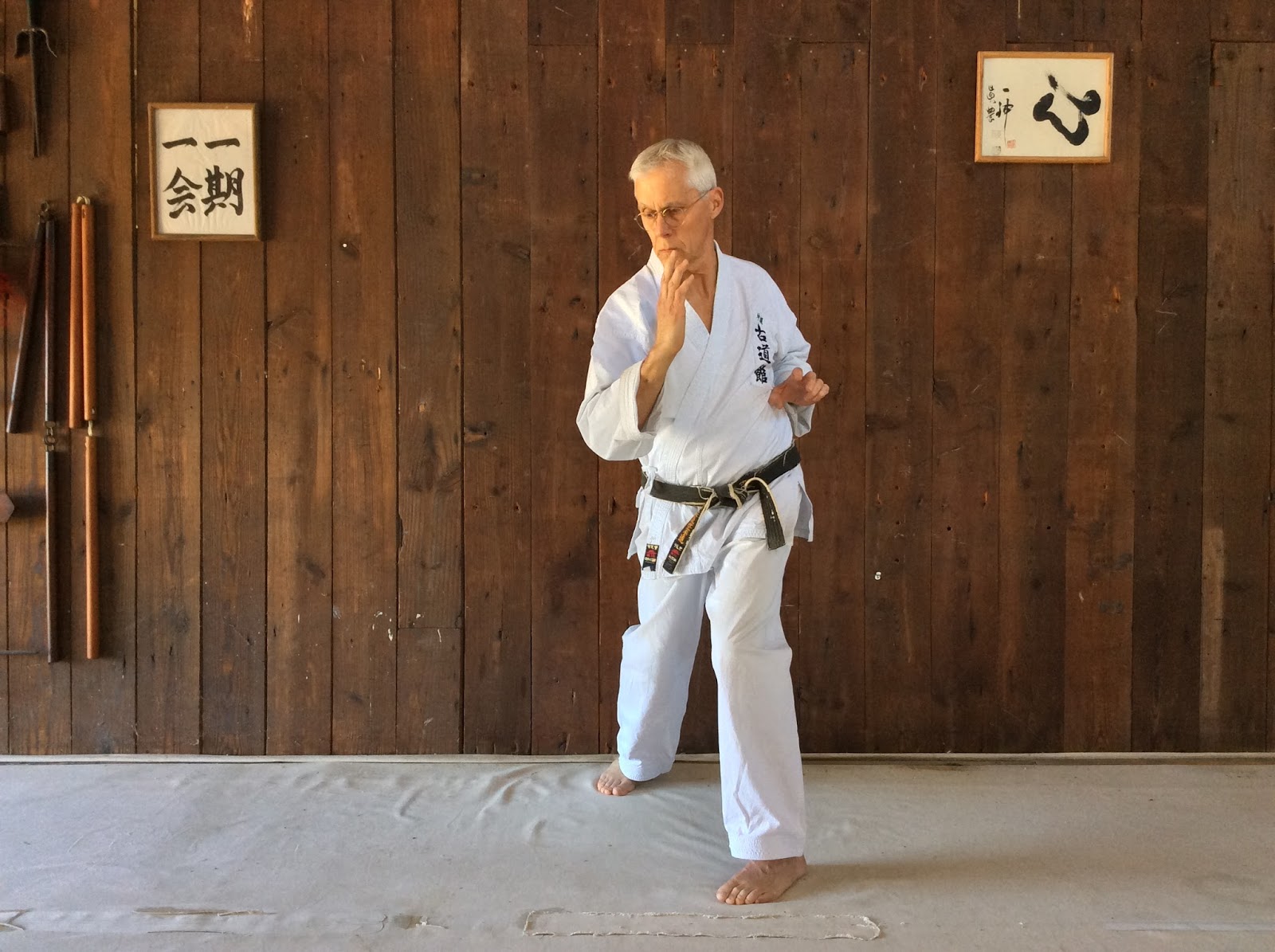
There’s a disconnect here, I think. What usually happens in kata—where at least in Goju-ryu we find illustrations of application (what we call bunkai)—is that the waist turns naturally with the initial block or parrying motion of the body (the uke or receiving technique). There is a structure to this, usually, because we learn it in Sanchin kata and we incorporate that learned movement in everything, remembering the admonition that “the arms do not move independently of the body.” This, of course, is facilitated by the notion that the first (and certainly instinctual) response to an attack is to get out of the way. Even if we can’t easily step off line, the body turns to deflect the attack or present a smaller target. The simplest way to picture this is to imagine an opponent stepping in with a right punch. The
The start of the fourth sequence in
Seipai kata.
defender turns to block the attack with the left forearm to the outside of the opponent’s right arm. The defender’s waist has naturally turned away, leaving the left hip forward and the right hip pulled back or “loaded.” In the next instant, the defender thrusts forward with a right counterattack. In each case, for both the “block” and the attack, the waist and arm move together. I’ve found that, more often than not, when you try to teach students to use the waist, they will disconnect the waist from the arms and use the arms independently, as if  the lower half of the body doesn’t know what the upper half is doing, and that seems like a lot of needless expenditure of energy. On the other hand, if all of this movement of the waist and the arms is done naturally and correctly, “blocking” and counterattacking takes very little effort. And, of course, this is greatly facilitated by the off-line stepping we see in kata, when, for example, the defender turns to block and counter, placing him or her self at a ninety degree angle to the attacker.

That seems like a rather long digression. I’m not sure what it has to do with deer standing quietly in the woods, not moving, unless it’s the notion that you probably won’t see much in the way of wasted movement when it comes to animals; they generally conserve their energy. We should too.  Oh, that, and learning to move naturally.


Friday, March 14, 2014

The geese are flying south

The geese are flying south--either that or they're lost. After all, it's well into March, and it's still colder than Flick's tongue musta felt on the schoolyard flagpole. I'd say that's a funny kind of thing that only happens in movies except that I read a story in the local paper the other week about how the Easthampton fire department had to be called when a kid got his tongue stuck to a pole (2/12/2014, www.gazettenet.com). Anyway, we had stuffed the car about as full as we could get it with duffle bags and food and boots and extra clothes, and bungeed the skis to the roof rack and headed up I-91 to the White Mountains when I started to think about ducks and geese and all. I wasn't wondering what happens to the ducks in Central Park in the winter or anything quite as literary as that, but it did occur to me--watching those geese or ducks or whatever they were...could've been crows, I suppose--it struck me that we're often headed off in all different directions.

At some point, we debate
the arc of the strike, the
sweep of the foot, the
position of the open hand.

But if you don't know the
bunkai, what does it matter?
I mean, everyone's headed off in different directions; we're not all in the same place at the same time. One student may be working on perfecting his kata. Maybe sanchin dachi is new to him, and he's trying to make sure there's only a hand span's distance between his feet while keeping his front heel in line with the toes of his rear foot. For another student, these stances feel more natural--perhaps she's been training for a few years already and she's more concerned with natural movement than precise movement. She may be working on koshi and proper body mechanics. Other students, off to the side perhaps, are working on bunkai. They have practiced kata for years and they're now at a stage where the most important aspect of kata is for it to have meaning.  They experiment with different applications. In fact, they collect bunkai. It becomes a sort of obsession. The kata they thought they had mastered now becomes an encyclopedia of possible applications. Each movement of the kata has an almost infinite number of possible applications. Viewing videos on the Internet only confirms this view of kata. It's really amazing--who created this stuff, they wonder!? There are a lot of students in this place, at this point in their training. It's the bread and butter of a lot of traditional dojos. The students, or the teacher, are always coming up with new applications to practice, new bunkai to master. Sometimes they will even create levels of bunkai--different applications for the same kata moves but reserved for different "levels of mastery" all in a not-so-subtly designed effort to retain students, I suppose. They even attend seminars with teachers from different dojos or different styles to learn new bunkai. And this is where some students and teachers get stuck.

Students will argue about the angle
of the lower hand or the height of the
horse stance or whether to step in on
a 45 degree angle or a 30 degree angle.

But if you don't know the bunkai,
What does it matter?
But off in the corner, there's someone who's wondering how all of this stuff fits together. No one creates something that can mean ANYTHING. What are the principles behind the kata, behind the bunkai? Katas must have themes that tie the different movements together. In order to be able to really USE a system of self-defense there can't be an infinite number of applications. Perhaps he begins to notice that all the moves in kata don't seem to be the same kinds of movements--some seem to be blocking moves, some seem to be controlling or grappling moves. She begins to question some of the bunkai she sees others do. This bunkai is not realistic. That bunkai only works on a willing partner. Another bunkai doesn't follow the kata. Still another one doesn't follow good martial principles. Another one leaves the defender in an exposed position. Another one is too complicated. Another takes too much strength. And on and on. The questions are good, but they're only the beginning.

The geese are flying south and I'm driving north, into the mountains. We're all headed somewhere...just not at the same time. "Are we there yet," my son asks? You can tell where people are by the questions they ask. Sometimes you can tell by the answers they give. In martial arts, you can usually tell by watching someone's kata. But their bunkai is a dead giveaway.


Wednesday, January 01, 2014

Why train martial arts?

Celebrating the New Year with
Matayoshi sensei and family.
I often find myself wondering why people train the martial arts, and the New Year is a good time, I suppose, to reflect on why we all train. We don't live in a particularly threatening environment, at least most of us. At least it's not like feudal times anyway. And most of the people I know who train karate aren't the type who go around looking for a fight. Most don't even frequent places where fights break out. So why train something that, by all appearances, seems so anachronistic?

I thought about this recently because I came across a discussion of the place of Gekisai kata in one's training (or Fukyu kata or the Pinan kata for that matter). The primary aim of these training subjects, as the evidence suggests, was to popularize karate and provide a healthy program of study for school-age children. While some of the techniques in these training subjects can be found in the classical katas of Goju-ryu--the double punch can be found both in Sanseiru and Suparinpei and the mawashi occurs repeatedly in Goju kata--techniques such as the jodan uke and the oi-tsuki or punch off the forward foot (with the possible exception of Sanchin) don't occur in the classical Goju katas. And in any case, even the front kick-elbow-punch sequence is not practiced quite the same in terms of bunkai as what occurs in Sanseiru. And yet, many dojos spend an inordinate amount of time training these subjects, even among senior students. And if not the training subjects themselves, then basics derived from these subjects. Throw in the two-person continuous bunkai for Gekisai Ichi, Gekisai Ni, Gekiha, and Kakuha developed by Toguchi sensei and most of your training time can be taken up with subjects that bear little resemblance either to the structure or the principles of the classical katas of Goju-ryu.

Matayoshi sensei at my dojo.
Which takes me back to my original question: Why do people train the martial arts? Is it for exercise or is it merely that they like the social aspect, working and moving together? Perhaps it's the spiritual nature of martial arts that comes with anything foreign or things Eastern. Perhaps for some it's the attraction of the strange rituals, the clothes, the language. Or perhaps it's just a form of exercise, though personally I think I'd rather go for a run around the block or a bike ride or buy a single scull and crew up and down the river.

Some, I'm sure, see martial arts training as a way to develop self confidence and even self defense. They may even believe that they have attained, along with a black belt, some level of menacing lethality or ability to defend themselves. They may even imagine a certain degree of invincibility, if not in terms of self defense, since most of us are less and less likely to face actual physical encounters outside the dojo, perhaps in terms of being able to face all of the difficulties that life throws at us. The problem is that those who spend so much time training Fukyu or Gekisai katas, and their attendant basic techniques, are not practicing a very lethal system of self defense. School-boy kata and bunkai were never meant to be lethal. And yet this is what most schools, at least the ones I have seen, tend to put their emphasis and time on. It's ironic that the more time you spend on martial arts, the less lethal you become as a martial artist--at least if what you're training is the Gekisai/Pinan kind of karate. Perhaps that's overstating the case...but I don't think so.

Yet the other side of the coin is just as curious. Why do we spend years practicing traditional/classical kata and bunkai--how to break someone's neck--in an age where this sort of confrontation, for most of us, is less and less likely? I'm reminded of a caption under a picture of Miyagi Chojun sensei that a friend of mine translated for me in Okinawa. It said something to the effect of "don't hit anyone, and don't get hit." Perhaps that should be the focus of our martial training. But why we train something that by all appearances seems so out-of-date is still a mystery to me...we just do it, I guess.


Thursday, June 06, 2013

Saxophones and Habitual Acts of Physical Violence

Habitual Acts of Physical Violence (HAPV) was all the rage a few years ago.  I haven't heard much about it recently, or at least that particular acronym, which got me to thinking. Why do you need to know 36 HAPV? How do you come up with the number 36 in the first place? It reminds me of Sanseiru, another 36 whose cryptic meaning has spawned all manner of strange interpretations. So is there something inherently magical about 36? I suppose someone is going to say that it's just a way to organize or wrap your head around different scenarios. That makes some sort of sense. But still, acts of aggression happen very quickly. Should I be thinking of which act of violence a particular technique is a response to when I need a quick response? Should I necessarily be thinking at all?

This is where the saxophone part comes in. My son, who has just started sax lessons, had an interesting admonition from his sax teacher the other day. He told him to try to just play the notes he sees on the scale--he said, "try not to say the name of the note in your head when you play it." This sort of by-passing the need to consciously verbalize (or think about) what you are doing made a lot of sense to me.

Back to the Habitual Acts of Violence thing....So you have 36 of these HAPV, and on that list are such things as #32 garment pulled over the head, #24 both hands grabbed from the front, #28 front arm-bar.... Now one would certainly need to respond to these aggressive acts. But aside from the rather obvious--for any number of them can't I just punch or kick the other guy?--my real question hinges on how you got yourself into this fix in the first place. Most of these acts of violence occur when you are attacked by an opponent, and that unarmed attack, I assume, means he comes at me with one or both hands, a foot, or charges me like a bull with his head. So putting the kicks and tackles aside for the moment, how many ways do I need to know to respond to his hands? He can attack with the left or the right, and on the inside or the outside. So I can block (or "receive") each attack with one of four blocks; that is, my left arm to his right arm on the inside or the outside, and my right arm to his right arm on the inside or the outside, and the same on the other side.

This would seem to me to be a much simpler way of looking at HAPVs or the multiplicity of ways one might be attacked. And if we can simplify our perception of the attack, perhaps the initial response may also be simplified and more reactive, spontaneous, or reflexive. It would, it seems to me, facilitate quick responses instead of having to think about, if you will, which "note" is being played. And lastly, each receiving
technique would lead to a limited, but still somewhat open-ended, number of bridging techniques and finishing techniques taken from other kata--thus encouraging a familiarity with variations that are useful in volatile and quick-changing encounters. So rather than expanding the list of Habitual Acts of Physical Violence--and there actually would seem to be more than 36 since the list includes variations of single-handed and two-handed attacks and the same attack from the front and the back--we should perhaps look to reduce them as much as possible. Goju-ryu classical subjects do show responses to attacks from the rear--such as the Shisochin response to #17 rear over-arm bear hug--but for the most part even a #31 single-hand shove is really the same as a #3 straight punch or a #30 single lapel grab or for that matter a #11 single-hand hair pull from the front, etc., etc., etc.  But whatever you do, "try not to say the name of the note in your head when you play it."