I have often wondered about the supposed complexity of the way many people see karate. People seem to pride themselves, and build reputations, on how many applications of kata technique they can come up with. These are the same people, of course, who propagate the notion that kata can mean anything you want it to mean.
I once read a forum post by someone who was arguing that “every inch” of movement in kata was meaningful (which I don’t have a problem with) and should be analyzed for bunkai (which I do have a problem with)—and not just full of meaning but containing multiple application possibilities. His example was the simple punch or tsuki. This technique, he pointed out to his obviously less schooled audience, in addition to being a punch, could be a block on the way out, a block on the way back, a grab, an elbow attack to the rear, etc., not to mention the multiplicity of technique s that could be gleaned if one were to couple it with the other arm. I think he randomly threw out the number twelve as the number of possible techniques one could apply from the simple punch. But this is not simple to me.
 s that could be gleaned if one were to couple it with the other arm. I think he randomly threw out the number twelve as the number of possible techniques one could apply from the simple punch. But this is not simple to me.
It seems to me that if you want an effective method of self-defense, you must simplify it. This is really what happens when you are able to see your martial art as a system. It’s what happens when you look for and base your practice on principles instead of techniques a nd the acquisition of techniques. Certainly you need to learn, practice, and study technique, but in Goju-ryu, when the techniques are based on principles (for lack of a better or more specific word), the techniques in kata can be seen as variations. And when you study kata this way, it tends to simplify your understanding.
 nd the acquisition of techniques. Certainly you need to learn, practice, and study technique, but in Goju-ryu, when the techniques are based on principles (for lack of a better or more specific word), the techniques in kata can be seen as variations. And when you study kata this way, it tends to simplify your understanding.
For example, using the Goju-ryu classical kata, one might argue that there are only four ways to block an opponent’s right punch; blocking on the outside with your left arm or hand, blocking on  the outside with your right arm or hand, blocking on the inside with your left arm or hand, and blocking on the inside with your right arm or hand. Whether you block with your hand, forearm, or closed fist is itself only a variation. So the “entry” or receiving (uke) technique of any of the Goju bunkai shown in the classical kata must begin with one of these in some manner—not, for the moment, considering responses to an opponent’s two-handed push or a grab.
 the outside with your right arm or hand, blocking on the inside with your left arm or hand, and blocking on the inside with your right arm or hand. Whether you block with your hand, forearm, or closed fist is itself only a variation. So the “entry” or receiving (uke) technique of any of the Goju bunkai shown in the classical kata must begin with one of these in some manner—not, for the moment, considering responses to an opponent’s two-handed push or a grab.
One can imagine then that any bunkai sequence that begins with a left outside block to the opponent’s right punch might “tack on,” so to speak, any other closing or bridging technique and finishing t echnique from any other kata. That is, the last technique in Saifa, for example, is a variation of the last technique in Seipai—or the corner techniques in Seipai or the second sequence with the right front kick, for that matter. They all begin with a left outside block to the opponent’s right punch attack. So one could begin with Saifa and end with Seipai.
 echnique from any other kata. That is, the last technique in Saifa, for example, is a variation of the last technique in Seipai—or the corner techniques in Seipai or the second sequence with the right front kick, for that matter. They all begin with a left outside block to the opponent’s right punch attack. So one could begin with Saifa and end with Seipai.
 The same would be true for any left hand outside block to the opponent’s left punch. We see this in the “blocking” technique in the left or west side move in Kururunfa, or the closed fist double block-punch before the “jump” in Seipai, or the double handed changing-gate technique in Sanseiru. They all begin with a left outside block (palm up) to the opponent’s left punch. So one could begin with any one of them and end with any other one.
The reason this is important is because as a matter of self-defense, as opposed to agreed upon dojo practice, one can’t predict how the opponent will move, so one must be flexible or sensitive enough to vary one’s technique. It’s easiest to vary one’s technique if one simplifies one’s technique, and one way to simplify is to see the relationships between various techniques. The system then becomes both smaller in the sense that it is easier to grasp, and larger in one’s ability to draw on any number of responses depending on the situation.
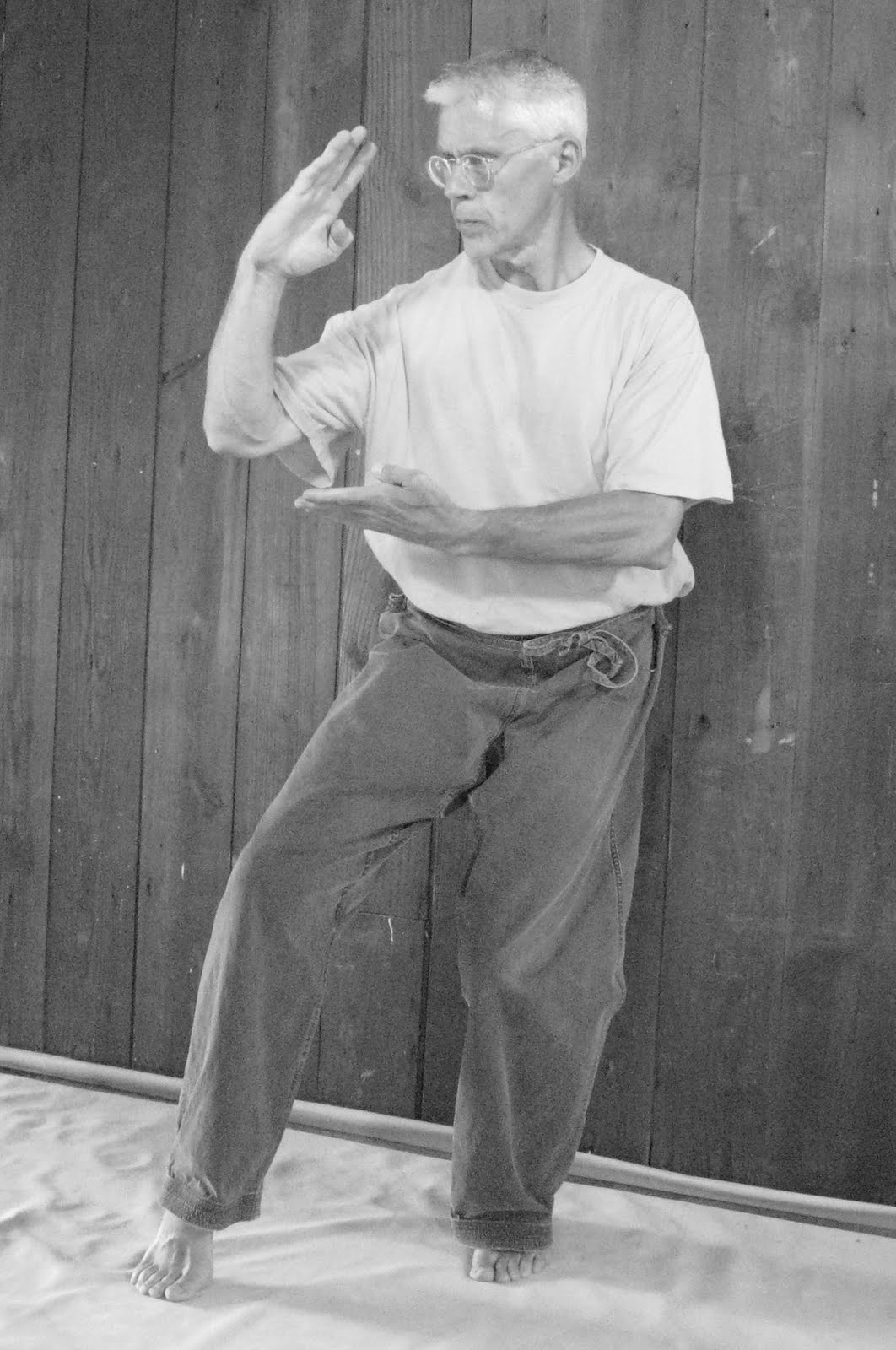
*Pictures: 1) Saifa 2) Seipai 3)Kururunfa 4) Seipai 5)Sanseiru
*Pictures: 1) Saifa 2) Seipai 3)Kururunfa 4) Seipai 5)Sanseiru


 sustained application of strength, the kind that would be evident in grappling or throwing? And yet not all slow moves seem to be used in that fashion.


