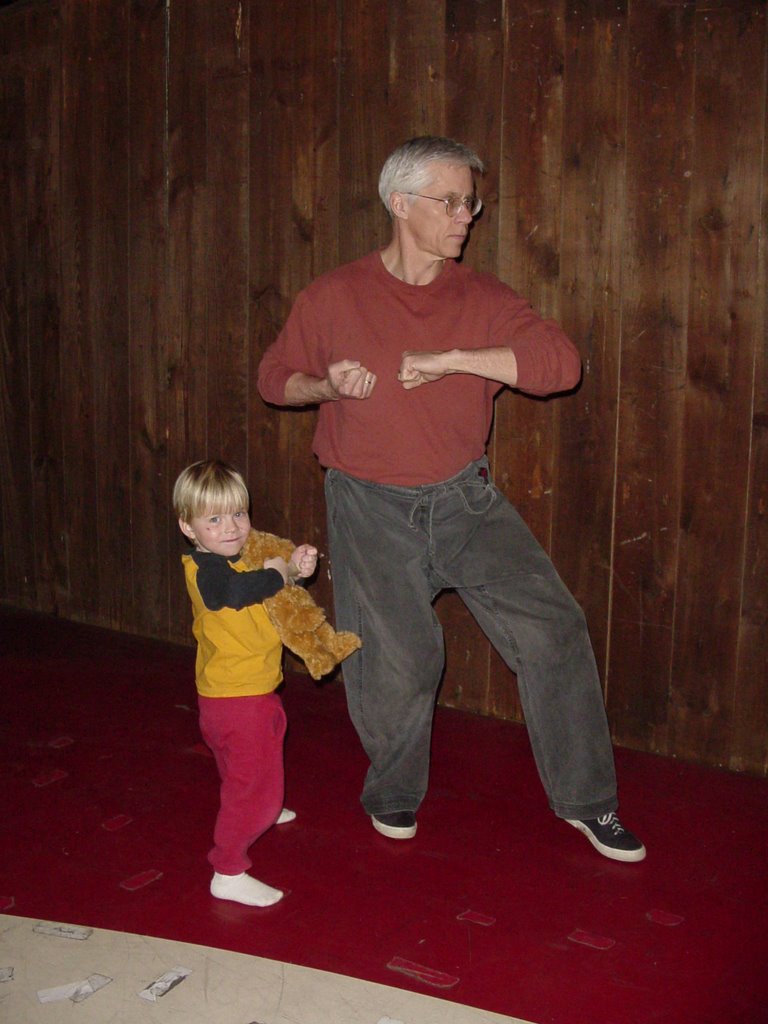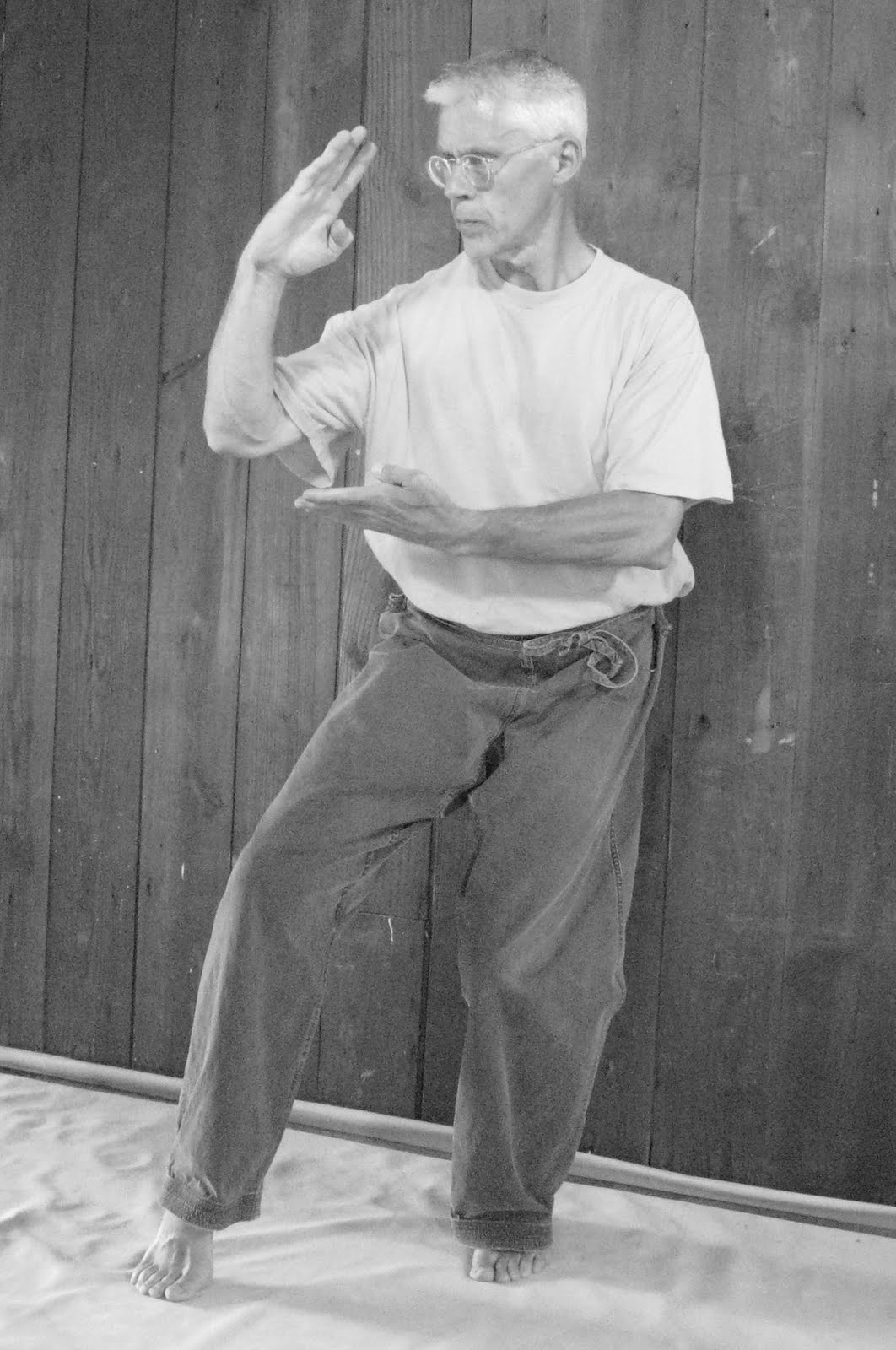
Entrance to the Barn Dojo....

Thursday, August 25, 2011

There are still questions...

Why do some katas begin with three elementary techniques, as if you were practicing basics--Shisochin, Seisan, Sanseiru, Suparinpei--while others begin with what seem to be three techniques showing bunkai/application--Saifa, Seiunchin--and some begin with neither--Seipai, Kururunfa?

Why are some techniques done slowly in kata? Is it because these moves are demonstrating a different kind of sustained application of strength, the kind that would be evident in grappling or throwing? And yet not all slow moves seem to be used in that fashion.


How were teachers able to preserve kata movement without teaching bunkai? Or is that itself an assumption--that is, is it a faulty assumption to presume that some schools accurately preserved kata? And if so, which ones? Or, how do we know they didn't teach and pass on bunkai? There is certainly some evidence to suggest that they didn't. I had a friend in Okinawa, who had been studying for 10 to 15 years, who said he had never been taught bunkai to classical kata. A senior student in Jundokan once told me that Taira sensei spent years trying to "work out" his bunkai for the classical katas, implying that he was not taught them in the dojo by his teachers. Does kata movement get corrupted when there is no reference to bunkai? Or does our natural inclination to "find" bunkai, when none is taught, corrupt the way we practice kata? Conspiracy theorists might indulge in the notion that Okinawans are just not teaching bunkai to Americans. Or others might question this altogether, saying that they have been taught bunkai and their school is very clear about bunkai. But then why does bunkai vary so much? Does kata mean anything you want it to mean provided it "works" in a fashion? If the bunkai deviates from the kata--that is, if how one applies a technique from kata doesn't look anything like it does when one does kata--can it still be called bunkai? Some would suggest that these deviations demonstrate different levels of bunkai. Is it logical that kata--meant to preserve technique--has different levels? Can something be used to show and hide at the same time?


Why do I keep thinking of a Ralph Waldo Emerson quote? "A foolish consistency is the hobgoblin of little minds." Was Emerson right or was this just an easy way out of a sticky situation?

Monday, August 22, 2011

Short Power

Liu Chang'I, lineage heir to the Liu family Feeding Crane system (Shi He Quan), will be giving a seminar in Boston on October 15th and 16th. I first met Sifu Liu when Kimo Wall sensei brought him to the states in the 90s. It was an eye-opening experience. If you have never seen real short power, or as Sifu Liu jokingly calls it, "inchy power," you really should try to make it to this seminar or any of the other seminars Sifu Liu is giving on this tour across the states. Sifu Liu is able to deliver power from all points of his body; that is, if you are in contact with his body at any point, he can use his short power to either throw you off or attack. One of the very useful things about this system is that Sifu Liu is so willing to teach other martial artists exercises that will develop this power.


I'm not really interested in proselytizing the obvious link between Goju-ryu and Feeding Crane. I think it's an unanswerable question as to whether Feeding Crane is the real Chinese antecedent of Goju-ryu. There are certainly very obvious similarities--the stance and breathing being just two. But more interesting for me is what light a little bit of training in Feeding Crane can shed on Goju-ryu. One begins to see how to truly relax one's technique and how the power generates from the body's core. Once you can see this (or feel?), it doesn't matter what part of the body delivers the attack--the open hand, the fist, the forearm, the elbow--it's all the same. The other thing that this admittedly very simple understanding of power gave me was--and I don't really know how to put it succinctly--a better understanding of what was going on in the Goju-ryu katas; that is, how the forearms, for example, were used to attack the opponent even though one might not see any significant arm movement. Since the arms are attached to the body and the body moves naturally in kata--either forward, as it does at the beginning of Sanseiru, or 90 degrees to the side, as it does in Shisochin--this forearm can, and quite effectively does, attack the opponent's neck with significant "fa jing," for lack of a better term (though one used by Sifu Liu himself), without any noticeable movement in the kata itself. One begins to see that the application of this short power is everywhere in the classical katas. And it also helps one see that there is very little of what some call "chambering" of techniques in Goju-ryu. A kind of chambering may naturally occur when the body is turning in kata, from one direction to another, where the body really catches up to the arm rather than the arm being pulled back into chamber. But there are also many cases where one should avoid this extra movement that chambering often requires. It leaves a "gap," and the Chinese Classics are very clear that there should be no gaps in one's technique. Gaps leave spaces for the opponent to enter.

Thursday, August 18, 2011

Teaching martial arts

There is an old zen parable about a very knowledgeable teacher who one day comes ot visit a zen master. Ostensibly, he comes for instruction, but right away the zen master can see that the teacher has come to show off his own knowledge...blah, blah, blah...the pouring of the tea...blah, blah...it overflows...blah, blah. Everyone's familiar with the story, but it seems to me it's particularly appropriate as every martial arts teacher has certainly encountered students who begin with their cups already full. Once and a while they arrive at the dojo to test the teacher, but more often they come in sincerely, even with humility, yet with expectations. Their expectations are filled with preconceptions about karate or just martial arts in general. Sometimes they are able to revise their expectations, but more often than not they just quit and move on, looking somewhere else for something to match their expectations. (I wonder if this is also the way most of us live life in general: not looking for challenges, but for things that reinforce, conform to, or reaffirm our expectations.)

This summer I started to teach my nine-year-old son. We did some things when he was seven and a few more things when he was eight, but only this year has he had the desire and the discipline to really begin to learn. And I am constantly amazed at how he learns. I don't explain much, but what I do find is that he is very observant and picks up very subtle movement. Even at this age, when we do Kung Li, or power development exercises, he is able to see where the power comes from and he works diligently on imitating this. I don't know whether it's because he is an inexperienced beginner or whether it's his age and a lack of expectations. A lot of times, I think our expectations get in the way.

I have seen this problem of expectations even with experienced martial artists. Their expectations, however, produce a kind of tunnel vision so that they see only what they have been conditioned to see. Like the old adage that speaks of the carpenter who sees the solution to every problem in terms of a hammer and a nail, the karate practitioner who has spent endless hours pounding a punching post or makiwara tends to interpret all kata in terms of punching, blocking, and kicking. A Shotokan teacher once asked me what I trained. I said, "Goju-ryu." He said, "Oh, that's a very hard style isn't it?" I said, "Well, actually, the name itself means 'hard-soft style." So which is it, hard or soft? I often have a hard time trying to show people another way of looking at Goju-ryu and the applications of kata. I have been told that I was wrong because my bunkai was not the same bunkai that their teachers had shown them. I try to explain the principles upon which I'm basing my interpretations but the disbelief is still there--they have been told something else, and what I am suggesting flies in the face of what they have been told by their teachers, or by their teachers' teachers. That's another subject: when do we rightly use lineage to justify what we do and when should we question this "blind faith" we have in our teachers?

Wednesday, August 03, 2011

Expectations

"People generally see what they look for and hear what they listen for." --Harper Lee, To Kill a Mockingbird


It's a lot like the carpenter who sees the solution to every problem in terms of a hammer and a nail. The karate practitioner who has spent endless hours pounding a punching post or makiwara tends to interpret all kata in terms of punching, blocking, and kicking. How do we bring an open mind, a beginner's mind, to the analysis of kata (bunkai)?


For example:


This move in Seipai kata (right) is not a lower-level block or a block of a kick, even though the final position is low, as the left hand illustrates the first of these techniques in this picture.


This move from Seiunchin kata (left) (though the photograph shows the hands reversed, that is the non-kata side of the technique) is not an assisted punch, even though that is what it is often called, and that is how most schools interpret the bunkai.


And this move from Sanseiru kata (right) is not a block of a kick, even though the stance is low and the left arm is low and the eyes are focused out front and down, and even though one can find any number of people who say that's exactly what it is...it's not.


How then does one get around this prescribed way of seeing? How can we stop our expectations from informing our thinking? We generally see what we expect to see or what we are told to see, in some cases. Question what you are seeing and apply logic and martial principles (see "Principles," first blog post).


Sunday, July 31, 2011

A little more on sanseiru

I suppose blogs are where you can air your complaints to no one in particular and not offend anyone...because no one's listening anyway. The airways are too full of noise. I read one time in an Alexandra David Neal book how the Tibetans, she says, believed that once upon a time everyone had telepathy but that modern inventions--telephones, television, radio, etc.--have messed up the airways so that nothing else gets through. There is a lot of noise out there, but not much worth listening to.


Anyway, I was watching a video of Dan Djurdjevic doing Sanseiru "as a cluster M" kata. Now what does this mean and why would one bother? What Djurdjevic was attempting to demonstrate was what the kata would look like if it were entirely "symmetrical"--that is, if all the techniques done on one side were also done on the other side--right and left equality. Mario Mckenna did a piece a while back where he talked about the evident differences in structure, trying to prove some link between some kata (Sanchin, Sanseiru, and Suparinpei) in the Goju canon and how structurally they were very different from the others, possibly evidence of different origins. Certainly there may be some truth to this--there are structural differences--but there are perhaps more similarities overall than differences and a "cluster analysis" based on so little is perhaps not the most convincing method of scientific analysis. Be that as it may, it also begs the question: A thorough understanding of the subject one is examining--that is, the bunkai of these katas--might prove more helpful than a comparison based on appearances, what the kata techniques look like.


Anyway, back to a symmetrical performance of Sanseiru. Why bother? Two questions occur to me: Where do you break the techniques apart to show repetition? Some techniques are combinations. And, this sort of performance tends to ignore the directional and angle movement demonstrated in the kata, not to mention the lesson of the 90 degree/180 degree turns. If you repeat tecchniques in a way that moves differently from the original kata, it affects the bunkai or the analysis of the kata moves.


Along these lines...I was watching an old video of Morio Higaonna doing some bunkai from Sanseiru. His bunkai for the last move of the kata was: The opponent punches to the chest with the right hand. The defender (doing kata) blocks this with his left hand. Then the opponent punches with his left hand to the head. The defender blocks this with the rising wrist block (te kubi uke), and follows this with a crane's beak attack to the opponent's eyes or face (hard to tell in the video). So what's wrong with this? Well, there's a bunch wrong with this bunkai, but most importantly it ignores the movement that the kata shows. In the kata, the defender steps back into shiko dachi at more than a 180 degree angle. The steps and turns in kata are just as important for understanding technique (bunkai) as the hands, so why are they so often ignored?!?

Saturday, July 30, 2011

The End of Sanseiru


Now William of Ockham (1285-1349) must have been an interesting guy. I often think of him when I come across inventive interpretations of kata applications. A lot of explanations of bunkai stray pretty far from kata movement. Some may be quite effective, but I have my doubts about whether one should actually call them bunkai, if bunkai is the analysis of kata. Logically, if kata is a means of remembering technique, and in applying the principles to the movements of kata one can discover the bunkai or applications of technique, then straying from a strict interpretation of kata movement would seem to be wrong-headed or at least counterproductive. On the other hand, there are those who see everything overly simplistically--that is, their bunkai tends to always be on a beginner level: block, punch, kick. Goju-ryu employs many more techniques than this and often to far deadlier effect. For example: The bunkai for the last technique or combination in Sanseiru may not be readily apparent but illustrates the softness of Goju with the first absorbing "block," the simultaneous block and attack with the hooking palm strike to the opponent's head, the stickiness of following the opponent, the use of the forearm instead of a basic punch in what looks like a double punch, and then the simplicity and control of pulling the head in with the crook of the arm, stepping back to unbalance the opponent, cranking the chin around and attacking the throat with the fingers in the crane's beak hand position. To me, this follows kata technique exactly, and yet is simple, deadly and highly effective. That's Ockam's Razor--an effective principle to use when studying bunkai.


To get there: Though the illustrations show the opposite of kata side for the last technique/combination, using kata side you have just finished the first of the double punch techniques in a right foot forward basic stance, facing west (if we imagine the kata begins facing north). Imagine the opponent coming from the west and step back with the right foot, starting the block in the first illustration as soon as you begin to move. You are intercepting the opponent's right punch. As you block, you are also attacking the opponent's head, then the left hand/arm comes down into "changing gate" to take his right arm out of the way. You are stepping to the east in order to follow the opponent and, as you do so, you execute the double punch shown in the second picture. You are punching across the opponent's throat, clotheslining him if you will. Then immediately draw in the right arm, cradling the opponent's head. Step back with the left foot into shiko dachi, pulling the opponent off balance. The left hand comes up and around to grab and pull the opponent's chin to the left. The right crane's beak attacks to the throat.

Wednesday, July 27, 2011

Blogs and pictures

Every time I write something--whether it is working on an article or writing a blog--I can't help thinking that this is time that I could be training. When I used to drive a half hour to train with my teacher, I remember him pointing out to me that I was spending an hour in the car to train for two hours--that is, for every two hours I was training I could have been training another hour.


Pictures. Many people look at the final moves in kata and use that position to interpret bunkai, missing everything in between. The application of the move can often better be seen in the movement from the previous position to the end of the next move. Like this move in Seipai. Many people look at it and see the lower hand blocking a kick simply because its final position is pretty low. But if you look where the technique begins, where it passes through the centerline of the body, you will see it as a middle level circular block. It starts on the outside of the opponent's punch and brings it across and down, opening the target.

Tuesday, July 26, 2011

Random thoughts on Sanseiru

We've been working a bit recently on Sanseiru. There are those who have suggested that the canon of Goju kata should be separated--based on some selective historical hearsay or what seems to be slightly flawed "cluster analysis"--with Sanseiru, Seisan, Suparinpei and Sanchin on one side, and Saifa, Seiunchin, Shisochin, Seipai, and Kururunfa on the other.


But, using only one example, how does one then explain the similarity between the "changing gate" blocks of Sanseiru and Seipai--open hand in the first kata and closed hand in the latter? Admittedly, there does seem to be a kinship between the structures of Seisan and Sanseiru, but there are many more similarities between all of the different katas, those included.


I find the changing gate block (the illustrated technique and the move that follows it) a fascinating technique--typifying many aspects of Goju, from the simultaneous block and attack, to the "softness" of the technique, to the ability to almost instantly change attacks. Another aspect of this combination fascinated me as well: The first time it occurs in kata--facing north from the double open-hand down technique in shikodachi--the attack is from the front or north. The defender (kata) is in a 90 degree relationship in applying this technique. In the second instance, facing west after the double punch, the attacker is coming from the west, and the defender (kata) "absorbs" the attack, stepping back with the right foot, right forearm blocking and left open palm attacking, and then follows the attacker along the west-to-east line into the double punch; that is, in this second application, the relationship has moved to one of 180 degrees. Interesting, because both Sanseiru and Suparinpei employ this 90 degree/180 degree movement in the structure of their center sections.


Of course, this directional turn does not occur in the way Sanseiru is done in all schools. The Toguchi Shoreikan, for example, will turn to the left into a closed hand chudan block (done twice with a step) before this second technique. They also don't quite employ this "changing gate" block, though one can see a vague similarity. And there are certainly other differences as well.

The opening of Sanseiru is also different to some extent in the Shodokan of Higa Seiko sensei. After the three "punches"--or tsuki-uke (my own thoughts on the subject)--there is a right open hand block (or grab), followed by the left open hand coming to the right elbow and stepping back into a front stance as the left hand is swept out along the right extended arm. Some have described this as a grab release. Some have even suggested that the hand follows your own arm as a means of situating your technique in the dark! I believe this is an arm bar, which follows the tsuki uke and grab. Once you have stepped back into the front stance, levering the opponent down, you then reach over for the head (in the Shodokan version), as you step forward. In the process of stepping forward, the left hand quite naturally scoops the opponent's right previously barred arm up and locks it out of the way. The defender's right arm is now grabbing the opponent's head, the left arm controls the arm and is lying on the opponent's back. This is then followed by a left knee to the opponent's ribs, moving forward into a right elbow attack, etc.

Curious to me how the different schools of Goju developed different versions of this opening. And more curious still, how some schools "fudge" their explanations by saying things like: "The kata may show one stepping back into front stance, but in reality one would step forward." Or, trying to block and grab an opponent's kick with this technique...as if, one, his kick is really that slow, and, two, he wouldn't then punch you in the head! Anyway, just my own random thoughts.


Wednesday, May 30, 2007

Cryptic?

In a recent blog, Mario McKenna turns his thoughts to the writings of Toyama Kanken, writing in Encyclopedia of Karate-do, who, according to McKenna, wrote:

Secret technique begins from simple technique.

Simple technique ends in secret technique.

In the beginning there is no secret technique, in the end there is secret technique.

One must grasp and forge the intangible key.


McKenna asks, "is Toyama being [purposefully] cryptic"?

Certainly there is a long history of cryptic statements--or at least poetic description--by practitioners of the martial arts. The Chinese classics particularly abound with poetic description that is perhaps only really understood by those who already know what they are doing. That is, writings would seem to serve as reminders rather than learning tools. So what is Toyama hinting at?

Kata, I would suggest, are composed of basic techniques (usually found as strings of three at the beginning of the kata) and combinations or sequences that show the applications of techniques. Each combination begins with a "uke" or receiving technique, an entry if you will, which is generally followed by a controlling or attacking technique, which is itself followed by a finishing technique/s. The controlling and/or finishing techniques are fairly situation specific and may appear more "complicated" in comparison to other techniques. They also yield up their applications fairly readily to the observer or practitioner. The entry techniques and the "basics" appear somewhat simpler, and consequently seem more cryptic. One needs an "intangible key" to understand them. That "intangible key" is a way of looking at the kata--to see it as a collection of combinations, each beginning with an entry or "uke"; to see the steps in kata as an indication of how to move off-line; and to see that the attacker is not necessarily coming from the front or the direction we may be facing, but from the direction we are stepping away from. In the end, Toyama expresses all of this in a wonderfully simple manner--three little phrases!

Wednesday, June 21, 2006

Principles of Goju-ryu

There are many "principles" one might apply to the study and training of Goju-ryu. However ambiguous the term may be, I will list a number of ideas that I have found useful in analyzing kata. Here is a short list:

 Katas are composed of combinations or sequences of techniques. Certainly there are an infinite number of techniques that one can study, but one will never truly understand Goju-ryu as a system until one can clearly see the combinations or sequences contained within the katas.

 “Eyes see in four directions. Ears hear in eight directions.” This means that one should be aware of an attack from any of the four directions: front, either side, or behind. The eight directions are not directions of attack, but response. One should “listen” or be able to read the opponent’s attack in order to respond in the correct manner. That is, in reading the opponent’s attack correctly—which side is attacking, where his balance is, how much force is being used—one will know in which direction to move, whether forward, back, to the sides, on an angle to the front, or stepping away at an angle. These are the eight directions which one employs against an attack: in terms of the compass, they are north, south, east, west, northwest, northeast, southeast, and southwest. The katas illustrate this movement.

 Steps and turns indicate directions of attack. That is, directional changes in kata show where the attack is coming from and how to step off the centerline. Turns in kata do not show the defender turning to face the attacker, but stepping off the line of attack in any one of the eight compass directions. Always step off the centerline when this is possible. Always remove your center. Put more simply, get out of the way.

 Each sequence or series of techniques begins with a block and ends with the opponent on the ground or finished. To understand kata, look for the beginnings and the endings.

 Study the relationship between the hand and the elbow in all techniques and all katas.

 Block the arms, but attack the head.

 In karate there is only one attack. This means that the attacker is allowed only one punch. When this is blocked, the karate-ka moves in such a way that the attacker cannot attack a second time.

 Rather than collections of individual techniques, katas in Goju-ryu were formed to show variations of technique or principles.

 Block on the outside, move to the inside. It is safer to be outside, moving in only to attack.

 Look at techniques as if they were applied in combat on the battlefield, not as if they were restricted to competition or demonstrations. Bunkai is a response to fully committed or surprise attacks. It is not meant to mimic sport or a mutually agreed upon contest. Karate is not boxing. However, there are many counters in kata that show responses to an attack that is not a fully committed attack or a response to an attacker that has begun to withdraw. This has to do with listening skills.

 Techniques that appear to be repetitions are often meant to be done together. That is, they are part of the same sequence combination, done against a single attack by a single attacker. This may not always be the case in kata, but such techniques occur often enough that one should not always assume that such techniques are done simply to practice on both the left and right sides. This is particularly evident when there is the repetition of four similar techniques.

 When a block or grabbing technique appears with an advancing rather than retreating step, the opponent is already being controlled. This usually means that one already has control—has hold— of the attacker’s head or arms.

 The cat stance is used to attack with the front knee. Sometimes kata will show this and other times it will only be implied. But it should be noted that the technique being applied makes the use of the knee possible.