Entrance to the Barn Dojo....

Saturday, August 24, 2013

Bunkai thoughts: Can we please apply logic to the analysis of kata?

Imagine some guy in ancient Greece sitting around contemplating the universe. Maybe he's woken early and trudged the sheep out to pasture. Sitting up on a rocky crag, he looks out over the sea, waiting for the sun to rise. Maybe he's praying that Apollo will harness the horses to carry the chariot of the sun up into the sky or maybe he realizes that all of that's simply an old worn-out myth. Maybe he looks at the world more
scientifically, more empirically, and when the sun finally comes up, rosy-fingered and all, it suddenly dawns on him that the earth is the center of the universe. He trusts his own eyes instead of tired cultural beliefs. It's obvious that the sun revolves around the earth; it comes up in the east and goes down in the west. If he were a little more worldly, if he had managed to make his way into Athens to visit the great academy there, he might have been able to ask one of the great teachers. Perhaps he could have consulted Aristotle himself and had his suspicions confirmed by the great minds of his day.

And yet today, we ask, how could he have been so wrong? How can the observations of his own eyes have led him so far from the truth? And how is it that those who are so esteemed, their venerable positions in the community so entrenched as to be referred to with sobriquets as sobering as "The World's Greatest..." could possibly err, could possibly have gotten it all wrong?

So, if you get my drift, sometimes I wonder if the same sort of thing can be applied to Goju-ryu kata and bunkai (the analysis of kata). Are we--at least those of us who are curious enough about it even to ask--content merely to practice kata the way that it has always been taught? Or the way we have been told to do it by the great teachers of our day? But then what other way is there? What other way was there for those who followed that ancient Greek guy up the hill to watch the sun rise?

Sometimes the theories need to be put to the test--and not just of observation, because we can't always trust what we see. What we see is often influenced by our expectations. We need to apply logic and look for sound basic principles. What else did Copernicus or Galileo have to do? So much of the bunkai I see on the Internet seems to ignore so many fundamental things. It's as if someone in a high school science class merely threw out data that didn't conform to the conclusions they already expected to find. And peer pressure has convinced everyone else to follow along.


How radical is it to suggest...that if one is analyzing the techniques of kata, one should do the moves the same as one does them in the kata? that if the opponent has the opportunity to hit you again, then you're probably in the wrong place? that if your counterattack does not either put the opponent down or make it extremely difficult for him to continue his attack, you've probably got it wrong? that the pattern of angles and turns in any given kata is important in how one moves in response to an attack? that correct bunkai does not need to add anything to finish the attacker off? that, hojo undo training aside, and this is self-defense after all, if the response takes too much strength or speed then you've probably got it wrong?  that punches and kicks are not the most lethal responses to an attack and therefore may be quite minor aspects of the karate arsenal or even the repertoire of techniques one sees in kata? that if anyone tells you the real bunkai is hidden or just have faith or you aren't up to that level yet, they're peddling the same hocus-pocus as an old-time snake oil salesman and you're about to sign up for cult membership?


See it on YouTube:
"Saifa kata and bunkai
 Northampton
Kodokan"
You want "proof"? Then every time you do bunkai, ask yourself:  Does it follow the kata, and I mean all aspects of the move in kata? Does the initial move or technique (uke) put you in a safe position--that is, the attacker has only been allowed the one attack (after all, this is self-defense)? Is it lethal--that is, in Goju-ryu at least, is it literally lethal? With one caveat: Remember that if you do stumble upon the real bunkai in any of the Goju-ryu kata, don't try it at home. Too dangerous!

Sunday, August 11, 2013

Saifa kata and bunkai

So the summer is finally winding down. The temperature this morning was in the 50s (F.) and there was condensation on the seat of the scooter I had to dry off before I rode down to get the morning paper. Still recovering from a bronchial infection and a cough that has put a serious kink into training for a fall marathon. Probably shouldn't have done that half-marathon last week but....

"Hey, hold on there partner. What's all this drivel?"

My bad self stood looking over my shoulder as I got up for another cup of coffee. "I'm writing this blog..." I started to answer defensively and a little unsure of what I could say that would be at all convincing. I mean, why do people write blogs? For that matter, why do people read blogs? Sometimes I think there's just too much noise out there anyway. Unless you've got something to say, I suppose, and even then, who listens? Or reads for that matter. We've become a nation of watchers. I'm not sure that's necessarily bad, but it sure ain't what it used to be. I remember giving a seminar to a group once upon a time. The teacher was a friend and had seen the first article I had written on the subject of Goju kata and bunkai for the Journal of Asian Martial Arts--"The Lost Secrets of Okinawan Goju-Ryu." This was back in 2002. I wanted to gauge how much he understood of it to get a better idea of where we might begin the seminar, and so I asked him how he liked it and what he got out of it. He said, "Oh, I'm not much of a reader."

And so, for all you non-readers out there. Here's a video of Saifa kata and bunkai.

"Saifa kata and bunkai Northampton Kodokan"
http://www.youtube.com/watch?v=MGVjubgVKI0


We pulled out the camera after training on one of those very hot and humid days during that heat wave in July. It's certainly not very professional and we were not setting out to perform for the camera. There are mistakes. But it's a training video. It shows a little of what we do. So in the words of Edward R. Murrow, "Good night and good luck." I'm going for a run.

Friday, July 12, 2013

Weeding the garden

The rains finally let up this week, at least for a day. The mosquitoes are still horrendous but with the sun out they keep mostly in the shade. Of course I had slathered on quite a bit of deet, so that may have been the reason. But what struck me, as I was pulling out Creeping Charlie and blades of grass and all manner of unidentifiable weeds from around the oregano and rosemary and catnip, is that it always seems as though the weeds take over. Why is it that the garbage stuff seems to proliferate and choke out the good stuff? Is that just the natural order of things? I read some place that when humans are gone from the earth it will be the cockroaches that take over. Of course, in the martial arts it may be different....

So I was watching a kung fu class training in the park the other day. Just a few people doing "animal forms." The teacher had said that they should just practice moving like the animal that they were envisioning. I didn't see anyone trying to be a cockroach though. A few people were prowling around being tigers or leopards or some sort of cats. And, of course, there were the obligatory cranes, though in this case I think they were black cranes, at least they were dressed in black. There were snakes, but they were walking upright too. I guess they were snakes before the Fall. It was sort of entertaining for about five minutes, before it started to get silly and irritating. I mean, these were all adults.

But I started to wonder about Goju-ryu kata. I've had a lot of conversations with people--some not so friendly--who steadfastly and adamantly argue that kata can mean whatever you want it to mean; that is, any bunkai/interpretation of kata movement that works is good, supposedly because the katas were created with this sort of intentional ambiguity. Look on the Internet some time and you will find all sorts of different explanations for the same moves in kata. Is everyone right? Or are most of them wrong?

I started to picture a couple of people fooling around in a park. Maybe one of them is a particularly good mimic. He starts to prowl around like a cat. Pretty soon he really gets into it, especially as he notices a number of people watching him. His friend thinks it's also pretty cool. Pretty soon they've developed a set routine and they call it the cat...or the snake...or the crane. They teach others. One thing leads to another, and slowly, over time, these random, meaningless movements take on a life of their own.

Of course, that's a ridiculous scenario. Kata did not come first, though there are plenty of people out there who think that this is a point as open to debate as the chicken and the egg. Isn't it far more likely--perhaps one should substitute logical for likely--that bunkai/application came first, and then in order to remember particularly good and effective applications they were put into solo routines so that they could be remembered and practiced in the absence of a partner or teacher? It's hard for me to believe that this is not universally acknowledged, but the larger question is, if we accept this: How do we know which applications are the ones originally intended by the kata? Are yours as good as mine? Are mine as good as some renowned teacher who has books and dvds and seminars?

Some would say you can't, since that would be trying to figure out what the original creators of the katas had in mind. But does that close off all of history to us? We unearth artifacts to learn about past civilizations. We apply the scientific method to problems in the universe. We analyze evidence to solve crimes. Why can't we apply logic and a knowledge of martial principles to the analysis of kata? Without it, it seems to me, we are doing a disservice to the garden, letting the weeds proliferate. Without it, the cockroaches will soon take over, and where will we be then?

Tuesday, June 25, 2013

Sanchin and stuff again

I recently came across this analysis of Sanchin kata.

http://www.youtube.com/watch?v=0qrGwPGku68

I'm not sure the link actually takes you to the right place, but it was a YouTube video called "Sanchin Basic Analysis."

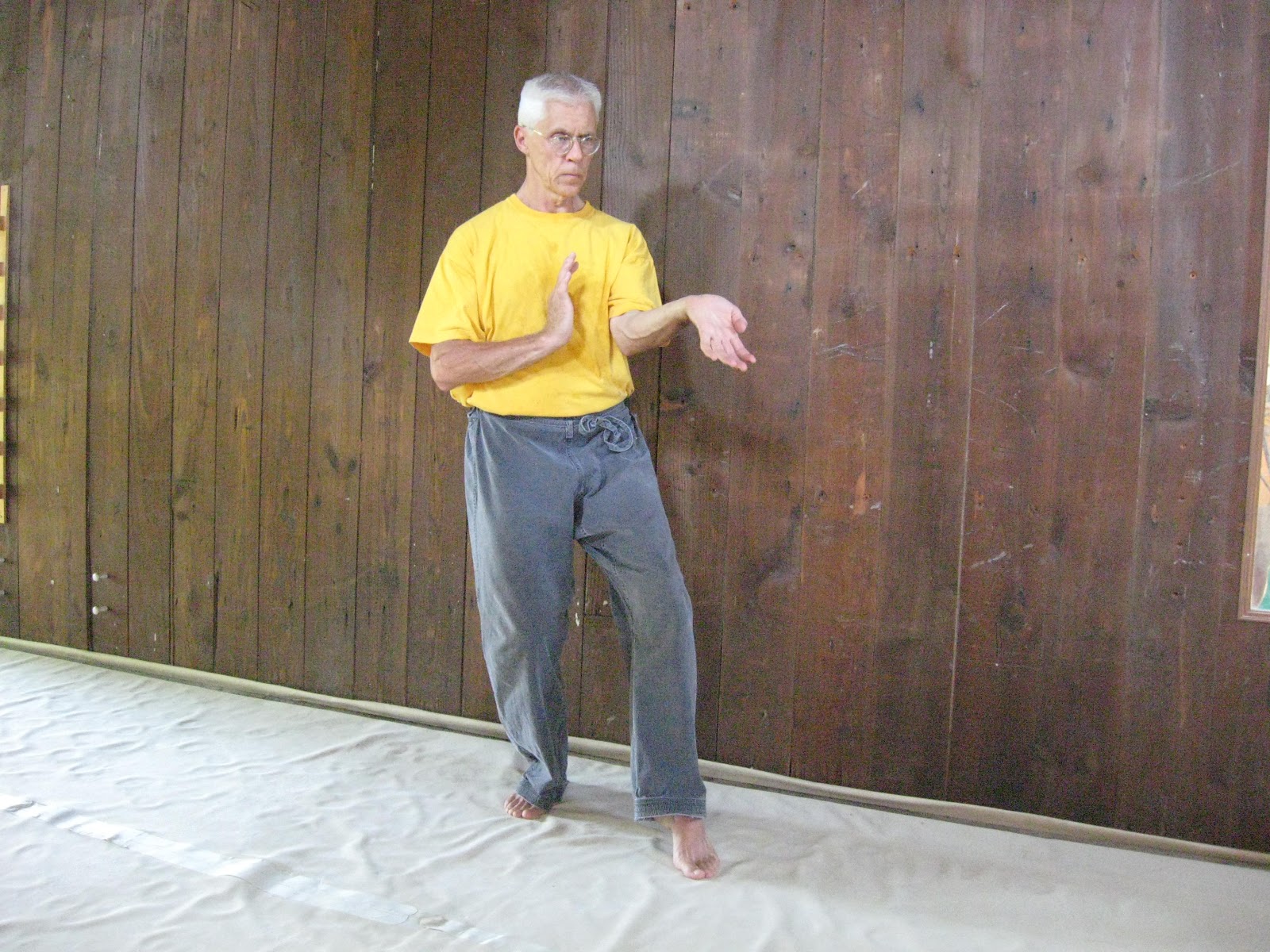
Yang Chengfu standing
in the Wu Wei posture
Now I must admit that any analysis of Sanchin--that is, the attempt to find bunkai in Sanchin--baffles me. A number of principles certainly, but I don't believe Sanchin in Goju-ryu was ever meant to be seen as a bunkai kata in the same sense as the other Goju subjects. I've written about this before. It's my belief that it's a futile endeavor--it's a basic kata to study  posture, breathing, and a number of other basic things--or, at best, the techniques are so elementary that it begs the question of why one would spend time trying to "find" applications for Sanchin when the other classical subjects are so much richer with intentional bunkai. I suppose this sort of thinking comes from what seems to me to be a misunderstanding of the oft-repeated statement that Sanchin is the fundamental kata of both Goju-ryu and Uechi-ryu. What do we mean by fundamental? Surely that doesn't mean, as I have sometimes heard, that the root of all Goju/Uechi techniques can be found in Sanchin. If that's true, it's certainly putting too fine a point on it for me. That's like saying that all T'ai Chi postures can be found in the Wu Wei beginning posture. I suppose in one sense that's true, as Wu Wei is emptiness or non-action, and all things begin from non-action, but it doesn't really get you very far.
First technique in Saifa kata

But what did interest me about this analysis of Sanchin was that the person demonstrating the techniques was doing the same technique against a right attack or a left attack, moving to the inside of the attacker or the outside. I have heard the same thing from some kung fu practitioners (and other karate people)--that you should be able to execute any technique regardless of which hand the attacker is attacking with. The "logic" behind this, as expressed to me, was that you don't have sufficient time to figure out which hand someone is attacking with and respond with the appropriate hand. I think this is ridiculous for two reasons: one, all techniques do not work from either side; and two, while I may not have sufficient time to contemplate which technique might be an appropriate response in a split second, I certainly have time to move and raise a hand to either the inside or the outside of the attack. That is, though I may not have time to contemplate which "bridging" or "finishing" technique may be appropriate, I certainly have time to respond with a "receiving" (uke) technique. (If I don't, I get hit--which means responding to the inside or outside with the same technique makes no difference anyway.)
What I do from there is dictated by my initial movement or uke (receiving of the attack)--and Goju actually shows a limited number of ways to receive that initial attack--the attacker's movements, and which controlling and finishing techniques fit with my initial response. One thing leads to the other rather
Part of second technique
in Seiunchin
fluidly and without a lot of thought. For example, the opening or first technique of Saifa (a technique that is shown three times to show the other side) is against an opponent grabbing my right hand with his left hand. It doesn't work if the opponent grabs my right hand with his right hand. If that were the case, I would respond with the second sequence of Seiunchin kata. Sometimes techniques are shown multiple times in kata because the kata shows attacks from one side or the other; the message is not, on the contrary, that the same technique (done with the same hand that is) should be able to be applied against any attack. Most of the time in Goju-ryu, this response is fairly easy to see based on the principle that the safest place to be or the safest response is to move to the outside of the attack. Training and logic both provide us with this answer. The problem, I think, is that the training is often not real enough or logic has flown right out the window.

Thursday, June 06, 2013

Saxophones and Habitual Acts of Physical Violence

Habitual Acts of Physical Violence (HAPV) was all the rage a few years ago.  I haven't heard much about it recently, or at least that particular acronym, which got me to thinking. Why do you need to know 36 HAPV? How do you come up with the number 36 in the first place? It reminds me of Sanseiru, another 36 whose cryptic meaning has spawned all manner of strange interpretations. So is there something inherently magical about 36? I suppose someone is going to say that it's just a way to organize or wrap your head around different scenarios. That makes some sort of sense. But still, acts of aggression happen very quickly. Should I be thinking of which act of violence a particular technique is a response to when I need a quick response? Should I necessarily be thinking at all?

This is where the saxophone part comes in. My son, who has just started sax lessons, had an interesting admonition from his sax teacher the other day. He told him to try to just play the notes he sees on the scale--he said, "try not to say the name of the note in your head when you play it." This sort of by-passing the need to consciously verbalize (or think about) what you are doing made a lot of sense to me.

Back to the Habitual Acts of Violence thing....So you have 36 of these HAPV, and on that list are such things as #32 garment pulled over the head, #24 both hands grabbed from the front, #28 front arm-bar.... Now one would certainly need to respond to these aggressive acts. But aside from the rather obvious--for any number of them can't I just punch or kick the other guy?--my real question hinges on how you got yourself into this fix in the first place. Most of these acts of violence occur when you are attacked by an opponent, and that unarmed attack, I assume, means he comes at me with one or both hands, a foot, or charges me like a bull with his head. So putting the kicks and tackles aside for the moment, how many ways do I need to know to respond to his hands? He can attack with the left or the right, and on the inside or the outside. So I can block (or "receive") each attack with one of four blocks; that is, my left arm to his right arm on the inside or the outside, and my right arm to his right arm on the inside or the outside, and the same on the other side.

This would seem to me to be a much simpler way of looking at HAPVs or the multiplicity of ways one might be attacked. And if we can simplify our perception of the attack, perhaps the initial response may also be simplified and more reactive, spontaneous, or reflexive. It would, it seems to me, facilitate quick responses instead of having to think about, if you will, which "note" is being played. And lastly, each receiving
technique would lead to a limited, but still somewhat open-ended, number of bridging techniques and finishing techniques taken from other kata--thus encouraging a familiarity with variations that are useful in volatile and quick-changing encounters. So rather than expanding the list of Habitual Acts of Physical Violence--and there actually would seem to be more than 36 since the list includes variations of single-handed and two-handed attacks and the same attack from the front and the back--we should perhaps look to reduce them as much as possible. Goju-ryu classical subjects do show responses to attacks from the rear--such as the Shisochin response to #17 rear over-arm bear hug--but for the most part even a #31 single-hand shove is really the same as a #3 straight punch or a #30 single lapel grab or for that matter a #11 single-hand hair pull from the front, etc., etc., etc.  But whatever you do, "try not to say the name of the note in your head when you play it."

Friday, May 17, 2013

People say the damnedest things

I was raised to think that there were no stupid questions...only stupid answers. But I think I may have grown more curmudgeonly as I get older. Human behavior in general perplexes me. Sometimes it's the big things that confuse me--like why would someone place a bomb at the finish of the Boston Marathon? Sometimes it's just stupid little things--like the guy driving next to me on the highway at 65 miles an hour and texting with the phone right up in front of his face. Well, maybe that's not such a little thing either. But here's my list of stupid karate questions, and it's not exhaustive by any means, only the ones that come to mind at the moment:

What's your favorite kata? (If it is a system, should we be focusing on individual parts of the system to the exclusion of others or favor one part over any other part?)
How high (or low) should your shiko-dachi be? (Does it really matter as long as it is stable and functional?)
Do you practice karate or karate-do? (I practice this stuff. I don't really care what you call it.)
Why does this teacher (or was it that teacher) turn his foot when he steps forward in Sanchin? (Sanchin is a kata to train stance and posture and breath, etc. It's not a bunkai kata. It doesn't matter whether you turn the foot before you step.)
Is this a cluster "M" kata or a cluster "H" kata? (Who decided on these categories anyway? Whoops, that's not fair responding to a question with a question. Ah, tough, that's all it deserves.)
How long does it take to make black belt? (As long as it takes.)
What kata is the best for self defense? (Depends, doesn't it?)
Do you kick with the ball of the foot or the heel? (Depends, doesn't it?)
What kata is the deadliest? (All of them.)
Should you cross-train? (Don't we already?)
Did you know that karate was not even systematized until the 20th century? (Not fair--rhetorical! Why do people ask questions they already know the answer to?)
Which do you think came first, kata or bunkai? (Emphasis on you and thinking, as if this is, in fact, open for discussion. It's not. Guess what the answer is.)
Hey, I wonder what it would be like to focus on one kata for five years? Or even one technique for a year? (Stupid. What a waste.)
Do you say "Osu"? (Will it help my karate?)
Do you spend more time on basics, kata, or two-person bunkai? (You do what you need to do, don't you?)
Do you wear a gi at your school? (What for?)
Matayoshi sensei helping my
daughter Emily on her first bike.
Do you practice "flow drills"? (Whatever the hell they are?!)
Do you compete in tournaments? (No, I buy my plastic trophies at the local sporting goods store instead.)
Aren't all styles really the same--they just take different paths to eventually get to the same place? (No, some styles are better than others.  And some are so corrupted that it's hard to see the original intent anymore.)
What the heck is "oyo" bunkai? (Now that's a good question. And while we're on it, what are different levels of bunkai? Bunkai is bunkai.)

The Greeks had a name for it...hubris. Most of these questions reek of hubris. A Greek tragedy in the making. This rant smacks of hubris too, doesn't it? But that's the irony of it, isn't it?


Saturday, May 04, 2013

Marathon training at my age???

This is a bit of a ramble. In fact, I'm hesitant to even write a post like this. I've tried to  keep all of my blog posts focused on Goju kata and bunkai--technique rather than musings about my personal "journey" or what it means to train, etc. I wonder sometimes why people share all that personal stuff. Why should someone else care? What does it have to do with my own training? After all, I'm not trying to proselytize; I'm just training and sharing what I do. What others make of it is up to them. The funny thing about blogs, in fact, is I'm not exactly sure what purpose they serve. You never really hear from most of the people who read your blog, so you have no way of knowing who you are reaching or what they make of what you're saying. Sometimes I think most people only encounter your blog when you mention some well-known person that the Google algorithm can pick up on a random search. The most email I've received has had to do with posts I've written that were critical of Higaonna sensei or Taira sensei or Mabuni sensei. Those individuals are, of course, so popular that any criticism calls into question what you yourself are doing. That is, if I am in disagreement with those individuals who are so popular--and their students and their organizations--then I must be doing something wrong. A minority of one. I never felt particularly uncomfortable being in a minority of one though. After all, the majority of Americans watch "reality" TV. The majority of Americans eat at McDonald's. The majority of Americans, I recently read, believe in ghosts but don't believe Darwin was correct. And we shouldn't forget that the Church (the Roman Catholic Church) only came out a few years ago to say that it had perhaps been wrong about Galileo. I am reminded of something Hamlet says:

"Sure, He that made us with such large discourse, looking before and after, gave us not that capability and god-like reason to fust in us unused."

But all of that perhaps is neither here nor there...the effusive ramblings of the typical blog post. I'm not training at the moment...obviously. I'm actually sitting here typing, with a glass of wine, listening to Bach violin concertos. I wonder how many intense martial arts blog posts and forum comments are written under the same or similar conditions?

But when I sat down, I was thinking of writing about training for a marathon....a 26.2 mile run. I'm not really a runner, but this is what I've been doing--in addition to martial arts training, of course--for the past three to four months. But first-time marathon runners can get really obnoxious, so obsessively focused on what they're doing. It's certainly understandable; the training for a marathon is really really hard. It's an incredible challenge. It's probably not even good for you. But I think challenging yourself is, at the very least, interesting. And anyone who hasn't trained for a marathon can't really relate to it. Sort of like traditional karate training. I've met a lot of people who say, "Oh, you train karate? I did that once." But what they did was a month of Fred Villari stuff or a year at the local American Kempo Institute. What do they know?

When I first started training Okinawan Goju-Ryu with Kimo Wall sensei, we trained two hours a day, five days a week, and sometimes on Saturday as well. Sometimes we would slip shoes on and go out and train in the snow. Often we trained in hallways or stairwells. The club at that time had fifty or sixty members who trained regularly. We would do basics--blocks, punches, and kicks--and count around the dojo, each person counting to ten. And that was followed by kata or two-person paired basics or two-person bunkai with training subjects. We would have speed drills in pairs till you wore yourself out, going home with bruises up and down the forearms. In between training kata and bunkai, we might do shiko-dachi races, carrying a classmate across the floor on our backs. Or we might have races across the floor in push-up position. Or we might have tug-o-wars with our belts. And, of course, there were all of the traditional drills--arm pounding, log tossing, push-ups, sit-ups, breathing exercises, stretching, learning to sit in full lotus, etc.

I'm thinking of all this because it reminds me of a training story I once read. The point of the story was something to the effect that if you didn't train hard when you were young and strong, then you wouldn't have anything when you got old. You would only be a paper tiger. When I'm out on those fifteen or twenty mile training runs--and my feet hurt and my knees ache and my hips are starting to bother me and I'm wondering what the heck I'm doing all this for even for the briefest of moments--I remember how hard we used to train in the old days. It's a reminder for me of the mental, physical, and spiritual effort that karate training attempts to foster in students, and the phrase we often heard: "Ganbatte kudasai!!" Never give up. I'll remember that when we head up that hill at mile fifteen!

Ganbatte kudasai!


Thursday, April 11, 2013

Seiunchin "uke" in pictures

Reversing the grab to use an arm-bar.


First Seiunchin entry or receiving technique against a wrist grab.


Trapping the hand to escape a grab.


Second Seiunchin entry or receiving technique against a wrist grab.


Dropping back to avoid the push
and control the arm.


Third Seiunchin entry or receiving technique against a two-handed push.

Side-stepping to block a push
and attacking at the same time.


Fourth Seiunchin entry or receiving technique against a two-handed push.


I mentioned in a much older post that Goju kata are composed of combinations or sequences that teach not only the bunkai (or imi-wa) of individual techniques but also the principles of the system. But in order to see any of this, you have to start with the "uke" techniques or the entry techniques. This, I think, may be what was meant by the saying: "Karate Ni Sente Nashi" (There is no first attack in karate). In other words, karate is a system of self-defense and does not initiate a violent or aggressive encounter. But it would also seem to go further than this--that is, the idea seems to be reflected in the techniques of kata. Each sequence or combination of techniques begins with an "uke" or receiving technique, regardless of which of the classical kata you are considering. From there it is easier to understand the "controlling" or bridging techniques, and finally the "finishing" techniques in kata, and in turn the structure of kata. There are, of course, some who dismiss this view of kata, and there are certainly many more who make their names and reputations on finding hundreds of applications for each subtle movement, an infinite variety of techniques or levels of bunkai, if you will. But one should always approach things with an open mind. So here are the five entry techniques of Seiunchin kata. 


Tying up the arms to escape a grab.


Fifth Seiunchin entry or receiving technique against a wrist grab.


Monday, April 01, 2013

Saifa "uke" in pictures

The five "uke" or receiving techniques of Saifa kata.

Using the elbow to come over the opponent's
arm and pull down.
Splitting a two-handed push to kick and
pull down.
Getting behind the attacker to pull down.
 
Attacking high and low to sweep the base
and attack the head.
Stepping off-line to capture the head
and attack with the knee.


Friday, March 22, 2013

You have to teach it first

Higa Seiko sensei demonstrating
a technique from Seipai
Is that a problem? Yeah, well, it might be. Now I'm just thinking about teaching Goju-Ryu, for instance, but if you're going to teach it, you need to think about which techniques to teach, and when you're going to teach them. Then there's the problem of what constitutes a technique. That may sound like a silly question, but if a particular sequence in kata involves a number of different movements, where do you break it down? This may not have tremendous implications for kata movement but what about bunkai? How you separate movements in kata may affect how you interpret techniques. What looks like uraken may really be a forearm strike or even an elbow, and yet they may look almost identical when you see the kata performed.

Once you separate the different parts of the movement, you put in artificial pauses or gaps. The sole purpose of the pauses is simply to make it easier to teach, but the pauses may get in the way of understanding how the techniques are supposed to be used. But it's hard to teach a beginner the fluid movement that may be required to execute techniques against an opponent, not to mention one who is attacking with any speed. And yet we teach kata in such a stylized and punctuated manner--as if the important point is to drag the performance out or make sure the judges at a tournament see every nuanced movement.

Once you have the techniques, it's hard to resist giving them names--mawashi-uke, down block, front kick--and it doesn't matter what language you use. Again, the names make it easier to teach. But the problem with names is that the names predispose us to seeing the techniques in a particular way. The names may even mislead us as to their function. The other problem is that when we name the techniques, we tend to homogenize them--for example, we tend to see all of the mawashi-uke techniques as the same, functioning in the same way. It happens with stances too. Stances are much more fluid (and purposeful), but the conformity we use in teaching kata--and this would seem to apply to stances and stepping as well--makes it easier to teach, and especially easier to teach large groups. Maybe that's the problem--the teaching of large groups, the popularization of karate in the 20th century.

Miyagi Chojun sensei overseeing
a large group of students
Then there's built in ambiguity. It's easy to see how ambiguity could be a problem. For example: Suppose the cat stance (neko-ashi-dachi if you're going to name it) is not really a stance at all but merely a teaching indicator. Suppose it was only meant to remind the student that every time there is a cat stance in kata, it indicates where one could kick, either with the knee or the foot. Here's the irony: By suggesting that you could use either one by only showing the cat stance--because if a kick with the foot is shown then a kick with the knee is not and vice-versa--it leaves this particular technique open to interpreting it as no kick at all; as some literalists might put it,  it's a cat stance and it's used to move forward and back, for example. So in order to teach the idea that a technique could be used in more ways than one, the opposite idea is actually conveyed; that the technique is neither a kick with the foot nor a kick with the knee. Again, the fact that we're trying to teach it gets in the way, or to be fair the teaching methodology gets in the way.

I don't know whether any of this was intentional on the part of the old teachers. I tend to think they were doing their best trying to convey something that is difficult to convey. I know it's certainly difficult to put into words. Sometimes I think that the only words one should hear in the dojo are the words that I so often heard in Gibo Seki sensei's dojo whenever we asked any questions: "Kori wa, ko desho?" And then, of course, you'd have to do it.

Tuesday, March 12, 2013

What does martial arts have to do with englightenment anyway?

I remember once reading an interesting article (or was it a blog?) about this subject. Or maybe it was a discussion of zen and the martial arts. Some histories make a lot of this connection and many modern martial arts practitioners would certainly like to believe that there is something  more spiritual to their practice, that it's not simply a refined method of brutally dealing with threatening physical attacks. Yet that's exactly the way this one commentator put it; that in ancient times, he argued, martial arts was used to kill in life-threatening situations, and that those trained in it--and he applied this also to the samurai--gave little but a passing nod or prefunctory attention to zen or any other spiritual concerns. Hence his explanation of why in many stories some of these olden-day teachers and martial artists did some unsavory things or exhibited less than exemplary morals on many occasions.

But still, many of us, with fewer battles to fight in modern times, hope that there is a sort of spiritual side to training. As a friend of mine often jokes, "So, after 30 or 40 years of training martial arts, when do we become enlightened?" And with that, we continue to train...in the same way that Kosho Uchiyama Roshi sat zen: "Sit silently for ten years, then for ten more years, and then for another ten years."
But still the idea persists--if you just train long enough, enlightenment will come. So, I'm wondering, what are the lessons of training that if nothing else may "point the finger at the moon"?

The longer you train a particular system, the more you begin to see that all of the techniques are interrelated; that is, they are all connected. Or, from another perspective, the body is connected; when one part moves, other parts move as well. Isn’t this a lesson that should be applied to life?
When we train together, we “listen” and receive the other person’s attack. We don’t formulate our response before the other person initiates an attack. So too, we shouldn’t rigidly adhere to an ideology before we consider the merits and shortcomings of the other side. This also reminds me of a line in the Happo: harmonize any situation without difficulty.

When we train together in partner drills or two-person forms, we say, “It’s like a dance; there shouldn’t be a winner or a loser.” Isn’t this a lesson we should take away from training?

I’m reminded of another line from the Happo: Know your opponent’s hand like your own. I think when we train hard and seriously for a long time, we begin to know ourselves. When we honestly can say we know ourselves, then we begin to know others. This, I think, goes back to the interconnectedness of all things.
A simple lesson in stepping: sometimes it is important to step back. You can’t always be on the attack. It reminds me of something I encountered in T’ai Chi years ago: Invest in loss. I don’t remember what book it was quoted in, but it went something like this: Someone once asked Cheng Man-ch'ing how he became so good at “pushing” (in the T’ai Chi push hands drill). He said he spent seven years getting pushed.

The mind guides the intention or something like that. Some say the mind directs the ki or chi. T.T. Liang said, “The imagination becomes reality.” Shakespeare said, “There’s nothing either good or bad but thinking makes it so.” In training the martial arts, we train the mind to direct our response. How then should the mind be used in life?
And then there's patience and dealing with the unexpected, and, of course, balance is very important in martial arts and in life.

I think there were some other things, but I have to go train. If I remember them while I'm out training, I'll try to remember to write them down. But I may forget....That's okay. Just train.

Sunday, March 03, 2013

Questions one should be asking or another turn at playing devil's advocate


Why do we use different stances? Are some stances just transitional? Do we use shiko-dachi (horse stance) for different reasons than we would use zenkutsu-dachi (front stances)? Shouldn't stances inform how we interpret techniques? If someone is showing bunkai, shouldn't the stances, the steps, and the turns be incorporated into the application of the techniques, not just the arms and hands?

Is the mawashi-uke technique at the end of Saifa the same as the one at the end of Kururunfa? Does the fact that Sanseiru, Seisan, and Suparinpei show some similarity in their final techniques mean anything? (And if you don't see the similarity, should you be asking yourself what you're not seeing?) What about the end mawashi in Seisan is similar? Are the nukite strikes at the beginning of Shisochin really nukite strikes or sho-tei or open hand forearm strikes or merely emphasizing the idea that hands work in opposition in Shisochin, reflecting a basic thematic element seen in the rest of the kata?

Why is there a repetition, for example, of the (quote) "elbow" techniques in Seiunchin, showing them being done four times? Is there really a need for redundancy of this sort in kata? Is it possible that the first two "elbow" techniques are connected and the second two "elbow" techniques are connected? Is it possible that they are not really elbow strikes? And if redundancy is not really necessary in kata, what about the doubling of the "forearm strikes," or what are sometimes referred to as arm-bars, in Shisochin kata that also occur four times? Or are they different because they initiate from a different position--that is, in the first instance the hands are down because of the previous technique, and in the second instance the hands are up because of the previous technique?

What do the kata differences mean when you compare the different schools of Okinawan Goju-ryu? Do the differences indicate a different bunkai or a misunderstanding of what the original bunkai was? And while on the subject of different schools of Goju-ryu, why did Yagi Meitoku sensei feel a need to create additional kata?

Why are some techniques in kata executed slowly while others are fast? Is this an indicator of the kind of attack that the kata creators envisioned; that is, a slower response on the part of the person doing kata to indicate something like the attacker pushing or grabbing--a different kind of energy on the part of the defender--while a faster response may indicate the block and countering of a punch?

In reality, how high are the kicking techniques in Goju kata? Isn't a kick to an opponent's knee much harder for the attacker to block than a kick to the mid-section--the height at which most front kicks are practiced, whether in kata or in kihon training?

Is there really such a thing as a neko-ashi-dachi (cat stance) in Goju-ryu kata, or is it merely an indicator, a teaching aid if you will, to show where there is a kick? Why do we show kicks in Shisochin kata or Saifa kata or Seipai kata and hide other ones--if that's what the cat stance indicates--in the same katas? How is it used in Kururunfa? Is it really just a stance to move backwards, as some suggest?

What does it mean when a technique in kata is repeated twice? What does it mean when it is repeated three times? What about four times? If the purpose of kata is to remember technique, is there really a need to repeat techniques in kata? If the purpose in repeating technique twice is to practice a technique on both the left and right side, then why aren't all techniques in kata done this way?

Why is Sanchin seen as the fundamental kata of Goju-ryu? Is it only the stance, breathing, and posture that are fundamental? Why is Sanchin fundamental when Goju does not seem to be predominately based on straight punches?

Why are many Goju blocking motions (uke) circular? Why do many of the kata show a "block" stepping forward? Is gedan-uke really a block in any of the Goju kata?

What does the pattern of kata mean? If the turns and angles of stepping are not important in kata--since they are so often ignored when people interpret bunkai--then why aren't all kata done in a straight line? Why did Miyagi Chojun sensei use a straight-line pattern for Tensho?

Do all of the katas conform to the same martial principles? Can you begin to understand these principles by looking at the techniques themselves, to see commonalities? Is it enough data to formulate a hypothesis (bunkai)? To confirm a hypothesis?

What would Socrates say? So many questions, so many answers. But if you don't ask the questions....


Wednesday, February 13, 2013

What's wrong with this bunkai?

I've been watching a lot of bunkai recently. It seems everybody and his brother is putting out videos of bunkai. One guy out there seems to put out half a dozen short bunkai clips a week, and none of them seem very effective. Another guy has these "martial minutes" where he gives these techniques cute names, though the techniques only seem to have a remote resemblance to the katas. I've started to get discouraged.

Here's a video of Seiunchin bunkai by Morio Higaonna:

http://www.youtube.com/watch?v=NMJgHOhDTBI

What's wrong with this bunkai? In the first sequence, since Higaonna sensei takes the kata apart move by move, there's nothing lethal about the first move--the hands coming up and then down again to deal with a double wrist grab--so he puts in a front kick to the opponent's groin. He doesn't even get the opponent to release his grab until he kicks him! And the front kick he employs is not in the kata! Bunkai is supposed to be an analysis of kata. Horse stance is not a good kicking stance either. He also doesn't move off line. The kata shows one stepping in at an angle.

Where Seiunchin bunkai begins.
In the next move, Higaonna sensei steps to the outside of the opponent's right punch. Again, the kata does not step this way when it shows off-line movement. Then he blocks the punch with the palm-up movement, followed by a grab of the arm. Then he attacks the opponent's ribs with a "nukite" finger strike. One problem here is that the finger strike is not very lethal when aimed at the ribs. The other problem is that it's easily thwarted in this position--the attacker need only bend his elbow down to cover the ribs.

First step forward in Seiunchin.
The problem with the third sequence is that it doesn't look anything like kata. He does not shift back into cat stance against the opponent. Why the hands are shown together in kata is not at all clear, because they aren't in his bunkai! And then he pushes and punches to the attacker's chest--again, not very lethal.


Bringing the head down.
In the fourth sequence Higaonna sensei shows, he blocks the attacker's right punch with his left open hand and then attacks with his right rising elbow. This is also confusing, because Higaonna sensei doesn't step back as in the kata movement--in fact, when he finishes the technique the wrong foot is forward. And it's questionable whether the elbow attack would even reach the opponent in this case. Perhaps that's why he pushes the attacker away at the end--out of frustration.

Grabbing the head.
So how do so many people get it wrong--because Higaonna sensei has a lot of followers!? I think there are a number of reasons. One: They look at kata as individual and isolated techniques, instead of combinations or sequences of moves that go together. Two: When they practice bunkai against a partner in the dojo, they don't try to see how the opponent would react to any of the techniques. Since they don't actually connect with the opponent, the opponent ends up standing there as stiff as a makiwara. Three: They don't look for the techniques to be lethal. When the technique is lethal, it usually involves an attack to the head or neck.

Turning the body--hair and chin.

Take the second point first. If you pull the arms of a double wrist grab apart and down to the sides or if you see it as a double lapel grab, it brings the opponent's head down also. Then apply the first point: techniques in kata are not isolated and independent. Once the head is brought down, bring the hand up and grab it--the hair or topknot--with the right hand. The palm is brought up to remind you to keep your elbow down. Then apply the third point: techniques are lethal. The target of the nukite finger strike is the opponent's throat, not the ribs. Then, continuing to apply the principle that techniques are connected in sequences or combinations, the head is twisted, pulled in and then pushed forward. Then, stepping back and pulling the opponent back--who has been turned at this point--the back of the opponent's neck and head is attacked with a right rising elbow/forearm as the left hand holds onto the opponent's chin/neck. This ends the first sequence in Seiunchin kata. And every technique of the bunkai should look exactly as it does in kata--only where the hands touch in the last technique there's actually the opponent's head between them. The sequence may seem a lot longer than Higaonna sensei's rather simple block-punch/kick, but the other principle always present in Okinawan karate is that the defender should move in such a way as not to allow the attacker a second attack. One should receive the attack (uke) and control the opponent from there on.

This last point--get out of the way or move off-line--is actually one of the problems with Hiagonna sensei's interpretation of the opening move of Seiunchin. By seeing this as a release from an opponent's double-handed wrist grab--as if anyone would get themselves into this in the first place!?!--Higaonna sensei doesn't take into account the stepping movement shown in the kata. If the attacker is coming from the front, the kata shows the defender stepping forward (and off-line) along the northeast angle to deal with the attack. Putting oneself into a relatively safe position against the opponent means moving to his outside. So if we look at his attack as a cross-grab or his left hand grabbing my left wrist, I can explain not only how the hands move but also how the feet and stance of kata are utilized in the bunkai.

Here's a video of Shisochin bunkai by Higaonna sensei that shows many of the same interpretive problems:

http://www.youtube.com/watch?v=6-embKzrjaI
Attack to the back of the head
or neck to end the sequence.

So what's the lesson here? Well, in the first place, there's probably a good argument not to put any videos of yourself on the Internet. There's probably good reason not to put anything into words, too, or to state an opinion contrary to generally held beliefs, but I've been out on that limb before. So the real lesson, it seems to me, is that when bunkai doesn't look like kata, it's not the right bunkai. Oh, and it should make sense too. And be real.

Thursday, January 31, 2013

Technique in kata and bunkai

"First one specializes in technique till he comes to the end of technique and bases everything on the heart itself--this is the best way of practice." (p. 175)

"When he has completed the training and has accumulated a great fund of practice experience, he moves hands and feet and body without the mind being involved; this is leaving the training methods without going against them, and now there is freedom in using any technique (waza) at all." (p. 161)


I love these quotes--and a whole host of others from this little book--taken from Zen and the Ways by Trevor Leggett. The book is an old paperback from the Charles E. Tuttle Company out of Rutland, Vermont. It's a kind of compilation on zen and different martial arts. It's one of my favorite books on martial arts, though I suppose some might find it a bit cryptic or esoteric.

But I was thinking of this the other day when practicing kata and bunkai with a few other students. I was thinking: we were all doing the same kata, but we didn't look the same. Now when I was younger, I trained in a variety of different schools--Tae Kwon Do, Shotokan, Yang T'ai Chi, etc. And whether it was the fact that I was a beginner or a particular predilection of the teachers, they would all go around, during kata practice, making minute adjustments to students' arms and legs. You might do a technique, and the teacher would come around and move your arm a fraction of an inch, as if you almost had it right but you were off by the smallest amount. As if that would make all the difference in doing bunkai! (Heavy amount of skepticism here.)

Of course, in most of these schools we never did bunkai. Kata was merely an exercise. You practiced stuff I suppose--though it was never explained in so many words--but I'm guessing that aside from the unspoken tradition that one must practice esoteric solo routines when doing Asia martial arts, I suspect that they would tell us we were also practicing the individual techniques that we would employ in the next phase of class--namely, sparring. In fact, in one school I was even told that kata had nothing to do with sparring, and you shouldn't confuse the two!

This is all to say--and this is why I mention these two quotes--that there has always seemed to me to be an acceptable window (for lack of a better word) of difference in how one performs kata techniques. I'm not suggesting that one should change kata. Far from it. But as long as one knows the bunkai, and it is apparent that the way the technique is performed would accomplish the bunkai, then I see no problem with some of the little differences that I see on occasion. Others might say that these differences are changes to the way the kata is supposed to be done. But I don't believe kata was ever meant to be an exercise in aesthetics. Kata is not done for kata's sake. Kata, for me, is not an end in itself.

For example: If someone's rear leg is bent instead of being locked out in zenkutsu dachi, I don't have the slightest problem with it. If someone's front heel is down in cat stance--as long as the weight is on the rear leg--I don't have a problem with it. If someone's arm is straighter or not so straight as someone else's arm in the hammer fist technique of Saifa kata, I don't have a problem with it. All of these "kata problems" usually get cleared up when one explains bunkai. And as long as one's bunkai is performed the same as the kata, what's the problem?! Now there's a potential conundrum.

Wednesday, January 23, 2013

You call that a cat stance?!

I've got two cats. One of them is a frisky orange cat that looks as though she has a bit of Maine coon cat in her. She's a pretty good mouser and she's always curious and getting into things. Sometimes this gets her into quite a bit of trouble. The other is an old tiger cat. He used to jump up on my shoulder if I happened to walk by and was in reach. Now I think he'd just prefer to sleep all day.  And the funny thing is that I've never seen either one of them assume a "cat stance."

Now I know that these are just figurative descriptions, but when I come across people getting downright poetic about describing techniques I wonder whether this tendency to describe movements and techniques confuses more than it elucidates. I came across one guy on the Internet saying that just "as the name suggest [sic], the animal form is the cat and the practitioner should keep in mind the nature of the cat when using this stance." What is the "nature of the cat"?

Another person on the Internet says that the cat stance is "designed for pivoting, night walking, returning to the rear, blocking and weapons fighting." Why would you assume a cat stance before pivoting? Just pivot. Try walking at night or in the dark and see if you use a cat stance. Certainly when you are stepping back you shift the weight, but is it a cat stance? And a stance for blocking? Or weapons fighting?

Cat stance at end of Seiunchin.

I think there are two things going on here. In one sense, when you give a name to techniques--the more picturesque the better--the techniques are easier to remember, but it also provides a short cut for training; that is, you can just refer to the name of the technique you want people to practice. It's a lot easier to say, "Go practice 'single whip'," than it is to tell someone to practice the ninth technique in the form.  But does calling a technique "embrace tiger and return to the mountain" really shed light on the technique? Do you really "repulse a monkey" that way? And what would it mean to tell someone to keep in mind the nature of the mountain? Needlessly cryptic, it seems to me, and no more useful than telling someone they should keep in mind the nature of the cat.

The temptation to translate cryptic or figurative language literally is understandable. We are looking for meaning where meaning is not clear. And so when we see pivoting from a cat stance in Seipai kata, we say cat stance is "designed for pivoting." When we see a step back into cat stance in Seiunchin kata, for example, we say that the cat stance is for "returning to the rear." When we see a cat stance accompanied by a block in Kururunfa kata, we say that the cat stance is "designed for...blocking."

Cat stance in Kururunfa kata.
But what's missing is a more complete understanding of kata and bunkai (the analysis of kata). As someone perhaps with a little more experience or understanding on the Internet wrote: "...stances are actually more about shifting position and body weight. In other words they are not static positions that we assume...." When we name and codify techniques--and this is certainly true of stances as well--we make it easier to teach but we may also be leaving things open to all manner of misinterpretations. Stepping back into "cat stance" at the end of Seiunchin is not so much an assuming of a particular stance as it is shifting the weight onto the rear leg and off of the front leg in order to attack the head (which the defender--using yama uke or mountain block--has in both hands) by raising the knee sharply into the opponent's face. Blocking in cat stance at the beginning of Kururunfa kata is not so much an assuming of a particular stance as it is stepping off line and shifting the weight in order to kick. We block the opponent's punch and kick to the opponent's knee. The diagonal sequences near the beginning of Kururunfa show good examples of high-low attacks. And we don't assume the cat stance and then kick--this is too slow. As soon as we can shift the weight, we kick. The whole point of shifting the weight is to kick--whether with the knee or the foot--not to assume a cat stance.

I can remember hearing criticism about different schools. People would say, "Oh, their cat stances are too low." Or, "Their cat stances are too high." Or, "In that style they turn their knees in a little in cat stance in order to protect the groin." But all of this makes sense only if you sit in the cat stance as if it were a kamae posture waiting for an attack. But it's not. Most stances in Goju-ryu are transitional and used in attacking the opponent in various ways. Of course, if you want to merely assume a stance there's always basic stance.