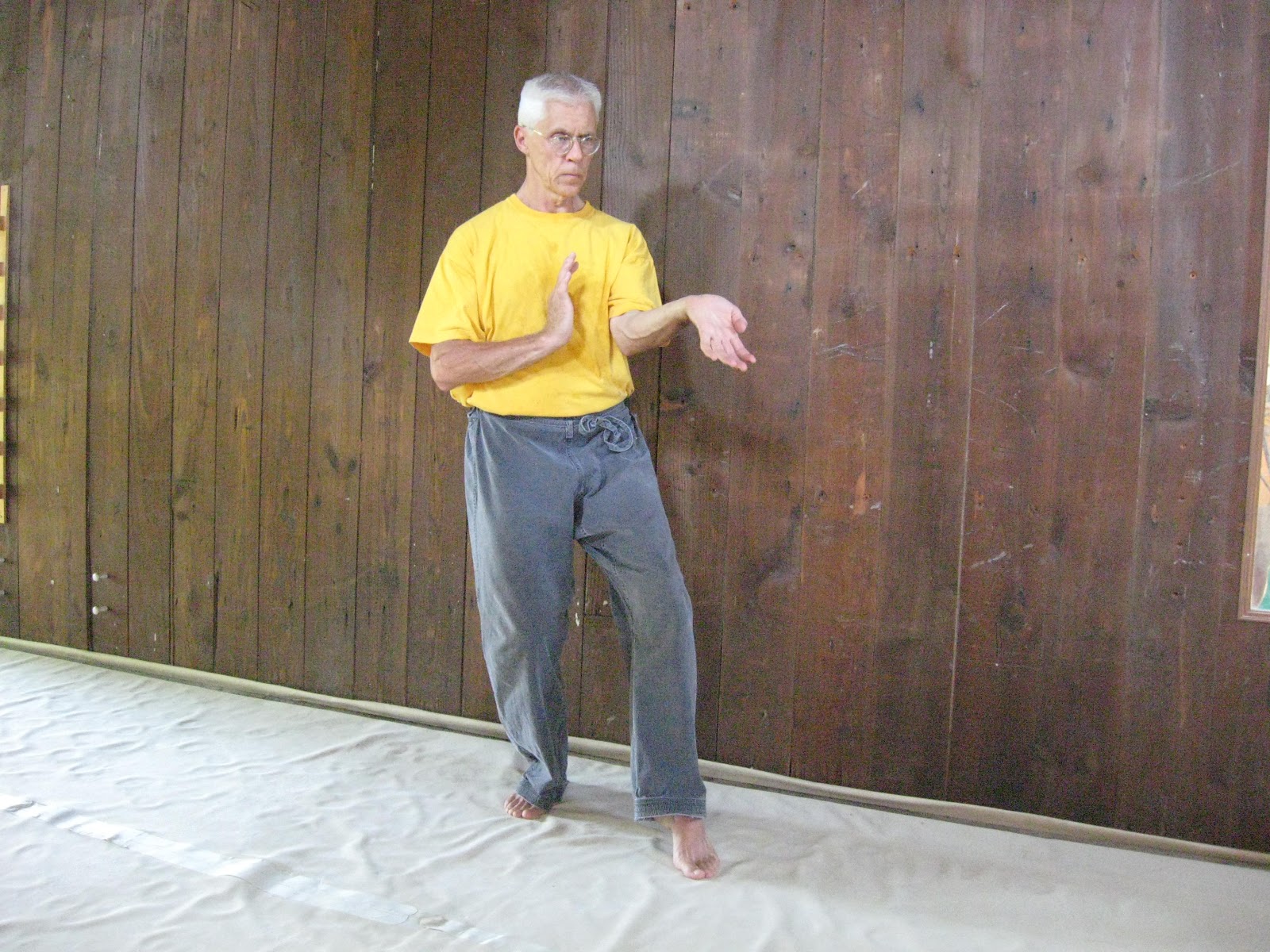
Entrance to the Barn Dojo....

Thursday, April 11, 2013

Seiunchin "uke" in pictures

Reversing the grab to use an arm-bar.


First Seiunchin entry or receiving technique against a wrist grab.


Trapping the hand to escape a grab.


Second Seiunchin entry or receiving technique against a wrist grab.


Dropping back to avoid the push
and control the arm.


Third Seiunchin entry or receiving technique against a two-handed push.

Side-stepping to block a push
and attacking at the same time.


Fourth Seiunchin entry or receiving technique against a two-handed push.


I mentioned in a much older post that Goju kata are composed of combinations or sequences that teach not only the bunkai (or imi-wa) of individual techniques but also the principles of the system. But in order to see any of this, you have to start with the "uke" techniques or the entry techniques. This, I think, may be what was meant by the saying: "Karate Ni Sente Nashi" (There is no first attack in karate). In other words, karate is a system of self-defense and does not initiate a violent or aggressive encounter. But it would also seem to go further than this--that is, the idea seems to be reflected in the techniques of kata. Each sequence or combination of techniques begins with an "uke" or receiving technique, regardless of which of the classical kata you are considering. From there it is easier to understand the "controlling" or bridging techniques, and finally the "finishing" techniques in kata, and in turn the structure of kata. There are, of course, some who dismiss this view of kata, and there are certainly many more who make their names and reputations on finding hundreds of applications for each subtle movement, an infinite variety of techniques or levels of bunkai, if you will. But one should always approach things with an open mind. So here are the five entry techniques of Seiunchin kata. 


Tying up the arms to escape a grab.


Fifth Seiunchin entry or receiving technique against a wrist grab.


Monday, April 01, 2013

Saifa "uke" in pictures

The five "uke" or receiving techniques of Saifa kata.

Using the elbow to come over the opponent's
arm and pull down.
Splitting a two-handed push to kick and
pull down.
Getting behind the attacker to pull down.
 
Attacking high and low to sweep the base
and attack the head.
Stepping off-line to capture the head
and attack with the knee.


Friday, March 22, 2013

You have to teach it first

Higa Seiko sensei demonstrating
a technique from Seipai
Is that a problem? Yeah, well, it might be. Now I'm just thinking about teaching Goju-Ryu, for instance, but if you're going to teach it, you need to think about which techniques to teach, and when you're going to teach them. Then there's the problem of what constitutes a technique. That may sound like a silly question, but if a particular sequence in kata involves a number of different movements, where do you break it down? This may not have tremendous implications for kata movement but what about bunkai? How you separate movements in kata may affect how you interpret techniques. What looks like uraken may really be a forearm strike or even an elbow, and yet they may look almost identical when you see the kata performed.

Once you separate the different parts of the movement, you put in artificial pauses or gaps. The sole purpose of the pauses is simply to make it easier to teach, but the pauses may get in the way of understanding how the techniques are supposed to be used. But it's hard to teach a beginner the fluid movement that may be required to execute techniques against an opponent, not to mention one who is attacking with any speed. And yet we teach kata in such a stylized and punctuated manner--as if the important point is to drag the performance out or make sure the judges at a tournament see every nuanced movement.

Once you have the techniques, it's hard to resist giving them names--mawashi-uke, down block, front kick--and it doesn't matter what language you use. Again, the names make it easier to teach. But the problem with names is that the names predispose us to seeing the techniques in a particular way. The names may even mislead us as to their function. The other problem is that when we name the techniques, we tend to homogenize them--for example, we tend to see all of the mawashi-uke techniques as the same, functioning in the same way. It happens with stances too. Stances are much more fluid (and purposeful), but the conformity we use in teaching kata--and this would seem to apply to stances and stepping as well--makes it easier to teach, and especially easier to teach large groups. Maybe that's the problem--the teaching of large groups, the popularization of karate in the 20th century.

Miyagi Chojun sensei overseeing
a large group of students
Then there's built in ambiguity. It's easy to see how ambiguity could be a problem. For example: Suppose the cat stance (neko-ashi-dachi if you're going to name it) is not really a stance at all but merely a teaching indicator. Suppose it was only meant to remind the student that every time there is a cat stance in kata, it indicates where one could kick, either with the knee or the foot. Here's the irony: By suggesting that you could use either one by only showing the cat stance--because if a kick with the foot is shown then a kick with the knee is not and vice-versa--it leaves this particular technique open to interpreting it as no kick at all; as some literalists might put it,  it's a cat stance and it's used to move forward and back, for example. So in order to teach the idea that a technique could be used in more ways than one, the opposite idea is actually conveyed; that the technique is neither a kick with the foot nor a kick with the knee. Again, the fact that we're trying to teach it gets in the way, or to be fair the teaching methodology gets in the way.

I don't know whether any of this was intentional on the part of the old teachers. I tend to think they were doing their best trying to convey something that is difficult to convey. I know it's certainly difficult to put into words. Sometimes I think that the only words one should hear in the dojo are the words that I so often heard in Gibo Seki sensei's dojo whenever we asked any questions: "Kori wa, ko desho?" And then, of course, you'd have to do it.

Tuesday, March 12, 2013

What does martial arts have to do with englightenment anyway?

I remember once reading an interesting article (or was it a blog?) about this subject. Or maybe it was a discussion of zen and the martial arts. Some histories make a lot of this connection and many modern martial arts practitioners would certainly like to believe that there is something  more spiritual to their practice, that it's not simply a refined method of brutally dealing with threatening physical attacks. Yet that's exactly the way this one commentator put it; that in ancient times, he argued, martial arts was used to kill in life-threatening situations, and that those trained in it--and he applied this also to the samurai--gave little but a passing nod or prefunctory attention to zen or any other spiritual concerns. Hence his explanation of why in many stories some of these olden-day teachers and martial artists did some unsavory things or exhibited less than exemplary morals on many occasions.

But still, many of us, with fewer battles to fight in modern times, hope that there is a sort of spiritual side to training. As a friend of mine often jokes, "So, after 30 or 40 years of training martial arts, when do we become enlightened?" And with that, we continue to train...in the same way that Kosho Uchiyama Roshi sat zen: "Sit silently for ten years, then for ten more years, and then for another ten years."
But still the idea persists--if you just train long enough, enlightenment will come. So, I'm wondering, what are the lessons of training that if nothing else may "point the finger at the moon"?

The longer you train a particular system, the more you begin to see that all of the techniques are interrelated; that is, they are all connected. Or, from another perspective, the body is connected; when one part moves, other parts move as well. Isn’t this a lesson that should be applied to life?
When we train together, we “listen” and receive the other person’s attack. We don’t formulate our response before the other person initiates an attack. So too, we shouldn’t rigidly adhere to an ideology before we consider the merits and shortcomings of the other side. This also reminds me of a line in the Happo: harmonize any situation without difficulty.

When we train together in partner drills or two-person forms, we say, “It’s like a dance; there shouldn’t be a winner or a loser.” Isn’t this a lesson we should take away from training?

I’m reminded of another line from the Happo: Know your opponent’s hand like your own. I think when we train hard and seriously for a long time, we begin to know ourselves. When we honestly can say we know ourselves, then we begin to know others. This, I think, goes back to the interconnectedness of all things.
A simple lesson in stepping: sometimes it is important to step back. You can’t always be on the attack. It reminds me of something I encountered in T’ai Chi years ago: Invest in loss. I don’t remember what book it was quoted in, but it went something like this: Someone once asked Cheng Man-ch'ing how he became so good at “pushing” (in the T’ai Chi push hands drill). He said he spent seven years getting pushed.

The mind guides the intention or something like that. Some say the mind directs the ki or chi. T.T. Liang said, “The imagination becomes reality.” Shakespeare said, “There’s nothing either good or bad but thinking makes it so.” In training the martial arts, we train the mind to direct our response. How then should the mind be used in life?
And then there's patience and dealing with the unexpected, and, of course, balance is very important in martial arts and in life.

I think there were some other things, but I have to go train. If I remember them while I'm out training, I'll try to remember to write them down. But I may forget....That's okay. Just train.

Sunday, March 03, 2013

Questions one should be asking or another turn at playing devil's advocate


Why do we use different stances? Are some stances just transitional? Do we use shiko-dachi (horse stance) for different reasons than we would use zenkutsu-dachi (front stances)? Shouldn't stances inform how we interpret techniques? If someone is showing bunkai, shouldn't the stances, the steps, and the turns be incorporated into the application of the techniques, not just the arms and hands?

Is the mawashi-uke technique at the end of Saifa the same as the one at the end of Kururunfa? Does the fact that Sanseiru, Seisan, and Suparinpei show some similarity in their final techniques mean anything? (And if you don't see the similarity, should you be asking yourself what you're not seeing?) What about the end mawashi in Seisan is similar? Are the nukite strikes at the beginning of Shisochin really nukite strikes or sho-tei or open hand forearm strikes or merely emphasizing the idea that hands work in opposition in Shisochin, reflecting a basic thematic element seen in the rest of the kata?

Why is there a repetition, for example, of the (quote) "elbow" techniques in Seiunchin, showing them being done four times? Is there really a need for redundancy of this sort in kata? Is it possible that the first two "elbow" techniques are connected and the second two "elbow" techniques are connected? Is it possible that they are not really elbow strikes? And if redundancy is not really necessary in kata, what about the doubling of the "forearm strikes," or what are sometimes referred to as arm-bars, in Shisochin kata that also occur four times? Or are they different because they initiate from a different position--that is, in the first instance the hands are down because of the previous technique, and in the second instance the hands are up because of the previous technique?

What do the kata differences mean when you compare the different schools of Okinawan Goju-ryu? Do the differences indicate a different bunkai or a misunderstanding of what the original bunkai was? And while on the subject of different schools of Goju-ryu, why did Yagi Meitoku sensei feel a need to create additional kata?

Why are some techniques in kata executed slowly while others are fast? Is this an indicator of the kind of attack that the kata creators envisioned; that is, a slower response on the part of the person doing kata to indicate something like the attacker pushing or grabbing--a different kind of energy on the part of the defender--while a faster response may indicate the block and countering of a punch?

In reality, how high are the kicking techniques in Goju kata? Isn't a kick to an opponent's knee much harder for the attacker to block than a kick to the mid-section--the height at which most front kicks are practiced, whether in kata or in kihon training?

Is there really such a thing as a neko-ashi-dachi (cat stance) in Goju-ryu kata, or is it merely an indicator, a teaching aid if you will, to show where there is a kick? Why do we show kicks in Shisochin kata or Saifa kata or Seipai kata and hide other ones--if that's what the cat stance indicates--in the same katas? How is it used in Kururunfa? Is it really just a stance to move backwards, as some suggest?

What does it mean when a technique in kata is repeated twice? What does it mean when it is repeated three times? What about four times? If the purpose of kata is to remember technique, is there really a need to repeat techniques in kata? If the purpose in repeating technique twice is to practice a technique on both the left and right side, then why aren't all techniques in kata done this way?

Why is Sanchin seen as the fundamental kata of Goju-ryu? Is it only the stance, breathing, and posture that are fundamental? Why is Sanchin fundamental when Goju does not seem to be predominately based on straight punches?

Why are many Goju blocking motions (uke) circular? Why do many of the kata show a "block" stepping forward? Is gedan-uke really a block in any of the Goju kata?

What does the pattern of kata mean? If the turns and angles of stepping are not important in kata--since they are so often ignored when people interpret bunkai--then why aren't all kata done in a straight line? Why did Miyagi Chojun sensei use a straight-line pattern for Tensho?

Do all of the katas conform to the same martial principles? Can you begin to understand these principles by looking at the techniques themselves, to see commonalities? Is it enough data to formulate a hypothesis (bunkai)? To confirm a hypothesis?

What would Socrates say? So many questions, so many answers. But if you don't ask the questions....


Wednesday, February 13, 2013

What's wrong with this bunkai?

I've been watching a lot of bunkai recently. It seems everybody and his brother is putting out videos of bunkai. One guy out there seems to put out half a dozen short bunkai clips a week, and none of them seem very effective. Another guy has these "martial minutes" where he gives these techniques cute names, though the techniques only seem to have a remote resemblance to the katas. I've started to get discouraged.

Here's a video of Seiunchin bunkai by Morio Higaonna:

http://www.youtube.com/watch?v=NMJgHOhDTBI

What's wrong with this bunkai? In the first sequence, since Higaonna sensei takes the kata apart move by move, there's nothing lethal about the first move--the hands coming up and then down again to deal with a double wrist grab--so he puts in a front kick to the opponent's groin. He doesn't even get the opponent to release his grab until he kicks him! And the front kick he employs is not in the kata! Bunkai is supposed to be an analysis of kata. Horse stance is not a good kicking stance either. He also doesn't move off line. The kata shows one stepping in at an angle.

Where Seiunchin bunkai begins.
In the next move, Higaonna sensei steps to the outside of the opponent's right punch. Again, the kata does not step this way when it shows off-line movement. Then he blocks the punch with the palm-up movement, followed by a grab of the arm. Then he attacks the opponent's ribs with a "nukite" finger strike. One problem here is that the finger strike is not very lethal when aimed at the ribs. The other problem is that it's easily thwarted in this position--the attacker need only bend his elbow down to cover the ribs.

First step forward in Seiunchin.
The problem with the third sequence is that it doesn't look anything like kata. He does not shift back into cat stance against the opponent. Why the hands are shown together in kata is not at all clear, because they aren't in his bunkai! And then he pushes and punches to the attacker's chest--again, not very lethal.


Bringing the head down.
In the fourth sequence Higaonna sensei shows, he blocks the attacker's right punch with his left open hand and then attacks with his right rising elbow. This is also confusing, because Higaonna sensei doesn't step back as in the kata movement--in fact, when he finishes the technique the wrong foot is forward. And it's questionable whether the elbow attack would even reach the opponent in this case. Perhaps that's why he pushes the attacker away at the end--out of frustration.

Grabbing the head.
So how do so many people get it wrong--because Higaonna sensei has a lot of followers!? I think there are a number of reasons. One: They look at kata as individual and isolated techniques, instead of combinations or sequences of moves that go together. Two: When they practice bunkai against a partner in the dojo, they don't try to see how the opponent would react to any of the techniques. Since they don't actually connect with the opponent, the opponent ends up standing there as stiff as a makiwara. Three: They don't look for the techniques to be lethal. When the technique is lethal, it usually involves an attack to the head or neck.

Turning the body--hair and chin.

Take the second point first. If you pull the arms of a double wrist grab apart and down to the sides or if you see it as a double lapel grab, it brings the opponent's head down also. Then apply the first point: techniques in kata are not isolated and independent. Once the head is brought down, bring the hand up and grab it--the hair or topknot--with the right hand. The palm is brought up to remind you to keep your elbow down. Then apply the third point: techniques are lethal. The target of the nukite finger strike is the opponent's throat, not the ribs. Then, continuing to apply the principle that techniques are connected in sequences or combinations, the head is twisted, pulled in and then pushed forward. Then, stepping back and pulling the opponent back--who has been turned at this point--the back of the opponent's neck and head is attacked with a right rising elbow/forearm as the left hand holds onto the opponent's chin/neck. This ends the first sequence in Seiunchin kata. And every technique of the bunkai should look exactly as it does in kata--only where the hands touch in the last technique there's actually the opponent's head between them. The sequence may seem a lot longer than Higaonna sensei's rather simple block-punch/kick, but the other principle always present in Okinawan karate is that the defender should move in such a way as not to allow the attacker a second attack. One should receive the attack (uke) and control the opponent from there on.

This last point--get out of the way or move off-line--is actually one of the problems with Hiagonna sensei's interpretation of the opening move of Seiunchin. By seeing this as a release from an opponent's double-handed wrist grab--as if anyone would get themselves into this in the first place!?!--Higaonna sensei doesn't take into account the stepping movement shown in the kata. If the attacker is coming from the front, the kata shows the defender stepping forward (and off-line) along the northeast angle to deal with the attack. Putting oneself into a relatively safe position against the opponent means moving to his outside. So if we look at his attack as a cross-grab or his left hand grabbing my left wrist, I can explain not only how the hands move but also how the feet and stance of kata are utilized in the bunkai.

Here's a video of Shisochin bunkai by Higaonna sensei that shows many of the same interpretive problems:

http://www.youtube.com/watch?v=6-embKzrjaI
Attack to the back of the head
or neck to end the sequence.

So what's the lesson here? Well, in the first place, there's probably a good argument not to put any videos of yourself on the Internet. There's probably good reason not to put anything into words, too, or to state an opinion contrary to generally held beliefs, but I've been out on that limb before. So the real lesson, it seems to me, is that when bunkai doesn't look like kata, it's not the right bunkai. Oh, and it should make sense too. And be real.

Thursday, January 31, 2013

Technique in kata and bunkai

"First one specializes in technique till he comes to the end of technique and bases everything on the heart itself--this is the best way of practice." (p. 175)

"When he has completed the training and has accumulated a great fund of practice experience, he moves hands and feet and body without the mind being involved; this is leaving the training methods without going against them, and now there is freedom in using any technique (waza) at all." (p. 161)


I love these quotes--and a whole host of others from this little book--taken from Zen and the Ways by Trevor Leggett. The book is an old paperback from the Charles E. Tuttle Company out of Rutland, Vermont. It's a kind of compilation on zen and different martial arts. It's one of my favorite books on martial arts, though I suppose some might find it a bit cryptic or esoteric.

But I was thinking of this the other day when practicing kata and bunkai with a few other students. I was thinking: we were all doing the same kata, but we didn't look the same. Now when I was younger, I trained in a variety of different schools--Tae Kwon Do, Shotokan, Yang T'ai Chi, etc. And whether it was the fact that I was a beginner or a particular predilection of the teachers, they would all go around, during kata practice, making minute adjustments to students' arms and legs. You might do a technique, and the teacher would come around and move your arm a fraction of an inch, as if you almost had it right but you were off by the smallest amount. As if that would make all the difference in doing bunkai! (Heavy amount of skepticism here.)

Of course, in most of these schools we never did bunkai. Kata was merely an exercise. You practiced stuff I suppose--though it was never explained in so many words--but I'm guessing that aside from the unspoken tradition that one must practice esoteric solo routines when doing Asia martial arts, I suspect that they would tell us we were also practicing the individual techniques that we would employ in the next phase of class--namely, sparring. In fact, in one school I was even told that kata had nothing to do with sparring, and you shouldn't confuse the two!

This is all to say--and this is why I mention these two quotes--that there has always seemed to me to be an acceptable window (for lack of a better word) of difference in how one performs kata techniques. I'm not suggesting that one should change kata. Far from it. But as long as one knows the bunkai, and it is apparent that the way the technique is performed would accomplish the bunkai, then I see no problem with some of the little differences that I see on occasion. Others might say that these differences are changes to the way the kata is supposed to be done. But I don't believe kata was ever meant to be an exercise in aesthetics. Kata is not done for kata's sake. Kata, for me, is not an end in itself.

For example: If someone's rear leg is bent instead of being locked out in zenkutsu dachi, I don't have the slightest problem with it. If someone's front heel is down in cat stance--as long as the weight is on the rear leg--I don't have a problem with it. If someone's arm is straighter or not so straight as someone else's arm in the hammer fist technique of Saifa kata, I don't have a problem with it. All of these "kata problems" usually get cleared up when one explains bunkai. And as long as one's bunkai is performed the same as the kata, what's the problem?! Now there's a potential conundrum.

Wednesday, January 23, 2013

You call that a cat stance?!

I've got two cats. One of them is a frisky orange cat that looks as though she has a bit of Maine coon cat in her. She's a pretty good mouser and she's always curious and getting into things. Sometimes this gets her into quite a bit of trouble. The other is an old tiger cat. He used to jump up on my shoulder if I happened to walk by and was in reach. Now I think he'd just prefer to sleep all day.  And the funny thing is that I've never seen either one of them assume a "cat stance."

Now I know that these are just figurative descriptions, but when I come across people getting downright poetic about describing techniques I wonder whether this tendency to describe movements and techniques confuses more than it elucidates. I came across one guy on the Internet saying that just "as the name suggest [sic], the animal form is the cat and the practitioner should keep in mind the nature of the cat when using this stance." What is the "nature of the cat"?

Another person on the Internet says that the cat stance is "designed for pivoting, night walking, returning to the rear, blocking and weapons fighting." Why would you assume a cat stance before pivoting? Just pivot. Try walking at night or in the dark and see if you use a cat stance. Certainly when you are stepping back you shift the weight, but is it a cat stance? And a stance for blocking? Or weapons fighting?

Cat stance at end of Seiunchin.

I think there are two things going on here. In one sense, when you give a name to techniques--the more picturesque the better--the techniques are easier to remember, but it also provides a short cut for training; that is, you can just refer to the name of the technique you want people to practice. It's a lot easier to say, "Go practice 'single whip'," than it is to tell someone to practice the ninth technique in the form.  But does calling a technique "embrace tiger and return to the mountain" really shed light on the technique? Do you really "repulse a monkey" that way? And what would it mean to tell someone to keep in mind the nature of the mountain? Needlessly cryptic, it seems to me, and no more useful than telling someone they should keep in mind the nature of the cat.

The temptation to translate cryptic or figurative language literally is understandable. We are looking for meaning where meaning is not clear. And so when we see pivoting from a cat stance in Seipai kata, we say cat stance is "designed for pivoting." When we see a step back into cat stance in Seiunchin kata, for example, we say that the cat stance is for "returning to the rear." When we see a cat stance accompanied by a block in Kururunfa kata, we say that the cat stance is "designed for...blocking."

Cat stance in Kururunfa kata.
But what's missing is a more complete understanding of kata and bunkai (the analysis of kata). As someone perhaps with a little more experience or understanding on the Internet wrote: "...stances are actually more about shifting position and body weight. In other words they are not static positions that we assume...." When we name and codify techniques--and this is certainly true of stances as well--we make it easier to teach but we may also be leaving things open to all manner of misinterpretations. Stepping back into "cat stance" at the end of Seiunchin is not so much an assuming of a particular stance as it is shifting the weight onto the rear leg and off of the front leg in order to attack the head (which the defender--using yama uke or mountain block--has in both hands) by raising the knee sharply into the opponent's face. Blocking in cat stance at the beginning of Kururunfa kata is not so much an assuming of a particular stance as it is stepping off line and shifting the weight in order to kick. We block the opponent's punch and kick to the opponent's knee. The diagonal sequences near the beginning of Kururunfa show good examples of high-low attacks. And we don't assume the cat stance and then kick--this is too slow. As soon as we can shift the weight, we kick. The whole point of shifting the weight is to kick--whether with the knee or the foot--not to assume a cat stance.

I can remember hearing criticism about different schools. People would say, "Oh, their cat stances are too low." Or, "Their cat stances are too high." Or, "In that style they turn their knees in a little in cat stance in order to protect the groin." But all of this makes sense only if you sit in the cat stance as if it were a kamae posture waiting for an attack. But it's not. Most stances in Goju-ryu are transitional and used in attacking the opponent in various ways. Of course, if you want to merely assume a stance there's always basic stance.


Wednesday, January 09, 2013

How do you train bunkai?

This raises a lot of questions for me. It almost seems as though the more appropriate question would be...How do you train kata? If the classical katas of Goju-ryu contain the essence or techniques of the system as well as the martial principles, then we use bunkai to study kata. Kata is the study of form--we practice to get the movements right and to understand the principles embedded in the kata--and bunkai is the study of how to use those movements. (When you think about it, what else is there?)

Goju attack to the head
from Saifa kata.

But if bunkai is the analysis of kata--which seems pretty straightforward--then what is henka bunkai or oyo bunkai or even different levels of bunkai??? I read these terms on the Internet all the time and wonder where they came from. There is only one kata movement, so why isn't there just one bunkai for that movement? We don't usually say a white belt should do the kata this way and a green belt should do it some other way and a black belt should do it a completely different way. So why should the bunkai be different? If you are trying to teach someone self-defense, why would you reserve some methods of self-defense for someone who has trained five years and some other techniques for someone who has trained ten years. I've even read authors who say the kata is like an onion, that the kata has different layers of bunkai. But katas are not like onions; ogres are like onions! This does not mean you are teaching a beginner Kururunfa, but the bunkai for Saifa is the same, it seems to me, for a white belt as it is for a black belt. Certainly we hope the black belt is able to execute the techniques better, but they are the same techniques.

Goju attack to the head
from Seipai kata.
Of course, the big question is finding the bunkai, but leaving that aside for the time being....

The next question is how to train bunkai. The problem for me is that so many karate schools base their training on, for lack of a better term, generic karate. The focus of much of the training time is spent on basics and training subjects. By basics, I mean the head punch, chest punch, down punch, the overhead block, the chest block, the down block and a few kicks. Everybody lines up--beginners to senior students--and they do high repetitions of these techniques. Then they practice training kata. In Shorin, this would be the Pinan kata, and in Goju, the Gekisai kata. It seems to me that the emphasis is all wrong here, and yet this is what you see in most schools. The problem is that the emphasis here is put on many techniques that don't really characterize the style, or techniques that don't actually occur that often in the classical kata, at least in Goju. In Goju, we don't see a jodan tsuki or upper-level punch in the classical kata. Rather, the idea is to bring the head down and then punch with a chudan tsuki or middle-level punch. Similarly, there is no jodan uke or rising block in the classical Goju katas, at least not the way that it is practiced in the basic drills of most karate schools. And what we actually find in the classical kata of Goju-ryu is not a gedan uke or down block but a down attack. So if you practice these generic karate techniques in this way, you really are confusing the issue, clouding one's understanding of certain martial principles found in the classical subjects.

Goju attack to the head
from Seiunchin kata.
So one way we should be practicing bunkai is to substitute the techniques of classical kata for the generic basics we seem to be spending an inordinate amount of time on. And we should be practicing them with high repetitions and on both the right side and the left side. Simply doing kata alone does not give us sufficient practice of these techniques, and some techniques are often only done on one side in kata.

The next thing we should be practicing is doing each of the moves against an opponent. The opening move of Saifa kata, for instance, is a response to a same-side wrist grab (or the opponent's left hand grabs the defender's right wrist). We should practice stepping forward along the northeast angle and dropping the right forearm and elbow over the opponent's arm to bring them down. This movement--when done correctly--brings the opponent's head down. The left hand is then brought over to grab the opponent's head, dropping and pulling back into horse stance, and the right forearm is brought down on the back of the opponent's neck. This should, of course, be practiced this way, just as it is done in solo kata.

But there are also some principles that should be trained here as well. It may be less likely that someone initiates an attack by grabbing your wrist, but they may grab your wrist at some point in an encounter. So this technique--in fact any wrist grab response from any of the other katas--can be trained this way: Train the same response with the defender punching and the attacker blocking and then grabbing the wrist. Additionally, the first movement in Saifa is showing you how one might deal with the opponent covering your arm on the same side--that is, your right arm or hand is under his left. Using the ideas or principles shown in this first move of Saifa, one should train turning the body--this is the equivalent of stepping forward along an angle--and coming over the opponent's arm with your elbow and forearm. In this case, we are training parts of the original bunkai but not the whole sequence. In the same way we might repetitively train moving to the northeast or northwest corner--to the outside--of an opponent's attack--that is, just training the stepping shown in the kata. There is nothing pedagogically surprising here; you just break the technique down into smaller and smaller parts until you "get it."

Another way of training bunkai is to train variations (see article "Kata and Bunkai: a study in theme and variations" in Journal of Asian Martial Arts, Vol. 18, no. 4) but that's perhaps a subject for another day.


Friday, December 28, 2012

What did he say???

Mabuni sensei shows this as a
block rather than grabbing the
head and kneeing because
one is in cat stance.
Over the holidays, after the feasting and the festivities began to wind down, I sat down for a few minutes and reached for a magazine and chanced upon a copy of the New Yorker from last year. After reading the cartoons, I turned to a short article in the "Hearsay Dept." which they described as "a karma chain set in motion by Lama Pema at the PEN World Voices Festival of International Literature." At this gathering of some 300 people (if my memory is not too faulty after a Christmas dinner and a few glasses of wine), Lama Pema whispered a sutra to the first person in line, who then passed it on to the next and she to the next and so on, until it came at last to the end of the line, where, of course, it bore very little resemblance to the sutra that set it all in motion.

The changing gate uke
from the Shodokan
version of Sanseiru
but not found in
many other versions
of the kata.
This reminded me of karate and particularly of the transmission of kata and bunkai--as of course everything reminds karate practitioners of kata and bunkai. But in that I don't suppose we're much different from gardeners or zen Buddhists or motorcycle mechanics.

When I was in Okinawa, we trained in a number of dojo, and the method of transmission always seemed to be the same--through observation and imitation. The teacher did not often "explain" anything, and the words we most often heard were "kore wa ko, desho" or, in a rough translation, "it's like this, okay"; the teacher would demonstrate, and you would do your best to reproduce what he did.

This reminds me of an old article I once came across in Classical Fighting Arts magazine. It was a short article titled "Aikido Memoirs" by Alan Ruddock. In it, he says, "I do not think that O-Sensei actually taught anyone, anything, in our western understanding of the word." He goes on to say, "I never saw any inkling of teaching, instruction, correction, or coaching....He did it; you saw it, and you had to figure it out. He went round smiling at everyone, with no clues, correction, or suggestions" (Vol. 2, No. 11, pg. 46).

Though all schools of Goju
end Sanseiru this way,
some turn to the left
and some turn to the right
to get here--a significant
difference for bunkai.
The implication, of course, is that each individual's understanding of what the teacher is showing, in either case, might vary...and it might vary considerably. You could say that that variation is fine as long as something works (though I wouldn't) or you could say that a certain amount of variation within well-defined parameters is okay--after all, people are all different. But what if some people got it wrong? What if change slowly crept in over time--as it clearly does with the telephone game? What if some things, particularly bunkai, were never taught in the first place, only imagined by the student after the kata was learned because there is very little instruction in the western sense of the word? And then what if the imagined bunkai informed (read altered to fit one's understanding of) the kata rather than the other way round? So, what are we left with? An impossible conundrum? A Gordian Knot? Thousands of teachers and practitioners merely fumbling around in the dark for some understanding of kata and bunkai?

The scenario begs the question of whether all versions of Goju kata (and here one might include Isshinryu as well), regardless of school/kan, are the same. And, of course, whether just any bunkai is good or real...whatever that means. Transmission is a tricky subject and perhaps not always the answer. I used to have a classic old Saab that had an automatic transmission and I could never get anyone to fix it so that it didn't slip. Everyone, it seems, can claim some sort of long-standing lineage--the easiest answer to any questioning of transmission. But the question for me has always been whether the bunkai is based on sound martial principles (see Principles blog post)  and whether it follows the kata. It should be lethal and real--not one of these applications where the training partner dutifully stands still while you apply some dream technique to their outstretched arm or they fall down because you're the teacher. And, since kata is a means of preserving technique, a bunkai should be executed against a partner the same as it is shown in kata--and not just a part of a technique, but the body movement, stepping, etc. Otherwise, you're doing something else. There are a lot of people out there who are very good at doing something else. I don't know what you call something else though, 'cause a lot of the time it ain't Goju-ryu.


Saturday, December 15, 2012

Martial arts forums, talk, and such

The place where questions
 are answered.
Why is everyone so damned polite on the Internet? Is it because of a cultural tidal wave of political correctness that we have forgotten how to be critical without ad hominem attacks? Wouldn't the martial arts benefit from some critical analysis, from some peer review? I watch videos on YouTube of people demonstrating kata that are down right horrendous and no one can say anything other than "nice" things. And these aren't beginners. I could understand if it were beginners, but I'm talking about people who have supposedly been training for years. Is it because of a recent case where someone was hit with a libel suit because they had written a scathing review of a business on their blog site? I suppose that would be chilling. Who's to blame? Is society to blame? Or the people with the hubris to put themselves up on YouTube?  Or the teachers who masquerade as experts?

Not the dreaded ridge-hand
at the end of Saifa kata.
And I'm not even talking about bunkai! There's some pretty silly stuff out there. I know it's been said before--and I do think the Interent has the potential to be a wonderful resource--but there's no filter on it. Perhaps the problem is that there are many many karate practitioners out there who subscribe to the view that there are many applications to every move in kata. Or as it says over and over again in Kane and Wilder's book, The Way of Kata, "more than one proper application exists for any given movement of any given kata....Anyone who says differently simply does not understand what he or she is talking about." Of course there is some ambiguity here. What do we mean by "proper application?" But, for example, do we mean that the final technique in Saifa--the mawashi uke if you will--can be used to break someone's double-handed grab? Or as a push? Or as a ridge hand attack to the opponent's ribs? Sure you can use it in any of these ways, but is that what was originally intended? 

This sort of view is only a small step--a little sliding step if you will because it's a slippery slope--from the notion that a technique can mean anything. And it's not too hard in the confines of the dojo--with a compliant junior student--to make anything work. Or to change certain aspects of the technique shown in kata and say that you're showing variations or hidden techniques or oyo bunkai or the more advanced levels of this that and the other. People say all manner of things when pushed into a corner. But whatever the bunkai, it should be logical, lethal, and conform to the principles of martial movement. It's easy to dismiss bunkai that isn't based on sound martial principles.

And to some degree, the same thing applies to kata. You can "see" the bunkai in a good performance of kata. I would argue that some of the performance kata one sees on the Internet may be appealing to the eye of the inexperienced--excessive use of dynamic tension, moves that are held too long, overly large and sweeping arm movements--but they only underscore the lack of any real understanding of bunkai on the part of the demonstrators. Okinawan karate, if done properly, is probably not very pretty to look at--certainly not very stylish or flamboyant--but it is effective.

So rant aside, what I am suggesting is that martial arts needs some critical rather than polite discourse. We need to argue with each other and scrutinize. We need to debate and defend and be a little less thin-skinned or politically correct. I think everyone would benefit from more open discourse.

Wednesday, December 05, 2012

The Seventh Principle...in no particular order

Don't look at the final position to explain a technique.

I think this happens a lot when it comes to interpreting kata--that is, people tend to look at the final position of a technique to explain its application. It's almost as if they are looking at still photographs in a book. Where does the fault lie? I'm actually not sure one can assign blame in this case. Karate is a movement art. In order to learn it, we follow the instructor, moving from technique to technique, stopping at the end of each until we begin the next. But we need to keep in mind that what is really important is often what happens between techniques--how we get from one position to the next.

Seipai kata
This technique from Seipai is not a block of a kick, even though the final position shows the left hand in a gedan or down position. From the previous position--with the left hand "chambered" on the left side at the ribs--the left arm moves in a clock-wise circular motion, crossing the centerline, ending in the final position that we see in the photograph. Most traditional interpretations show this as a block of an attacker's left front kick--as if someone is going to initiate an attack with a front kick to the midsection. The right hand is often sa id to be a block of the same attacker's left punch. So the attacker, supposedly, has attacked, rather awkwardly one can imagine, with a left kick and left punch. If we remember to look at the entire movement or how one gets to this position, however, we see a circular block of the opponent's right punch and a right open hand attack. The block is a kind of "changing gate" block that first blocks on the outside of the opponent's attack and then, because of the circular nature of the block, opens the opponent for the counter.

Sanseiru kata
Neither is this technique from Sanseiru a block of a kick as many have suggested, even though this "final position" might suggest that the left forearm is blocking a low front kick. If you try to block a front kick this way, however, chances are the opponent is going to punch you in the head--that is, unless they are quite compliant and agreeable. But if the technique actually begins before you think it begins--which is usually the case--then you will find an effective arm bar.

Which all goes to suggest that nothing is really hidden...but things are not always what they seem.

Wednesday, November 21, 2012

The Sixth Principle...in no particular order

To find and to properly understand the techniques, it is important to see how the attacker would respond to each of the defender's techniques.

This takes a bit of imagination on the part of both the attacker and the defender studying bunkai. So often, because we are either schooled from standing in front of a stationary post (makiwara) or perhaps because we are used to engaging in continuous two person drills where the agreed upon idea is not to end the encounter but to continue demonstrating technique, we fail to see how a technique is applied simply because we can't imagine the reaction of the opponent. And the opponent doesn't react to the techniques because the opponent is our dojo training partner and we have "pulled the punches!"

Opening technique of Saifa.
The opening technique in Saifa provides a good example. If the arm bar technique is really dropped over the attacker's elbow--in this case the opponent has grabbed our right wrist with his left hand--then the effect of this heavy dropping arm bar is to bring the opponent's head down. The next move then--the defender's left open hand coming forward and over the right forearm--is not, as is sometimes demonstrated, a block of the opponent's right punch, since the opponent is not in any sort of position to punch. Nor is it a grab of the opponent's arm or shoulder. The opponent's head has been brought down, and since Goju-ryu is nothing if not a lethal self-defense system, the head is grabbed with the left and the back of the neck is attacked with a dropping forearm.

First kick sequence in Saifa.
The next sequence in Saifa further illustrates this point. This begins with a step to the northwest, blocking an opponent's double-handed push. The defender kicks with the right foot, bringing the opponent's head down. Stepping in and to the right, the defender's left open hand then brings the opponent's head down as he brings his left knee up into the opponent's face.

Not to confuse the issue--certainly not my intention--but perhaps this is not really a principle in the same sense as keeping one's elbow down or the idea that one should step off the line of attack. The principles that I've been referring to in these blogs are simply ideas that one should keep in mind when trying to look at kata to find bunkai. I've been called an iconoclast by some, and I'm sure worse things by others. But I'm a strong defender of kata--more so, I believe, than many of the people who have disagreed with me. I strongly believe that your application of kata techniques or bunkai should look exactly the way it looks when you do kata. What is kata for if it's not a sort of living historical record of how a technique is meant to be executed?  So often I see what some call bunkai that strays so far from kata technique that it's difficult to guess even what kata the technique is taken from.

I don't know whether techniques were ever intentionally hidden or whether in the effort to popularize karate in the late 1930s and 1940s the more lethal bunkai of Goju-ryu were down played and less lethal techniques were substituted, ones you could actually do against a training partner in the dojo. Is that why we see the mawashi-uke technique applied today against an opponent's arms instead of used to break the opponent's neck or twist his head off? In any case, and before I become too long winded here, I think that we can at least be made aware of these bunkai, even if we can't actually train some of them realistically in the dojo or we have to significantly pull our punches, if only we can look at kata and bunkai in a different way.

It's quite amazing what you find when you start coloring outside the lines. Or, as my teacher was fond of saying: "Open mind, joyful training." Now there's a principle!


Sunday, November 11, 2012

Fifth principle...in no particular order

"In Goju-ryu katas, entry techniques and controlling techniques are followed by finishing techniques, but the finishing technique may sometimes only be tacked on to the second combination or sequence."


The bridging technique in the
opening sequence in Seipai.
Goju kata analysis can be confusing--that is, analysis that considers the structure of kata. Individual techniques can occur in kata without repetition, as in the opening of Seipai kata. These are fairly clear, but one must still recognize the sequence or combination--that is, the opening with the "uke," the controlling or bridging technique, and the finishing technique. The opening in Seipai is the initial move stepping back into horse stance with the sweeping, circular arm movement--the left hand blocks, while the right hand attacks. The controlling or bridging technique is the step with the hands together. And the finishing technique is the drop into horse stance again with the hands brought into the chest and the right elbow out.

The opening technique of the
 second hammer-fist in Saifa.
 
But techniques can also occur in pairs, and these sequences may be a little harder to see. These are techniques that are repeated on the right side and the left side, or against a right attack and again against a left attack. This is shown in the sweep and overhead or standing hammer-fist attack in Saifa. It is first shown against a right attack and then against a left attack. The opening is a block and hammer-fist attack by the defender, followed by a grab and upper-cut. The controlling and finishing techniques are only tacked on to the second (left) hammer-fist and upper-cut sequence.

The finishing technique of the
opening threesome of
Seiunchin kata.
To make it more confusing, techniques also occur as threes--that is, they are done first on one side, then on the other, and then repeated once again as they were done initially. These threesomes, however, occur, for the most part, at the beginning of katas, showing a kind of basic technique that may be explored in the rest of the kata (though there is a threesome in Kururunfa and Suparinpei). This is done in most of the Goju-ryu katas. However, to further confuse any analysis of kata structure, this sort of threesome repetition also shows some variation (a curious note that may argue for a variety of sources or kata creators over a long period of time). Saifa kata and Seiunchin kata both show threesome repetitions at the beginning, but Saifa's repetitions seem to be complete in themselves, whereas the opening techniques of Seiunchin have a single finishing technique tacked on only after the third repetition of the opening sequence.

And we see repetitions of four of the same techniques in Shisochin and Suparinpei, which leads to the question of why one needs any repetition at all. If kata is a means of preserving and remembering technique--which I believe it is--then why does one need any repetition at all, whether it's two times, three times, or four times? Obviously one can take a technique out of kata and practice it on either side. Kata should not be viewed as a means of practicing or perfecting a technique. If that were the case, every time we did kata there would be some techniques we would only be doing once!

In any case, kata does have structure, and once one sees this structure the analysis of individual techniques and an understanding of bunkai becomes a lot clearer.


Wednesday, October 31, 2012

The Fourth Principle of kata analysis...in no particular order

"Since Goju-ryu is a system of self-defense...it should seem effortless."

Even though you train to be stronger, faster, more flexible, or just plain tougher, self-defense techniques, or a self-defense system, should require little of this to work. You should put the effort into developing your strength and speed and flexibility when you are young; otherwise, you won't have much of anything when you are older it is sometimes said, but the techniques themselves shouldn't depend on strength or speed to work. In the first place, there will always be someone bigger or stronger or faster. But more importantly, your self-defense should work for you when you are old, when you may be least able to defend yourself.

Twisting the head in
Seipai kata.
Knee attack to the head
in Saifa kata.
Instead, Goju-ryu relies on technique, and that technique is based on principles of movement. This is what makes it seem effortless. For instance, we step off-line to "block," and most of these off-line movements may be accompanied by a spinal rotation in the trunk or core of the body. The receiving techniques ("uke") of Goju-ryu are, for the most part, "soft" because they can be, generally meeting the opponent's attack with circular "blocks" that deflect the attack. In addition, the position of the arms first encountered in Sanchin training is applied, in principle, to many of the receiving techniques in Goju, and when this "immovable arm" is used in conjunction with stepping off line and the rotation of the trunk, any effort or energy the defender uses can be saved for the counter-attack; though these counters can be just as effortless if the same understanding of stepping and rotation is used there as well.


Shoulder attack
to head in Seisan.
Lastly, so many of the techniques of Goju-ryu are effortless because Goju-ryu attacks vulnerable parts of the body. The finishing techniques of Goju are against the opponent's head or neck, either striking the neck with the fingers, the knife-edge, or the forearm, or grabbing the head and chin and twisting, as in Suparinpei. Or we attack the head with the elbow, as in Seiunchin. Sometimes the knee is used to attack the head, as in Saifa and Kururunfa, and sometimes even the shoulder is used, as in Seisan kata. 

Whatever the case, it should be effortless. And it is usually effortless because we have moved in such a way that the opponent is not given a second opportunity to attack, our first block/attack is often simultaneous, and we bridge the distance to attack the head or neck.

Relax, relax, relax...you'll be faster and stronger.